Showing posts with label natural disasters. Show all posts

21 February, 2020

Bushfire royal commission to look at mitigation but not climate change

Expanding federal government powers to call out the military, national standards for hazard reduction and the mitigation of natural disasters – but not climate change itself – will be the focus of the bushfire royal commission.
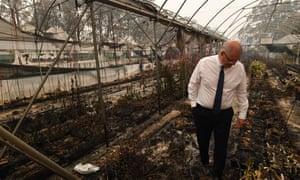
Scott Morrison tours a bushfire damaged farm in January. The PM has announced a royal commission to look at mitigation, adaptation and an expanded role for the military in natural disasters.
 Scott Morrison tours a bushfire damaged farm in January.On Thursday, Scott Morrison released the letters patent establishing the national inquiry, pushing ahead despite concerns over federal overreach into states’ emergency management powers and pressure from Labor jurisdictions to focus more explicitly on reducing emissions.

The royal commission will be led by the retired air chief marshal Mark Binskin, who is joined by the former federal court judge and Ruddock religious freedom review panel member, Annabelle Bennett, and professor Andrew Macintosh, a specialist in climate risk and impact management.


Read the story from The Guardian by Paul Karp - “Bushfire royal commission to look at mitigation but not climate change.”

20 October, 2019

Rain by Mary and Bryan Talbot review – climate-crisis graphic novel

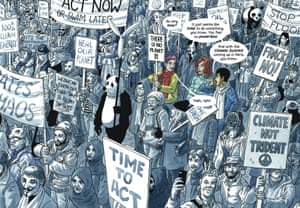
We provide help in disaster areas all around the world,” says the aid agency volunteer serving warm samosas. “Not usually in Yorkshire, though!” That natural disasters can and increasingly will affect not just people in rolling news stories a long way away but anyone, anywhere, is at the heart of Rain, a love story that’s also a flood story.
Illustration from Rain by Mary M Talbot and Bryan Talbot.
Illustration from "Rain" by Mary M Talbot and Bryan Talbot.
The samosa-bearing aid worker isn’t the only person on unfamiliar ground: with its tight contemporary focus, Rain is something of a departure for Mary and Bryan Talbot too. Two of Britain’s finest graphic novelists, the husband and wife team have previously covered the Paris Commune and imperialism in the South Pacific (The Red Virgin and the Vision of Utopia) and the women’s suffrage movement (Sally Heathcote: Suffragette). Bryan’s Grandville series stars a steampunk badger; and while his magnum opus Alice in Sunderland may start in modern Britain, its twists and turns connect prehistoric beasts, Humpty Dumpty and Sid James. And the pair’s finest hour, the Costa-winning Dotter of Her Father’s Eyes, slips between Mary’s childhood and the troubled life of James Joyce’s daughter Lucia.

Read the story from The Guardian by James Smart - “Rain by Mary and Bryan Talbot review – climate-crisis graphic novel.”

10 September, 2019

Australian natural disasters minister David Littleproud: 'I don't know if climate change is manmade'

Australia’s minister responsible for drought and natural disasters, David Littleproud, has said that he doesn’t “know if climate change is manmade”.

“I don’t know if climate change is man-made”: David Littleproud, minister for water resources, drought, natural disaster and emergency management, says he is unsure about causes of climate crisis..
David Littleproud, the federal minister for water resources, drought,
 natural disaster and emergency management, says he is unsure
about the causes of the climate crisis.
Clarifying earlier comments that the question is “irrelevant” when considering the Coalition government’s response to intensifying bushfires, he told Guardian Australia he was unsure about the causes of the climate crisis but wanted to give the country the tools to adapt.

The remarks by the minister for water resources, drought, natural disaster and emergency management are likely to anger political opponents, including the Greens who have targeted Littleproud and fellow members of the National party for refusing to acknowledge a link between human-induced climate change and bushfires.

Littleproud’s position was supported by the Nationals deputy leader, Bridget McKenzie, the minister for resources and northern Australia, Matt Canavan, and the environment minister, Sussan Ley, all of who denied knowledge of or downplayed the link.


02 January, 2019

Millions in Australia's east face natural disaster risk

More than 400,000 Melbourne residents face high risks of flooding, bushfires or both, new analysis shows, with warnings that without pre-emptive action even more people will face threats posed by natural disasters.
Governments need to do more to mitigate natural
disasters, says SGS principal Terry Rawnsley.
CREDIT:
Analysis mapping insurance data and risk levels from natural perils across local government areas in Victoria, NSW and Queensland reveals millions of residents across the three states are living with some sort of risk from floods, storms, bushfires and earthquakes.

Compiled by SGS Economics and Planning and released exclusively to The Age, the data breaks down the risk to local council areas and the potential economic impact from natural disasters.

SGS national partner Terry Rawnsley said much of the Australian population was at some form of natural peril.


Read the story from The Age by Shane Wright and Felicity Caldwell - “Millions in Australia's east face natural disaster risk.”

05 November, 2018

For us to tackle climate change, companies need to pay their tax

It’s been a year of natural disasters. After Irma, Maria, Harvey, hurricane Florence left a devastating landscape in the Caribbean. Extreme temperatures across the northern hemisphere have caused devastating fires from Europe to the US. Dozens have been killed in the Philippines after typhoon Mangkhut triggered landslides.
‘The IMF reports that the revenue lost from tax
evasion in developing countries is 1.3 times larger,
 as a share of GDP, than it is in advanced economies.’
And the worst consequences of climate change are yet to come.

It is a huge challenge for rich countries and for developing nations, a sisyphean task: how to collect enough revenue to respond to major catastrophes, while at the same time trying to lift billions of people out of poverty?

Look at Indonesia. Disasters are a familiar tragedy in the world’s fourth most populous nation, with its thousands of islands across hundreds of miles of ocean. This should make disaster risk planning crucial. It is not the case, as the latest earthquake and tsunami showed. Reports revealed that parts of the tsunami alert system didn’t work. In some areas, there were no sirens at all. The death toll is still climbing.


Read the opinion piece by Wayne Swan from The Guardian - “For us to tackle climate change, companies need to pay their tax.”

01 June, 2018

Helping kids cope with trauma from weather disasters

In September 2017, Hurricane Harvey closed schools in Texas for weeks. It stranded some families in their homes and forced others to evacuate, unsure if or when they would be able to return.
Our kids will need our care and attention as climate change closes in.
Simpson: “Not only did the hurricane throw off our daily lives, it also created this storm of uncertainty around everyone.”

Shelly Simpson is a social worker who counsels young adults at Houston’s Menninger Clinic. She says natural disasters can be particularly hard on young people.


Read the Yale Climate Connections story by Daisy Simmons -  “Helping kids cope with trauma from weather disasters.”

10 November, 2017

Deutsche Bank maps climate change risks for investments

Deutsche Bank has developed a tool to forecast where its investments across the globe may be impacted by natural disasters brought on by climate change.
"Factors such as sea level rise, droughts, flooding and
cyclones pose an immediate and measurable threat to
 investment portfolios," Deutsche Bank Asset Management said.
Although tools have existed in the insurance industry to model the impact of climate change, this is the first time this sort of data has been systematically applied to investments.

Deutsche Asset Management created the map with climate change intelligence firm Four Twenty Seven, covering more than one million individual locations in order to see how changes to climate will threaten its investment portfolios. The group currently has about €711 billion ($1.06 trillion) under management.

Economic modelling estimates that if carbon emissions aren't reduced throughout this century, per capita GDP will decrease by 23 percent from what it otherwise would be.


Read Cole Latimer’s story in today’s Melbourne Age - “Deutsche Bank maps climate change risks for investments.”

16 September, 2016

Buashfires shape as Tasmania's greatest natural hazard

Heatwaves and bushfires are emerging as
Tasmania's greatest climate change related threat.
Tasmania has had a damaging year, with the island state hit by a series of bushfires and floods.

Now a comprehensive new assessment of Tasmania’s exposure to natural disasters shows that bushfire remains the number one hazard to people and property, while also highlighting a range of new threats. These include coastal flooding, pandemic influenza and – despite being Australia’s most southerly state – an increasing likelihood of heatwaves.

The 2016 Tasmanian State Natural Disaster Risk Assessment (TSNDRA) aims to provide emergency services with key information to help prepare for and reduce the impact of disasters.

Read the piece on The Conversation authored by five people - “After Tasmania’s year of disasters, bushfire tops the state’s growing list of natural hazards.”

26 May, 2016

'Sorry, folks' - climate change news is not good

Australia is not prepared
for these worsening changes.
SORRY, folks. The news is not good.

This weather is only getting more extreme, natural disasters are getting increasingly more deadly, and we puny humans seem pretty content to sit back and accept our murky fate.

The World Bank has issued a warning to major cities around the world that we’re underprepared for major risks from extreme weather and other hazards, which will only intensify due to population growth and surging migration.

By 2050, 1.3 billion people and $AU217 trillion in assets will be affected by worsening river and coastal floods alone.

The report says many city officials have no clear idea of the range of disaster risks they face and how serious they could be.

A combination of sea-level rise and sinking of coastal cities, including from excessive extraction of the groundwater, could drive disaster losses in 136 coastal cities from $US6 billion a year ($A8.1b) in 2010 to $US1 trillion a year by 2070.

Read Gavin Fernando’s story on News.com.au  - “Australia is not prepared for growing natural disasters, experts warn.

24 May, 2015

Some, it seems, give and some, it appears, take away


A

ustralia’s politicians it seems have dedicated themselves to spending less on overseas aid, while Japan appears to have taken a quite different approach.

Japan's Shinzo Abe - his country has
 responded with nearly $600 million
 to help Pacific island
nations combat climate change.
The ABC reports: “Japanese Prime Minister Shinzo Abe has pledged $578 million in aid to Pacific island nations to help them combat climate change and natural disasters.

“Mr Abe made the pledge as leaders of 14 Pacific island nations gathered for a two-day meeting, which began on Friday in Iwaki, Fukushima prefecture, to discuss their development needs.

"As a pledge of the Japanese government, we will provide no less than 55 billion yen ($578 million) to you in the upcoming three years ... in order to foster resilient capabilities that will not be defeated by climate change or disasters," he told the meeting.”

Further the ABC reports that, “The seventh round of Pacific Islands Leaders Meeting (PALM) came as host Japan attempts to boost its profile in the Pacific, at a time of growing Chinese economic and political influence in the region.

“The meeting, held every three years, was also attended by senior officials from Australia, New Zealand and the United States,” is says in a story.

10 December, 2014

Strings, tarpaulins, wilting heat and $1 trillion bill


Australia’s damage bill from “natural disasters” could exceed $1 trillion according to the CSIRO.

The nation's premier science agency has warned climate change and poor planning were leaving the nation increasingly exposed to natural disasters.


Australia’s PM, Tony Abbott, has declared Australia “open for business”, but doing business from a country held together with string, covered in tarpaulins and wilting under ever-increasing heat, is going to be challenging, if not impossible.