Showing posts with label population growth. Show all posts

06 March, 2020

Climate explained: how growth in population and consumption drives planetary change

The growth of the human population over the last 70 years has exploded from 2 billion to nearly 8 billion, with a compounding net growth of over 30,000 per day. We all breathe out carbon dioxide with every breath. That equates to about 140 billion CO breaths every minute. Isn’t it logical that atmospheric carbon will continue to increase with the birth rate regardless of what we do about fossil fuel reduction?
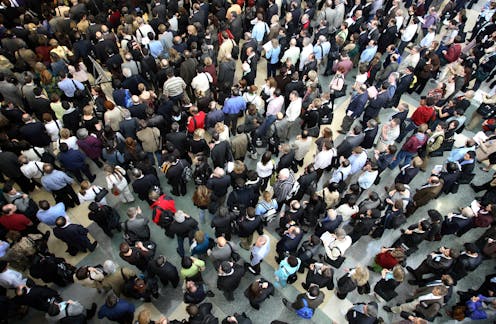
Image result for Climate explained: how growth in population and consumption drives planetary change
Rapid population growth and increased consumption are
now seen as the main drivers of environmental changes.
This question touches on the core of our impact on planetary change. It highlights the exponential growth in the human population, but also homes in on the potential direct input of carbon dioxide from humans, through respiration. 
As I explain in more detail below, our breathing does not contribute to the net accumulation of carbon dioxide in the atmosphere. But population growth, combined with an increase in consumption, is now seen as the main driver of change in the Earth system

Read the story from The Conversation by the Professor of Geology, from the Auckland University of Technology, Michael Petterson  - “Climate explained: how growth in population and consumption drives planetary change.” 

23 July, 2017

Prediction Melbourne could begin to run short of water by 2028

Melbourne could begin to experience chronic water shortages within about a decade, even if the desalination plant is cranked up to its full capacity, as climate change and population growth rapidly deplete the city's dams.


Demand for water could begin to exceed supply by 2028, triggering tough water restrictions and a costly 25 per cent boost to the capacity of the desalination plant, under a worst-case scenario modelled by Melbourne's water corporations.

This scenario suggests the city must take major steps in the next few years to guard Melbourne's water storages from reaching dangerously low levels that could put it on a permanent drought footing.


26 May, 2016

'Sorry, folks' - climate change news is not good

Australia is not prepared
for these worsening changes.
SORRY, folks. The news is not good.

This weather is only getting more extreme, natural disasters are getting increasingly more deadly, and we puny humans seem pretty content to sit back and accept our murky fate.

The World Bank has issued a warning to major cities around the world that we’re underprepared for major risks from extreme weather and other hazards, which will only intensify due to population growth and surging migration.

By 2050, 1.3 billion people and $AU217 trillion in assets will be affected by worsening river and coastal floods alone.

The report says many city officials have no clear idea of the range of disaster risks they face and how serious they could be.

A combination of sea-level rise and sinking of coastal cities, including from excessive extraction of the groundwater, could drive disaster losses in 136 coastal cities from $US6 billion a year ($A8.1b) in 2010 to $US1 trillion a year by 2070.

Read Gavin Fernando’s story on News.com.au  - “Australia is not prepared for growing natural disasters, experts warn.

29 April, 2016

Considering global catastrophic risks

All 55 pages of this report are somewhat daunting (I can’t claim to have read it all - Robert McLean), but maybe there might be something in there that catches your eye and excites you thoughts.

Global Catastrophic Risks 2016” has been assembled by The Global Challenges Foundation, which works to raise awareness of the Global Catastrophic Risks. Primarily focused on climate change, other environmental degradation and politically motivated violence as well as how these threats are linked to poverty and rapid population growth.

It considers global risks against the background of climate change, environmental degradation, violence, poverty, and population growth.

The Foundation also works to both identify and stimulate the development of good proposals for management models – global governance – able to decrease – and at best eliminate – these risks.

11 March, 2016

Global warming rolls on in, sooner than expected

The world is on track to reach dangerous levels of global warming much sooner than expected, according to new Australian research that highlights the alarming implications of rising energy demand.

University of Queensland and Griffith University researchers have developed a “global energy tracker” which predicts average world temperatures could climb 1.5C above pre-industrial levels by 2020.

That forecast, based on new modelling using long-term average projections on economic growth, population growth and energy use per person, points to a 2C rise by 2030.

The UN conference on climate change in Paris last year agreed to a 1.5C rise as the preferred limit to protect vulnerable island states, and a 2C rise as the absolute limit.

02 December, 2013

Those concerned about population are the best environmentalists: Thompson


Kelvin Thompson.
We are the most fundamental environmentalists you will find, Kelvin Thompson said when launching Victoria First on Sunday.

He was pointing to those who concern themselves with the size of populations.

The Federal Labor Member for Parliament, who represents the seat of Wills electorate, told those at the Flemington Community Centre launch about the perils facing Australia because of population growth.

Victoria First is a new non-government organization to promote democratic empowerment over the size of Victoria’s population.

He said Victoria is at the centre of the elite push for a huge population, which is projected to rise from 17 million in 1994 to 37.5 million by 2050 and possible 70 million by 2100.

Take 22 minutes to watch Kelvin’s launch of Victoria First.