Showing posts with label landslides. Show all posts

29 January, 2020

Brazil downpours displace tens of thousands

Rio de Janeiro: More than 30,000 people have been displaced by heavy rains in south-east Brazil that also killed 54 people and left 18 missing.
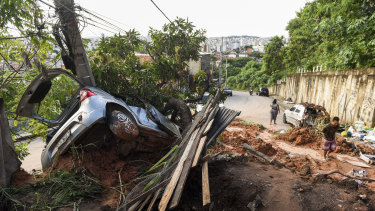
A vehicle lies half-buried in the mud after a landslide caused by heavy rains in Belo Horizonte, Brazil.
A vehicle lies half-buried in the mud after a landslide
 caused by heavy rains in Belo Horizonte, Brazil. 
The storms in recent days caused floods and landslides, submerging entire neighbourhoods and sending homes tumbling down hillsides in the states of Minas Gerais, Espirito Santo and Rio de Janeiro. Rains subsided by Monday, but were expected to resume later this week in some areas.
Flooded roads created violent rapids, sweeping up victims, cars and other debris.
Those evacuated were being housed in makeshift shelters in churches, schools and fire stations. Local authorities have asked for donations of clothes, sheets and mattresses for the victims.
Read the story from The Age by Anna Jean Kaiser - “Brazil downpours displace tens of thousands.”


(The climate crisis produces distinctly different weather, from droughts and downpours such as this one - Robert McLean)

05 November, 2018

For us to tackle climate change, companies need to pay their tax

It’s been a year of natural disasters. After Irma, Maria, Harvey, hurricane Florence left a devastating landscape in the Caribbean. Extreme temperatures across the northern hemisphere have caused devastating fires from Europe to the US. Dozens have been killed in the Philippines after typhoon Mangkhut triggered landslides.
‘The IMF reports that the revenue lost from tax
evasion in developing countries is 1.3 times larger,
 as a share of GDP, than it is in advanced economies.’
And the worst consequences of climate change are yet to come.

It is a huge challenge for rich countries and for developing nations, a sisyphean task: how to collect enough revenue to respond to major catastrophes, while at the same time trying to lift billions of people out of poverty?

Look at Indonesia. Disasters are a familiar tragedy in the world’s fourth most populous nation, with its thousands of islands across hundreds of miles of ocean. This should make disaster risk planning crucial. It is not the case, as the latest earthquake and tsunami showed. Reports revealed that parts of the tsunami alert system didn’t work. In some areas, there were no sirens at all. The death toll is still climbing.


Read the opinion piece by Wayne Swan from The Guardian - “For us to tackle climate change, companies need to pay their tax.”

12 May, 2018

How is climate change affecting Mexico?

As Mexico City’s chief resiliency officer, Arnoldo Kramer, said to The New York Times, “Climate change has become the biggest long-term threat to this city’s future. And that’s because it is linked to water, health, air pollution, traffic disruption from floods, housing vulnerability to landslides — which means we can’t begin to address any of the city’s real problems without facing the climate issue.”
Climate change is threatening to push a
crowded capital toward a breaking point.
And we’d argue the same is true for the rest of the nation – and the world. Climate change touches every aspect of our lives.

Here are three leading ways climate change is already hitting Mexico and its people. Plus, as a bonus, two ways you can take action today to help solve the climate crisis.


Read the Climate Reality Project story - “How is climate change affecting Mexico?

24 December, 2017

Philippines storm: At least 120 dead after tropical storm Tembin triggers flash flooding, landslides.

At least 120 people are dead and more than 160 missing after a tropical storm devastated the southern Philippines, unleashing flash flooding and setting off landslides.
Police officers help with rescue efforts, holding the hands
 and belongings of two women in rising floodwaters.
Most of the deaths from tropical storm Tembin were in the hard-hit provinces of Lanao del Norte and Lanao del Sur and on the Zamboanga Peninsula, according to an initial government report on storm casualties.

Romina Marasigan, of the government's disaster response agency, earlier said authorities had reported at least 75 deaths were due to landslides and sudden surges of floodwaters, but added those initial reports needed to be confirmed.

An entire village was buried by a mudslide, according to reports.


13 October, 2017

Vietnam floods: Death toll rises to 54 as swathes of land washed away

Floods and landslides have killed at least 54 people in Vietnam and left another 39 missing since a tropical depression battered the country earlier this week, officials say.

Two soldiers walk a pig through flood water

Vietnam is prone to destructive storms and flooding due to its long coastline, killing hundreds of people in Vietnam each year.

The heavy rain in the central and northern regions has disrupted travel in some areas, limiting the rescue attempts for the missing.

The storm that hit central Vietnam on Tuesday also injured 31 people and submerged more than 30,000 houses, damaged infrastructure, crops and livestock, the Vietnam Disaster Management Authority said in a statement.

Vietnam is prone to destructive storms and flooding due to its long coastline, killing hundreds of people in Vietnam each year.

28 May, 2017

Sri Lankan landslides, flooding kills 122, as nation appeals for international help

The number of people known to have been killed in floods and landslides in Sri Lanka has risen to 122, with the country appealing for international assistance.

Sri Lanka has asked its neighbours and the UN
for help in its search and rescue effort.
The state-run disaster management centre said a further 97 people were still missing after the worst torrential rains since 2003.

The Foreign Ministry said an appeal had been made to the United Nations and neighbouring countries to provide assistance "especially in the areas of search and rescue operations”.

India is sending three Navy ships with supplies and other aid, the first of which arrived in Colombo on Saturday.

Officials said deaths were reported from the western coastal district of Kalutara, the central southern district of Ratnapura and the southern district of Matara.


10 July, 2016

Downpours, floods test Chinese leaders ability to deliver on safety

Torrential rains brought flood to
 the southern half of China.
Beijing: Torrential rains and floods across the southern half of China have besieged cities and towns for days. Nearly 200 people had died by Friday in drownings, landslides and as buildings collapsed, including 35 buried by a landslide in the far west. Nearly 2 million people have been moved to safer ground while swollen rivers and lakes strain dykes and dams.

For China's leaders, the floods are a test of their ability to deliver on their promises of safety for citizens.

The country's flood defences have faltered in the past, weakened by neglect and corruption, and Prime Minister Li Keqiang and other leaders have said that this year the government is better prepared than ever.

Yet experts and residents in areas hit by the rains have claimed that local governments have neglected drainage and filled in lakes, leaving cities exposed to greater flooding.

Read Chris Buckley’s story in today’s Melbourne Age - “Deadly flooding hits China, putting pressure on leaders.”

(Torrential downpours are a symptom of climate change – Robert McLean.)

05 August, 2015

Monsoon rains lash southern Asia


H

eavy monsoon rains have continued to lash much of southern Asia, threatening further casualties and more destruction after a week of lethal floods and landslides.

More than 100 people have died and up to 1 million fled their homes as land from Pakistan to Burma was deluged.

In Burma, opposition leader Aung San Suu Kyi visited one of the country’s many flood-hit areas on Monday, raising her profile amid a national disaster that could have consequences in the general election due later this year.

17 December, 2014

More moisture in the atmosphere, more downpours, more landslides


One of the prime indicators of climate change is more moisture in the atmosphere and subsequent heavier and sudden downpours.

Climate change means more moisture in
 earth's atmosphere, more downpours and
 more soil erosion and landslides.
Those downpours are now frequently so intense that existing drainage systems and the geography of various places are often unable to cope.

The difficulty is often worsened in those areas were unrestrained market-driven systems have stripped away existing flora in the pursuit of profit leaving the soil vulnerable to rushing water from these storms.

With the root structures from vegetation virtually gone, serious erosion results and in hilly areas, landslides become a reality.

Indonesia, known for its deforestation recently experienced that trouble when more than 50 died in a landslide as reported by the ABC in a story headed: “Indonesian landslide death toll rises to 56.”