Showing posts with label safety. Show all posts

06 January, 2020

There Is No Safe Global Warming

Safety is something we all crave. It’s human nature. 
Considering two degrees Celsius a safe
 level of global warming is a delusion.
And so perhaps it’s not surprising that we’ve spent the past decade or so outlining what a “safe” level of global warming is. Language reflecting the conception of “safe” global heating abounds in scientific literature, climate negotiations, and the press. The Paris Agreement enshrined the idea that 2 degrees Celsius as pretty safe. Advocacy from small island nations and others has made a compelling case that 1.5 degrees Celsius would be safer still, allowing, at least, for their continued existence. 
At various times, each of these levels of heating have been called a “guardrail,” “defence line,” and “buffer zone.” On one side, dangerous climate change. On the other, something we can figure out and adapt to if we play our cards right.
Recently, the 1.5 degrees Celsius threshold appears to have won out as our best bet for safety. And over the next decade, the world will decide its fate of whether it can limit heating to within 1.5 degrees Celsius of pre-industrial temperatures. But we don’t have to wait to find out if that level of heating is safe because the answer is right in front of us. Spoiler: It’s not.

Read the Gizmodo story by Brian Kahn - “There Is No Safe Global Warming.”

05 September, 2019

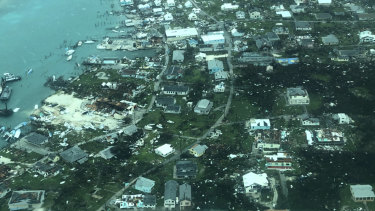
‘Apocalyptic': Hurricane Dorian's destruction sparks humanitarian crisis

Freeport: Bahamians have rescued victims of Hurricane Dorian with jet skis and a bulldozer as the US Coast Guard, Britain's Royal Navy and a handful of aid groups tried to get food and medicine to survivors and take the most desperate people to safety.
Destruction brought on by Hurricane Dorian on Man-o-War cay, Bahamas.
Airports were flooded and roads impassable after the most powerful storm to hit the Bahamas in recorded history parked over Abaco and Grand Bahama islands, pounding them with winds up to 295 km/h and torrential rain before finally moving into open waters on Tuesday on a course toward Florida.
People on the US coast made final preparations for a storm with winds at a still-dangerous 175 km/h, making it a Category 2 storm.
At least seven deaths were reported in the Bahamas, with the full scope of the disaster still unknown.

Read the story from The Age by Ramon Espinosa - “‘Apocalyptic': Hurricane Dorian's destruction sparks humanitarian crisis.”

18 January, 2018

'Modify facilities or move Australian Open': health and safety expert

The Australian Open shouldn't be held in January unless changes are made to Melbourne Park to protect players and fans from the searing heat, a health and safety expert has warned.

Players at the Australian
tennis open are suffering,
as are many spectators.
Players and spectators sweltered through 39-degree conditions at Melbourne Park, with 42 degrees the forecast for Friday.

Some clever kids took refuge in the water fountains at Garden Square to beat the heat. Outside courts with shade had spectators sitting out of the sun while courts with no shade were empty.

The crowd of 38,072 was down about 10,000 people on the two previous day-time totals.

Most players looked uncomfortable, but Frenchman Gael Monfils battled the most. He lost to Novak Djokovic on Rod Laver Arena where the on-court temperature was 69 degrees. 

He won the first set but then crumbled, virtually giving up in some points, to lose in four sets.


Read The Sydney Morning Herald story by Gene Efron and Anthony Colangelo - “'Modify facilities or move Australian Open': health and safety expert.”

22 March, 2017

Talking Beneath the Wisteria about purging ourselves of plastic

The idea that “Every piece of plastic ever created still exists, somewhere,” will be discussed on Saturday Beneath the Wisteria in Shepparton Maude St Mall. 

Plastic never dies, maybe it will breakdown into almost invisible tiny pieces; so tiny it is being ingested by microscopic species and so finding its way into the food chain.

Professor of environmental psychology from Cardiff University, Wouter Portinga, recently spoke at the University of Melbourne noting that plastic was becoming so pervasive in the food chain that people might just as well cut it into pieces and serve it up on their dinner plate.

The more visible pieces of plastic dumped carelessly by people, threaten the safety and lives of many species who live with us.

A visiting Rotarian who was out walking near the Shepparton/Mooroopna causeway was distressed by the sight of a wild duck struggling to walk because of a length of plastic wrapped around one leg.

Plastic is implicated in almost every aspect of our lives today and although it may enhance our wellbeing in many ways we do need to think about how much we use and why we use it.

Plastic, how we use it and how we dispose of it will be discussed at the Saturday, March 25, gathering Beneath the Wisteria in Shepparton’s Maude St Mall.
The gathering, which is free and open to anyone keen to join the discussion, or simply listen, starts at 11:00 am and continue for about an hour. 

Some public seating is provided, but those attending are advised to bring a folding chair.

Beneath the Wisteria was set up to allow people to consider individual and community responses to climate change and so a discussion about plastic may appear to be a distraction.

Plastic is not a distraction plastic as it emerged from the oil rich 20th Century and is a symbol of the human behaviour that leads to the worsening of climate change.

10 February, 2017

Droughts and flooding rains already more likely as climate change plays havoc with Pacific weather

Climate change is already delivering more
extremes of wet and dry to the Pacific region.
Global warming has already increased the risk of major disruptions to Pacific rainfall, according to our research published today in Nature Communications. The risk will continue to rise over coming decades, even if global warming during the 21st century is restricted to 2℃ as agreed by the international community under the Paris Agreement.

In recent times, major disruptions have occurred in 1997-98, when severe drought struck Papua New Guinea, Samoa and the Solomon Islands, and in 2010-11, when rainfall caused widespread flooding in eastern Australia and severe flooding in Samoa, and drought triggered a national emergency in Tuvalu.

These rainfall disruptions are primarily driven by the El Niño/La Niña cycle, a naturally occurring phenomenon centred on the tropical Pacific. This climate variability can profoundly change rainfall patterns and intensity over the Pacific Ocean from year to year.

Rainfall belts can move hundreds and sometimes thousands of kilometres from their normal positions. This has major impacts on safety, health, livelihoods and ecosystems as a result of severe weather, drought and floods.


10 July, 2016

Downpours, floods test Chinese leaders ability to deliver on safety

Torrential rains brought flood to
 the southern half of China.
Beijing: Torrential rains and floods across the southern half of China have besieged cities and towns for days. Nearly 200 people had died by Friday in drownings, landslides and as buildings collapsed, including 35 buried by a landslide in the far west. Nearly 2 million people have been moved to safer ground while swollen rivers and lakes strain dykes and dams.

For China's leaders, the floods are a test of their ability to deliver on their promises of safety for citizens.

The country's flood defences have faltered in the past, weakened by neglect and corruption, and Prime Minister Li Keqiang​ and other leaders have said that this year the government is better prepared than ever.

Yet experts and residents in areas hit by the rains have claimed that local governments have neglected drainage and filled in lakes, leaving cities exposed to greater flooding.

Read Chris Buckley’s story in today’s Melbourne Age - “Deadly flooding hits China, putting pressure on leaders.”

(Torrential downpours are a symptom of climate change – Robert McLean.)