Showing posts with label devastated. Show all posts

06 February, 2020

Hazard reduction burning had little to no effect in slowing extreme bushfires

Hazard reduction burning had little to no effect in slowing the most severe fires that devastated more than 5m hectares across New South Wales this summer, an analysis has found.
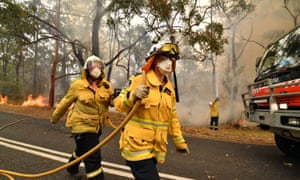
Firefighters conduct back-burning on the New South Wales Central Coast, 10 December 2019
University of Melbourne analysis challenges claims by
politicians that hazard reduction burning should
 substantially increase.
Forest scientists from the University of Melbourne said initial results suggested hazard reduction was best used in a targeted way around assets to help protect them from less intense fires.
It challenges claims by some politicians that state governments should substantially increase hazard reduction, possibly to meet a target of 5% of land each year. The prime minister, Scott Morrison, has suggested he may introduce national standards that would report on how much hazard reduction the states carried out each year.

Read the story from The Guardian by Adam Morton - “Hazard reduction burning had little to no effect in slowing extreme bushfires.”

08 February, 2019

Shark Bay: A World Heritage Site at catastrophic risk

The devastating bleaching on the Great Barrier Reef in 2016 and 2017 rightly captured the world’s attention. But what’s less widely known is that another World Heritage-listed marine ecosystem in Australia, Shark Bay, was also recently devastated by extreme temperatures, when a brutal marine heatwave struck off Western Australia in 2011.
Shark Bay was hit by a brutal marine heatwave in 2011.
A 2018 workshop convened by the Shark Bay World Heritage Advisory Committee classified Shark Bay as being in the highest category of vulnerability to future climate change. And yet relatively little media attention and research funding has been paid to this World Heritage Site that is on the precipice.


Read the piece from The Conversation - “Shark Bay: A World Heritage Site at catastrophic risk.”

08 March, 2018

Still fighting on the front lines: Puerto Rico’s energy warriors

It’s been five months since Hurricane Maria devastated the Caribbean. The rest of the world may have moved on to other news, but Puerto Ricans are still battling mudslides and eroded trees, garbage in the sewers, contaminated water, and limited electricity.
The Sonnen battery at Iglesia Bautista Mediania Alta.
Although there’s plenty of destruction to see this article won’t focus on the destruction. This is a story of problem-solvers.

In November 2017, I went with my team of renewable energy explorers at Vittoria Energy Expedition to visit Puerto Rico. We discovered some truly inspiring stories–individuals and groups fighting for energy independence and security. They are rebuilding an island 1,100 miles off of the mainland United States with limited resources and exceptional fortitude. They are finding new ways to recharge their phones, TVs, washers and dryers, streetlights, and hospitals.

They are Puerto Rico’s Energy warriors and here are some of their stories.


Read the Impakter story by Andrew Polich - “Still fighting on the front lines: Puerto Rico’s energy warriors.”

24 December, 2017

Philippines storm: At least 120 dead after tropical storm Tembin triggers flash flooding, landslides.

At least 120 people are dead and more than 160 missing after a tropical storm devastated the southern Philippines, unleashing flash flooding and setting off landslides.
Police officers help with rescue efforts, holding the hands
 and belongings of two women in rising floodwaters.
Most of the deaths from tropical storm Tembin were in the hard-hit provinces of Lanao del Norte and Lanao del Sur and on the Zamboanga Peninsula, according to an initial government report on storm casualties.

Romina Marasigan, of the government's disaster response agency, earlier said authorities had reported at least 75 deaths were due to landslides and sudden surges of floodwaters, but added those initial reports needed to be confirmed.

An entire village was buried by a mudslide, according to reports.


15 October, 2017

See it, say it: Climate change.

“NOTHING MORE than ash and bones.” That grim description of how some victims were found underscores the horror of the wildfires that swept through and devastated Northern California. At least 38 people were killed, including a 14-year-old boy found dead in the driveway of the home he was trying to flee, a 28-year-woman confined to a wheelchair and a couple who recently had celebrated their 75th anniversary. In addition to the lives lost, approximately 5,700 homes and businesses were destroyed, including entire neighborhoods turned into smoldering ruins.


A firefighter works to defend homes from the
approaching wildfire in Sonoma, Calif., on Saturday. 
Some 220,000 acres, including prized vineyards, have been scorched, and the danger is not over, as some fires are still burning and officials fear the return of winds could spread more catastrophe. Fire season is part of life in California, something that residents know and prepare for after the hot, dry summer months. But the events that began last Sunday have been unprecedented, and so the question that must be confronted is what caused the deadliest week of wildfires in the state’s history.

Gov. Jerry Brown (D) pointed the finger at climate change. “With a warming climate, dry weather and reducing moisture, these kinds of catastrophes have happened and will continue to happen and we have to be ready to mitigate, and it’s going to cost a lot of money,” he said last week.


Read The Post’s View from The Washington Post - “See it, say it: Climate change.

A group of prominent scientists says we have three years to save the planet from irreversible destruction

Leanna Garfield.
A planet devastated by climate change may seem like a distant future. But Earth is already experiencing effects today.

Globally, the mean rate of sea level rise increased 50% in the last two decades. In 2017, temperatures have already reached their highest levels in history in some areas, from California to Vietnam. And the past three years were the hottest on record

In a new open letter, six prominent scientists and diplomats, including former UN climate chief Christiana Figueres and physicist Stefan Rahmstorf, wrote that the world has approximately three years before the worst effects of climate change take hold. Published June 28, the letter urges governments, businesses, scientists, and citizens to address the world's greenhouse-gas emissions now.