Showing posts with label summer. Show all posts

06 February, 2020

Hazard reduction burning had little to no effect in slowing extreme bushfires

Hazard reduction burning had little to no effect in slowing the most severe fires that devastated more than 5m hectares across New South Wales this summer, an analysis has found.
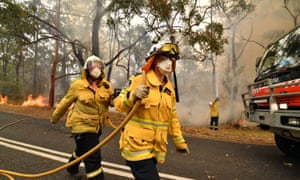
Firefighters conduct back-burning on the New South Wales Central Coast, 10 December 2019
University of Melbourne analysis challenges claims by
politicians that hazard reduction burning should
 substantially increase.
Forest scientists from the University of Melbourne said initial results suggested hazard reduction was best used in a targeted way around assets to help protect them from less intense fires.
It challenges claims by some politicians that state governments should substantially increase hazard reduction, possibly to meet a target of 5% of land each year. The prime minister, Scott Morrison, has suggested he may introduce national standards that would report on how much hazard reduction the states carried out each year.

Read the story from The Guardian by Adam Morton - “Hazard reduction burning had little to no effect in slowing extreme bushfires.”

06 January, 2020

The bushfires are horrendous, but expect cyclones, floods and heatwaves too

Public attention on the disastrous bushfire crisis in Australia will rightly continue for weeks to come. But as we direct resources to coping and recovery, we should not forget other weather and climate challenges looming this summer.
Image result for The bushfires are horrendous, but expect cyclones, floods and heatwaves too
Bushfires are not the only weather and climate
events set to ravage Australia in coming months.
The peak time for heatwaves in southern Australia has not yet arrived. Many parts of Australia can expect heavy rains and flooding. And northern Australia’s cyclone season is just gearing up. 
The events will stretch the ability of emergency services and the broader community to cope. The best way to prepare for these events is to keep an eye on Bureau of Meteorology forecasts.

Read the story from The Conversation by Professor emeritus from the School of Earth, Atmosphere and Environment, at Monash University, Neville Nicholls -  “The bushfires are horrendous, but expect cyclones, floods and heatwaves too.”

09 December, 2019

That’s more like summer: total fire ban in place for northern Vic with temperature forecast to reach 40 C.

After a cold and confusing start to summer, the mercury is tipped to hit a top of 40°C in Shepparton today with more warm weather on the way.
A total fire ban is in place across the Northern Country fire district, with a severe fire danger rating in place.
No fires are allowed to be lit or allowed to remain alight in open air across the 24 hour period from midnight.
Image result for bureau of meteorology logoAustralian Bureau of Meteorology data shows the hottest December day was recorded last year at 43.2°C, with the hottest day of this year recorded on January 25 at 46.2°C.
With temperatures set to reach 33°C tomorrow and 31°C on Wednesday, there will be little reprieve until Friday.
The extreme heat also means slight changes to the Seymour train line services with speed restrictions in place.
V/Line chief executive James Pinder said extra precautions were taken on extreme heat days to help train services run smoothly, minimise delays and ensure passengers arrived at their destinations safely.
‘‘Heat speed restrictions are enforced on the regional network when the temperature hits 36 degrees and above due to the steel tracks expanding in the heat,’’ Mr Pinder said.
‘‘Our team closely monitors the weather forecast and activates the extreme heat timetables across the network when necessary.’’
Passengers can download a copy of the extreme heat timetable for their line from the V/Line website at vline.com.au or ask for a copy from their nearest staffed station.
People are reminded to keep themselves, young children, elderly people and animals hydrated during the day.
Ashlea Witoslawski’s story from The Shepparton News - “That’s more like summer: total fire ban in place for northern Vic with temperature forecast to reach 40 C.”

29 November, 2019

Summer outlook from Bureau of Meteorology suggests hot, dry times to continue

Summer is looking hot for most of the country and dry for the east, according to the Bureau of Meteorology's summer outlook.
Map of Australia covered in red

Going in, swathes of the country are parched, water storages are down, streams are running low and fires are burning. 
This drought is now comparable with the big droughts of the past and this outlook suggests that isn't improving any time soon. 
But there is a distant glimmer of hope.

08 November, 2019

Climate change partly to blame for early bushfire season

Summer might be more than six weeks away but out-of-control bushfires have already torn across parts of eastern Australia in recent days, killing two people, destroying homes and threatening more lives.
Firefighters in Busbys Flat
Firefighters battle bushfires in Busbys Flat,
northern New South Wales, on 9 October.
By Wednesday afternoon up to 30 homes were feared lost or badly damaged by bushfires burning in northern New South Wales. About 40 fires burned across the state.
This did not surprise meteorologists and fire agencies. Record-breaking heat and windy conditions were forecast for parts of NSW and Queensland this week, prompting severe fire danger ratings.
We’re often told the Australian bushfire season is starting earlier. This year it began in September on the eastern seaboard. Last year and in 2013 significant spring fires hit NSW and in 2015 they affected much of the nation’s southeast.

Read the story from The Guardian - “Climate change partly to blame for early bushfire season.”

10 October, 2019

It’s only October, so what’s with all these bushfires? New research explains it

Summer might be more than six weeks away, but out-of-control bushfires have already torn across parts of eastern Australia in recent days, destroying homes and threatening lives. 
Image result for It’s only October, so what’s with all these bushfires? New research explains it
Summer is still weeks away and yet bushfires
 have ravaged parts of eastern Australia.
As of Wednesday afternoon, up to 30 homes were feared lost or badly damaged by bushfires burning in northern New South Wales. About 40 fires burned across the state.
This did not come as a surprise to meteorologists and fire agencies. Record-breaking heat and windy conditions were forecast for parts of NSW and Queensland this week, prompting severe fire danger ratings.
We’re often told the Australian bushfire season is starting earlier. This year it began in September on the eastern seaboard. Last year and in 2013, significant spring fires hit NSW and in 2015 they affected much of the nation’s southeast.


04 May, 2019

Lessons From a Genocide Can Prepare Humanity for Climate Apocalypse

Catastrophic global climate change, however, is not an event at all, and we’re not waiting for it. We’re living it right now. In August 2018, in a summer of forest fires and shattered heat records, the strongest, oldest ice in the Arctic Sea broke up for the first time on record, presaging the final throes of the Arctic death spiral.


The fantasy version of apocalypse always begins with the longawaited event a missile launch, escaped virus, zombie outbreak and moves swiftly through collapse into a new, steady state. Something happens, and the morning after you’re pushing a squeaking shopping cart down a highway littered with abandoned Teslas, sawed-off shotgun at the ready. The event is key: it’s a baptism, a fiery sword separating past and present, the origin story of Future You.

In September 2018, the secretary general of the United Nations, António Guterres, gave a speech warning: “If we do not change course by 2020, we risk missing the point where we can avoid runaway climate change.” The months following saw the US government crippled by a fight over whether to build a wall on the southern border to keep out climate change refugees, news that greenhouse-gas emissions have not decreased but in fact have accelerated upward, and a populist revolt in France sparked by opposition to a gas tax.


Read the story from MIT Technology Review by Roy Scranton - “Lessons From a Genocide Can Prepare Humanity for Climate Apocalypse.”

04 March, 2019

Summer temperature records tumble

If this summer felt hotter than normal, that is because it was.

Bureau of Meteorology figures show Shepparton recorded not only its hottest summer day, but also its highest mean daily minimum and record highest mean temperatures.

Summer’s mean maximum recorded at Shepparton Airport was 33.1°C, 2.5°C warmer than average.

This toppled the previous summer mean daily maximum record of 32°C, set in 2013.

Tatura also set a 53-year record for highest summer mean daily maximum; 31.8°C — 2.8°C hotter than the summer average.

Similarly, Shepparton set a summer mean minimum record (16.5°C), 2.1°C warmer than average.

The city’s hottest summer temperature in at least 20 years was recorded on January 25, 46.2°C at Shepparton Airport.

This toppled the previous record of 46.1°C from February 7, 2009.

The Shepparton Airport site has 22 years of data available.

Also on January 25, Tatura equalled a 55-year record for its hottest recorded temperature, 44.8°C (recorded at the Tatura Institute of Sustainable Ag).

Record highest summer mean temperatures were also achieved by Shepparton (24.8°C) and Tatura (23.7°C).

Summer rainfall was about 50 mm, almost half the summer average of 98 mm.

Meanwhile, outlooks indicate the region is unlikely to exceed its median March or autumn rainfall and maximum temperatures are likely to exceed the median for these periods.

Statewide, summer rainfall was 12 per cent less than the long-term summer mean of 120 mm.

Victoria’s mean temperature was more than 2.5°C warmer than the long-term summer average, making it the warmest summer on record.


Read the story from The Shepparton News - “Summer temp records broken.”

01 March, 2019

Heat to hang around

While it may not feel like it, summer is officially over.

But it appears there will still be about a week left of the heat.
Working up a sweat: Although summer ended yesterday,
 the scorching heat is forecast to linger in Shepparton
until the middle of next week.
The Bureau of Meteorology forecasts temperatures hotter than 35°C are expected for Shepparton, including 38°C for today, through to next Wednesday when some more autumn conditions (an expected 24°C) are set to arrive.

Each day for the past week the city has sweltered through temperatures hotter than 30°C. Yesterday reached 35°C at about 4 pm. This has all been part of what was being described yesterday as Victoria’s hottest summer on record.

Shepparton also sweltered through heatwave-like conditions during January, with the mercury passing 40°C on eight days and reaching a high of 46°C on January 25.

At the time the News went to print yesterday, Shepparton had received 6.6 mm of rainfall for February; the exact same amount as it received in January.

While this marks a significant increase on last year’s February rainfall — just 1 mm — it remains well less than the longer term February mean of 36.7 and the median of 26.6.

Most of this month’s rainfall was received on February 7, when 4.2 mm fell on the city.

Bureau senior climatologist Blair Trewin said it had been ‘‘an exceptionally hot summer for Victoria’’.

‘‘Averaged over the state it was the hottest on record . . . with particularly hot conditions in much of northern Victoria,’’ Dr Trewin said.

He said this summer came in about 2.5°C hotter than the long-term average and about 0.2°C warmer than the state’s previous hottest summer.

‘‘A lot of the really extreme heat (was) in late December and January,’’ Dr Trewin said.
‘‘We had some places have their highest temperatures on record.

‘‘In general, we saw persistent and extreme heat through January particularly in northern parts of the state. The start of March is looking pretty hot for many parts of the state.’’


Story by Thomas Moir from The Shepparton News - “Heat to hang around.”

28 February, 2019

The heat is building': Melbourne to see hottest start to autumn in 30 years

Summer may be ending, but don't expect autumnal temperatures to kick in quite yet.

A severe heatwave is set to hit Victoria, South Australia and Tasmania this week.CREDIT:
Melbourne is set to swelter through the hottest start to March in 30 years when the season changes on Friday.

A heatwave sweeping through Victoria, South Australia and Tasmania is set to reach Melbourne on Thursday, with gusty winds pushing hot air down from the north.


Read the story from The Age by Simone Fox Koob - “‘The heat is building': Melbourne to see hottest start to autumn in 30 years.”

02 February, 2019

Climate change a burning issue (again) in voters' minds

This piece of backroom intelligence shouldn’t come as a surprise, given the summer we are all still enduring. Record high temperatures, the hottest January on record; storms; floods in some places, droughts in others; mass fish kills in ailing rivers.
Adani protest
 ‘Climate change is not only a hot-button issue on its
own terms. Some of the research suggests it has
also become a proxy for political dysfunction.’ 
Climate change is back as a vote-changing issue – top of mind for many Australian voters. Private polling conducted for the environment movement and for the major parties suggests community concern about climate change is currently sitting at levels not seen since the federal election cycle in 2007.
If you can remember the events of 2007, you’ll recall that John Howard was forced into a significant about-face on the issue. Within sight of the election that swept Kevin Rudd into power, Howard signed the Liberal party up to emissions trading, a “world’s best-practice” cap and trade scheme, and declared Australia must prepare for a “low-carbon future”.


Read the story from The Guardian by Katharine Murphy - “Climate change a burning issue (again) in voters' minds.”

16 January, 2019

35 degree days make blackouts more likely, but new power stations won’t help

Summer is here with a vengeance. On hot days it’s very likely something in the power system will break and cause someone to lose power. And the weather bureau expects this summer to be hotter and drier than average – so your chances of losing power will be higher than normal.
Whether your energy comes from coal or renewable sources
 isn’t likely to make a difference to your risk of a blackout this summer.
We’ve analysed outage data from the electricity distribution networks over the past nine years and linked it to Bureau of Meteorology maximum daily temperature data for each distribution network. The findings are stark: customers are without power for 3.5 times longer on days over 35 degrees than on days below 35.


05 January, 2019

Yes, the chaotic the 2018 weather in Europe is linked to climate change

Europe was one continent that experienced abnormal weather during 2018. After a couple months of extremely cold weather, heat and drought through spring and summer meant temperatures were well above average in much of the northern and western areas.
A road in Villalier, France, destroyed by the flood.
Between May and July, Scandinavia had the driest and warmest period on record.

The highest temperatures ever were recorded in the Arctic Circle. In Helsinki-Vantaa Finland, figures how record long runs of warm temperatures. There were 25 consecutive days of heat above 25ºC.


15 December, 2018

Age of extremes.

Droughtheatwavesbushfires and intense rain. Summer has barely started, but spring brought more than enough extreme weather to go on with.
Early indications: firefighters working to control a bushfire at
Deepwater in Central Queensland last month. At one point,
140 fires were burning around the state.
Spring is a time when southern cold fronts and warm northern air often battle it out all over the country. This makes for changeable and sometimes unpredictable weather, with the southern states topping 40°C one day but barely reaching 18°C the next.

As summer approaches, warmer — and in the tropics, more humid and wetter — conditions become the norm, and they usually fall within a more predictable envelope of variability. Extreme events occur when that envelope is pushed. And while a couple of extreme events in a season is fairly standard, a greater number of extreme events is starting to become the norm.

Read the story Inside Story by Sarah Perkins-Kirkpatrick - “Age of extremes.


(Sarah Perkins-Kirkpatrick is featured on “Climate Conversations”)

30 August, 2018

Melbourne, get set for a warm spring and early summer

We’re heading for a warm and sunny Melbourne spring, with summer set to arrive early this year.
Melbourne is set for a warm spring this year.
Winter is almost behind us, and soon we'll came out of hibernation to attend park parties, outdoor barbies and the Spring Racing Carnival.

This year’s festivities are less likely to be marred by rain, with the weather bureau forecasting a drier than usual spring.

Bureau of Meteorology long-range forecaster Dr Andrew Watkins said temperatures would be one to two degrees warmer on average, equalling more glorious spring days in the high 20s or early 30s.


Read the story from The Age by Chloe Booker - “Melbourne, get set for a warm spring and early summer.”

11 August, 2018

2018 Is Shaping Up to Be the Fourth-Hottest Year. Yet We’re Still Not Prepared for Global Warming.

This summer of fire and swelter looks a lot like the future that scientists have been warning about in the era of climate change, and it’s revealing in real time how unprepared much of the world remains for life on a hotter planet.
Residents of New Delhi in June. Extreme heat hits poor
 and already-hot regions like South Asia especially hard.
The disruptions to everyday life have been far-reaching and devastating. In California, firefighters are racing to control what has become the largest fire in state history. Harvests of staple grains like wheat and corn are expected to dip this year, in some cases sharply, in countries as different as Sweden and El Salvador. In Europe, nuclear power plants have had to shut down because the river water that cools the reactors was too warm. Heat waves on four continents have brought electricity grids crashing.

And dozens of heat-related deaths in Japan this summer offered a foretaste of what researchers warn could be big increases in mortality from extreme heat. A study last month in the journal PLOS Medicine projected a fivefold rise for the United States by 2080. The outlook for less wealthy countries is worse; for the Philippines, researchers forecast 12 times more deaths.


Read the story from The New York Times by Simoni Sengupta - “2018 Is Shaping Up to Be the Fourth-Hottest Year. Yet We’re Still Not Prepared for Global Warming.”

18 April, 2018

Australia’s climate of fire

A big bushfire skirting the suburbs of Sydney, Australia, was made more likely by the preceding hot and dry start to autumn. The fire season has been extended by several weeks as summer heat kept recurring.
Australia's autumn heatwave is attributed to a
changing climate by scientists expert in the field.
This sort of heatwave, during spring or autumn, shows a greater divergence from the long-term average than a summer or winter heatwave.

"I would bet my house on it, that there's a climate change signal in this most recent heatwave," said Sarah Perkins-Kirkpatrick, climate scientist at the University of New South Wales.

Read the Aljezeera story - “Australia’s climate of fire.”

25 January, 2018

Petition: Matthew Guy, get serious on climate change.

In 2017, the world witnessed concerning climate change impacts, from record-breaking hurricanes and wildfire in the United States to bleaching of the Great Barrier Reef.

Closer to home we're seen parts of Victoria experienced the driest conditions on record and the state has faced a heightened bushfire risk in summer. 
It’s time for Matthew Guy and the Victorian Liberal and
National party to get serious about climate change.
Unchecked climate change exposes Victorian families and regional communities to intensifying heatwaves, bushfires, droughts, and extreme weather. These climate impacts threaten public health, infrastructure, and agricultural production.

Communities across the state are now taking action. Victorians are reining in emissions by getting energy efficient and installing solar. Others are working on projects to prepare their local communities from climate impacts that are now unavoidable.


Read the Friends of the Earth story - “Petition: Matthew Guy, get serious on climate change.

18 January, 2018

Melbourne to bake through another scorcher of a day as temperatures soar

Heat-weary Melburnians have received another blow with Friday's forecast revised up to a summer scorcher of 42 degrees.
Get set to swelter, or find a way to cool off -
like this young man at the Frankston Jetty. 
The Bureau of Meteorology issued the news late on Thursday, up from the previous forecast of 39 degrees.

Melbourne will toss and turn through another hot night with the mercury unlikely to dip below 25 degrees on Thursday.

The sudden surge in temperature predicted for Friday is due to a later than expected cool change, Bureau of Metrology senior forecaster Dean Stewart said.


Read Melissa Cunningham’s story from the Melbourne Age - “Melbourne to bake through another scorcher of a day as temperatures soar.”

17 January, 2018

Why we need to 'climate proof' our sports stadiums

For many Australians summer is synonymous with cricket and tennis. But as Australian summers become more prone to extreme heat conditions, sustainable and climate-adaptable stadium design has become a leading consideration for both sporting codes and governments.
The SCG was measured at 57.6 degrees
Celsius on Sunday during the fifth Ashes Test.
The final Ashes Test played at the Sydney Cricket Ground recently showed that the cricketing community must adapt to heatwaves made worse by climate change.

And in recent years the Australian Open has produced many stories of both tennis players and spectators suffering in extreme heat. And more are expected over the two weeks of the current tournament.

As the New South Wales Government embarks on a hugely expensive rebuild of major stadiums across Sydney, now is a good time to ask whether major Australian sports venues are adequately "climate-proofed" for a warming future.


Read the story on ABC News from The Conversation by Macquarie University’s Paul J Govind - “Why we need to 'climate proof' our sports stadiums.”