Showing posts with label eastern Australia. Show all posts

06 January, 2020

New study: changes in climate since 2000 have cut Australian farm profits 22%

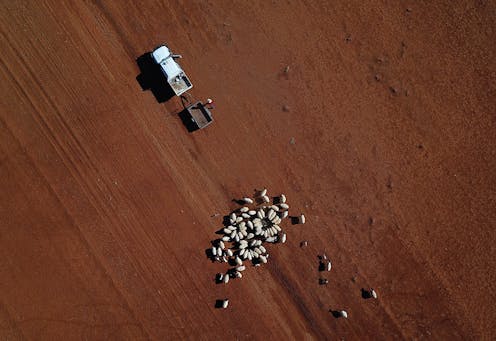
The current drought across much of eastern Australia has demonstrated the dramatic effects climate variability can have on farm businesses and households.
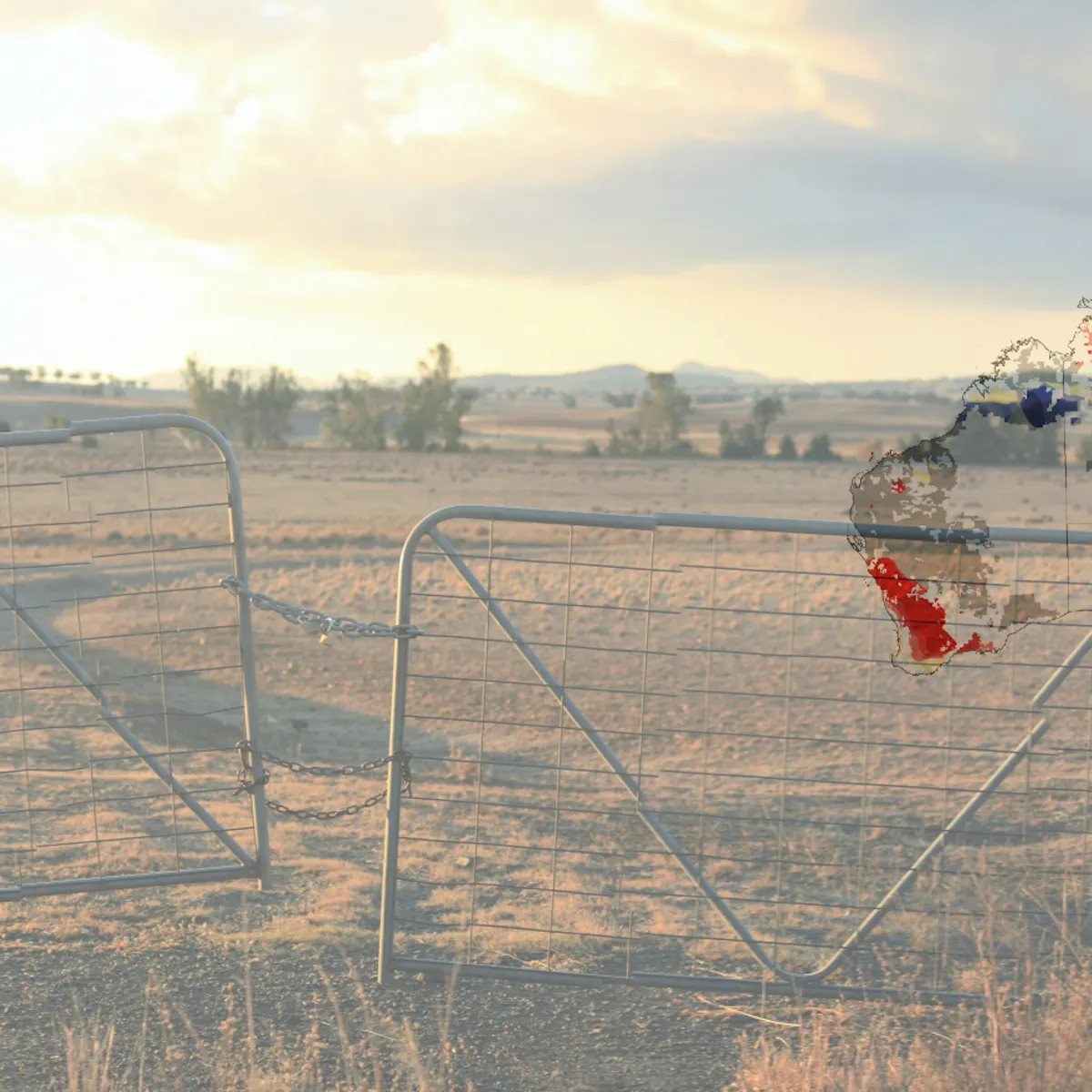
Image result for New study: changes in climate since 2000 have cut Australian farm profits 22%
The Australian Bureau of Agricultural and Resource
 Economics and Sciences farm predict model finds
 that changes in climate conditions since 2000 have
 cut farm profits by 22% overall, and by 35% for cropping farms..
The drought has also renewed longstanding discussions around the emerging effects of climate change on agriculture, and how governments can best help farmers to manage drought risk.

A new study released this morning by the Australian Bureau of Agricultural and Resource Economics and Sciences offers fresh insight on these issues by quantifying the impacts of recent climate variability on the profits of Australian broadacre farms.


31 December, 2019

The bushfires are a national catastrophe for the city and country. How are we going to live like this?

The fire situation in eastern Australia continues to rapidly escalate.
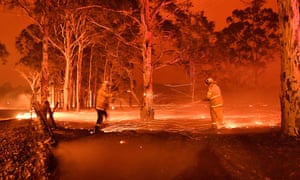
This timed-exposure image shows firefighters hosing down trees as they battle against bushfires around the town of Nowra in the Australian state of New South Wales on December 31, 2019.
‘The magnitude of these fires alone, apart from their
human and environmental consequences, simply
shows us that we now confront a new, more flammable world’.
At this stage we cannot predict when this will come to an end, but with losses of lives and property mounting on the south coast of NSW, eastern Victoria, South Australia, southwestern WA and Tasmania, we now have a nationally significant catastrophe that affects city and country alike.
The magnitude of these fires alone (about 5 million hectares and rapidly rising), apart from their human and environmental consequences, simply shows us that we now confront a new, more flammable world: a coupling of people, ecosystems and fire that is now irrevocably transformed.
As a society we should admit that our current policy, operational, knowledge-gathering and research capacity is inadequate to deal with such a new, fiery world.

Read the opinion piece from The Guardian by Ross Bradstock and David Bowman - “The bushfires are a national catastrophe for the city and country. How are we going to live like this?” 

21 November, 2019

Climate change will make fire storms more likely in southeastern Australia

Temperatures across many regions of Australia are set to exceed 40℃ this week, including heatwaves forecast throughout parts of eastern Australia, raising the spectre of more devastating bushfires.
Image result for Climate change will make fire storms more likely in southeastern Australia
Last year fire storms raged across California.
Similar conditions could become more likely for Australia.
We have already heard warnings this fire season of the possibility of firestorms, created when extreme fires in the right conditions form their own weather systems. 
Firestorms are the common term for pyrocumulonimbus bushfires – fires so intense they create their own thunderstorms, extreme winds, black hail, and lightning. 
While they are very rare, our research published earlier this year, found climate change is making it likely they will become more common in parts of southeast Australia.

08 November, 2019

Australia’s drought relief package hits the political spot but misses the bigger point

There are two basic components to the Morrison government’s latest A$1 billion package response to the drought affecting large parts eastern Australia. One part involves extra subsidies to farmers and farm-related business. The other involves measures to create or upgrade infrastructure in rural areas.
Image result for Australia’s drought relief package hits the political spot but misses the bigger point
All the indicators from climate science is that rain
 in many areas will be even more unreliable in the future.
Unfortunately, most funds will be misdirected and the response is unlikely to secure the long-term prosperity of regional and rural communities. This is a quick fix to a political problem, appealing to an important constituency. But it misses the point, again, about the emerging economics of drought.
The bulk of the A$1 billion package is allocated to a loan fund. The terms of the ten-year loans are more generous than what has been offered in the past. They are now interest-free for two years, with no requirement to start paying back the principal till the sixth year. 
Farmers will be able to borrow up to A$2 million. In addition, loans of up to A$500,000 will also be available to small businesses in drought-affected towns. 

Read the story from The Conversation by the Professor of Economics and Head of School from the University of South Australia, Lin Crase - “Australia’s drought relief package hits the political spot but misses the bigger point.”

10 October, 2019

It’s only October, so what’s with all these bushfires? New research explains it

Summer might be more than six weeks away, but out-of-control bushfires have already torn across parts of eastern Australia in recent days, destroying homes and threatening lives. 
Image result for It’s only October, so what’s with all these bushfires? New research explains it
Summer is still weeks away and yet bushfires
 have ravaged parts of eastern Australia.
As of Wednesday afternoon, up to 30 homes were feared lost or badly damaged by bushfires burning in northern New South Wales. About 40 fires burned across the state.
This did not come as a surprise to meteorologists and fire agencies. Record-breaking heat and windy conditions were forecast for parts of NSW and Queensland this week, prompting severe fire danger ratings.
We’re often told the Australian bushfire season is starting earlier. This year it began in September on the eastern seaboard. Last year and in 2013, significant spring fires hit NSW and in 2015 they affected much of the nation’s southeast.


04 January, 2019

How WA's Pilbara region can generate a heatwave that can stretch to Melbourne

A burst of extreme summer heat in southern and eastern Australia, including Adelaide and Melbourne, has been dragged down from Western Australia's Pilbara region, which has experienced record-breaking temperatures in the past fortnight.
Heatwaves generated in the Pilbara have
extended across the country this summer.
Intense heat has been building in the Pilbara, with temperatures in some towns hovering in the mid to high 40s over the past two weeks.

Marble Bar recorded 49.3 degrees Celsius on December 27 — the hottest day in the town since temperature records began in 1901.


15 December, 2018

Eastern states battered by more wild weather as a cyclone and floods hit

As Cyclone Owen made landfall and was downgraded to a category 2 storm over Queensland’s west coast, cities and towns across eastern Australia were hit by their own flooding and chaos.
Heavy rains on Friday night made movement difficult in parts of
 Melbourne - this is an underpass in Richmond.
And there’s more to come with weather warnings issued for more heavy rain and flash flooding across parts of NSW and Victoria over the weekend.

On Friday afternoon in Melbourne, where a late afternoon storm dumped 37.2 millimetres of rain in just 60 minutes, roads flooded and a Paul Kelly concert at the Sidney Myer Music Bowl came to a soggy halt.

Fans found themselves ankle-deep in water as speakers tumbled and the capacity crowd was soaked to the skin.


13 October, 2018

How climate change policy helps farmers

Drought is ravaging the land. Large swaths of eastern Australia are experiencing some of the worst seasons on record. Frosts have wiped out large areas of crops in Western Australia, southern New South Wales and Victoria. Hail has beaten crops into the ground in Queensland.
Tony Windsor.
The government is scrambling to be seen to be doing something meaningful for farmers, particularly in Queensland where traditional National voters are looking to desert in favour of minor parties, such as One Nation and Katter’s Australian Party. In some coastal seats in the state, Labor is also doing well. Hence the scene is set for the champion of the short-term, former agriculture minister Barnaby Joyce, to weave his web of utterances that join the drought, energy and climate scepticism into an electoral defence.

At the same time, the climate change debate proceeds at a crawl without any meaningful policy regarding the risk of increased drought and other weather events. This week a report, released by the Intergovernmental Panel on Climate Change (IPCC), declared that in order to keep warming within a relatively safe 1.5 degrees Celsius, global emissions will need to be cut by 45 per cent by 2030. Coal power will need to be phased out by 2050. The world has just 12 years, according to the IPCC, to avoid a climate change catastrophe. The deputy prime minister, Michael McCormack, rejected the IPCC’s call for transition from coal, saying “some sort of report” won’t stop Australia using up its coal resources. Renewable energy, and the opportunities it offers regional Australia, is still being used as a political pawn.


Read the story by Tony Windsor from The Saturday Paper - “How climate change policy helps farmers.”

16 August, 2018

No break for drought-hit areas as new research points to warmer years

Prospects of an early end to the big dry affecting much of eastern Australia are diminishing, with the latest estimates from the Bureau of Meteorology pointing to drought conditions intensifying and seeping southwards into Victoria.
Dry conditions that have taken hold over much of NSW,
such as this farm near Mudgee, are forecast to extend into Victoria.
Separately, new research out Wednesday points to an acceleration of global warming in the years to 2022, with natural variability predicted to accelerate the background increase in temperatures from climate change.


Read the story by Peter Hannam from The Sydney Morning Herald - “No break for drought-hit areas as new research points to warmer years.

06 June, 2018

National party comments on drought and climate 'a disservice' to farmers

Farmers have challenged National party claims that conditions in drought-stricken regions in eastern Australia should not be politicised by attributing them to climate change.
The Climate Council has identified an 11% decline in the
growing-season rainfall in south-east Australia since the mid-90s.
Farmer and former Nationals leader John Anderson said this week that while the drought was the worst he had experienced, it was not unprecedented.

He told the Financial Review farming records for his property, which had been in his family for more than a century, showed droughts of equal severity between 1902 and 1904 and again in 1940.


Read the story by Lisa Cox from The Guardian - “National party comments on drought and climate 'a disservice' to farmers.”

01 December, 2017

Wild weather: Monster storm threatens 20 per cent of Australia's wheat crop

Heavy rains in eastern Australia could wipe out or damage up to 4 million tonnes of wheat due to be harvested shortly, forecasters said on Friday.
Farmers have been working round the clock to harvest
their crops before the wild weather strikes.
 
The "major weather event" being faced by most of Victoria and parts of South Australia and NSW this weekend poses a major threat to the countries grain harvest.

"The main concern is that these are the areas where crops are still being harvested," said James Maxwell of Australian Crop Forecasters, which expects to downgrade its national wheat forecast of 21.7 million tonnes once the damage is assessed.

"At the moment, we estimate that around 4 million tonnes will be affected," Mr Maxwell said.
It was not yet possible to determine how much of the crop would be wiped out and how much is downgraded due to the onset of re-sprouting, or premature germination, resulting in lower yields.


26 September, 2017

New temperature records expected as NSW, Queensland brace for second spring heatwave

Temperature records set on Saturday may not last long, as eastern Australia braces for another heatwave.


Northern New South Wales and Queensland will bear the brunt of the extreme heat, with Brisbane and Ipswich expected to set new September records on Thursday.

Outback regions will be even hotter.

The Bureau of Meteorology predicts Queensland will hit a new September record on Wednesday, with Birdsville in the far west Channel Country expected to reach 43 degrees.

That would equal the hottest September day ever recorded anywhere in Australia.


07 April, 2017

How Cyclone Debbie exposed the perfect storm awaiting Australia's food supply

Cyclone Debbie, which lashed the Queensland coast a week ago, has hit farmers hard in the area around Bowen – a crucial supplier of vegetables to Sydney, Melbourne and much of eastern Australia.
Malcolm Turnbull looks at damaged and flooded areas
from aboard an Australian Army helicopter after
 Cyclone Debbie passed through the area
near the town of Bowen. 
With the Queensland Farmers’ Federation estimating the damage at more than $100m and winter crop losses at 20%, the event looks set to affect the cost and availability of fresh food for millions of Australians. Growers are reportedly forecasting a price spike in May, when the damaged crops were scheduled to have arrived on shelves.

The incident also raises broader questions about the resilience of Australia’s fresh vegetable supply, much of which comes from a relatively small number of areas that are under pressure from climate and land use change.


09 January, 2017

Australia’s climate in 2016 – a year of two halves as El Niño unwound

For Australia’s climate, 2016 was a year of two halves. The year started with one of the strongest El Niño events on record in place in the Pacific Ocean, and the opening months of 2016 were generally hot and dry, especially in northern and eastern Australia.

From May onwards there was a dramatic change in the pattern, with heavy rain and flooding a regular feature of the middle months of the year.

Overall temperatures were the fourth warmest on record in 2016, capping off Australia’s hottest decade. We track these events and more in the Bureau of Meteorology’s annual climate summary released today.

Read the thoughts of a climate scientist with the Australian Bureau of Meteorology, Blair Trewin, on The Conversation - “Australia’s climate in 2016 – a year of two halves as El Niño unwound.”

07 June, 2016

Storms fewer, but more intense - Karl Braganza

Houses at Collaroy Beach front got
smashed by the weekend storm surge.
Events like this weekend's super storm that smashed into eastern Australia are likely to become fewer in frequency in a warming world but pack more intensity when they hit, climate scientists say.

The damaging event came just a month after the NSW government announced increased funds and a new coastal management bill to require councils and residents to prepare for emerging threats.

The source of the wild winds, heavy rain and coastal erosion was an east coast low. Such storms are typical at this time of year, with as many as eight such lows a year.

Karl Braganza, head of climate monitoring at the Bureau of Meteorology, said climate models estimate the number of such lows may decrease by 25 per cent or more by the end of the century, particularly in winter.

Read Peter Hannam’s story in today‘s Melbourne Age - “Sydney storm: East coast lows to become fewer but more intense, scientists say.”

02 August, 2015

Diverse views and opinions about Galilee Basin coal mine


D

iverse views and opinions from callers about the proposed massive Adani supported Queensland coal mine surfaced today on a New South Wales call-back radio program.

Many of the protests were legitimate, including that of one fellow who said the mine, which he said would be biggest in the world, could impact on water quality in the Murray Darling Basin impacting on farmers from the northern and southern parts of eastern Australia.

One fellow was optimistic about the mine arguing it was of huge import to Australia both in terms of the jobs it would create and billions of dollars it would bring to Australia in exports.

Interestingly and importantly, no one mentioned the certain greenhouse gases that would evolve from the burning of coal from the Galilee Basin; GHG the world cannot afford as its carbon budget is close to exhausted, so it matters not where the coal is burned or by whom, for if we are serious about slowing global warming the only place for that coal is in the ground.

One caller pointed out that most of the coal would be going to India, the home of the Adani company, but as the world’s climatologists have repeated pointed out, it matters not where the coal is burnt, but whether or not it is burned.

Interestingly, while the debate goes on about Galilee Basin mine, Vietnam is struggling with a difficulty that has arisen because of global warming, involving heavy rainfall and coal mines.

EcoWatch reports: “Ongoing downpours in northeastern Vietnam have resulted in toxic spills and flooding from multiple coal mine and power plant sites in the province surrounding the Ha Long Bay World Heritage Site.”