Showing posts with label continues. Show all posts

31 December, 2019

The bushfires are a national catastrophe for the city and country. How are we going to live like this?

The fire situation in eastern Australia continues to rapidly escalate.
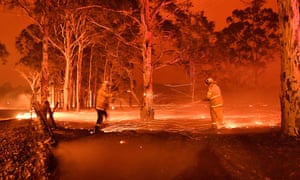
This timed-exposure image shows firefighters hosing down trees as they battle against bushfires around the town of Nowra in the Australian state of New South Wales on December 31, 2019.
‘The magnitude of these fires alone, apart from their
human and environmental consequences, simply
shows us that we now confront a new, more flammable world’.
At this stage we cannot predict when this will come to an end, but with losses of lives and property mounting on the south coast of NSW, eastern Victoria, South Australia, southwestern WA and Tasmania, we now have a nationally significant catastrophe that affects city and country alike.
The magnitude of these fires alone (about 5 million hectares and rapidly rising), apart from their human and environmental consequences, simply shows us that we now confront a new, more flammable world: a coupling of people, ecosystems and fire that is now irrevocably transformed.
As a society we should admit that our current policy, operational, knowledge-gathering and research capacity is inadequate to deal with such a new, fiery world.

Read the opinion piece from The Guardian by Ross Bradstock and David Bowman - “The bushfires are a national catastrophe for the city and country. How are we going to live like this?” 

25 August, 2019

California looks to Australia for ways to manage its groundwater after worst-ever drought

In the powerhouse food bowl of California, the impact of its most recent drought — which finally ended in 2017 after eight gruelling years — continues to be felt across the sunshine state.

San Luis Dam, Los Banos, California’s fifth-largest reservoir, only about 10% full
San Luis Dam is California's fifth-largest reservoir
but fell to less than 10 per cent capacity during the drought.
Farmers, experts and lawmakers are working to find more sustainable ways to droughtproof farms and address the vexed issue of water allocation.

And it turns out many farmers and water experts in California are looking to Australia for answers as they face up to the biggest water reforms in the history of the US.

When California's worst drought in history ended in 2017, it cost the country $US3.8 billion ($AU5.6 billion) and exposed deep flaws in its water management processes.


08 February, 2019

One of UK's last coal power stations to close due to rising costs

One of the UK’s last seven coal power stations will close this year after half a century of generating electricity, as the polluting fuel continues its rapid decline in the energy mix.
 Cottam power station is due to close, with the loss of more than 150 jobs. 
EDF Energy said more than 150 jobs were likely to be cut due to the closure of the Cottam plant in north Nottinghamshire on 30 September.

The power station was no longer economically viable, the company said. Cottam has been hit by the costs of working to European environmental standards and the failure to secure a contract for payments supply backup power after September.

The UK government has pledged to end coal power generation in the UK by 2025 to meet its climate change commitments.


Read the story from The Guardian by Adam Vaughan - “One of UK's last coal power stations to close due to rising costs.”

15 May, 2018

How do Queensland's land clearing laws impact farming profits?

The land clearing debate continues in farming communities across Queensland in the wake of the Labor Government's decision to pass laws banning the broad scale clearing of remnant vegetation.
Debate continues among farming communities across
 Queensland about the broadscale clearing of remnant vegations.
Now the focus is on the Far North where the Federal Environment Department has given the green light to the clearing of 2,000 hectares of forest at Kingvale on Cape York.

Conservationists fear bulldozing the vast tract of land will cause dangerous runoff into rivers that eventually flow into the Great Barrier Reef.

But local politicians are looking to money and jobs that increased farming development on the station will produce.


Listen to the Radio National report - “How do Queensland's land clearing laws impact farming profits?”

30 January, 2018

Naring is latest stop on solar

The solar farm train in northern Victoria continues to roll on, with Naring now jumping on board with a $55million project.
The solar farm train in Northern Victoria continues to roll on,
with Naring jumping on board with a $55 million project.
British solar project developer Lightsource is building a 60MW solar farm on 122ha at 3405 Katamatite-Nathalia Rd, which will be a first for the company in Australia.

The project is set to power 17240 homes and includes 204012 solar panels.


Read the story in Country News by Rodney Woods - “Naring is latest stop on solar farm roll-out.”

03 November, 2017

‘Critical turning point' as more nations hit peak carbon emissions: think-tank

The number of countries in which greenhouse gases has peaked continues to rise, representing a "critical turning point" in the task of curbing climate change, according to a report by the World Resources Institute.

While offering a "silver lining", the rate of national peaking won't be fast enough to prevent emissions reaching a zenith before 2030, assuming countries implement their Paris climate pledges, the Washington D.C.-based think-tank said.

Any backsliding by China and the US, the two biggest emitters accounting for more than a third of the total, would also "significantly compromise" the peak projections, it said.

Most of the early peakers were former Eastern Bloc nations, whose heavy industry sectors hammered in the run-up to the 1991 collapse of the Soviet Union. Germany, France and the United Kingdom, though, had also seen their greenhouse gas pollution top out by that year.


Read Peter Hannam’s story in today’s Melbourne Age - “‘Critical turning point' as more nations hit peak carbon emissions: think-tank.”