Showing posts with label summers. Show all posts

04 January, 2020

Hot and bothered: heat affects all of us, but older people face the highest health risks.

Australian summer temperatures have risen by 1.66℃ over the past 20 years. In the past century we’ve seen a significant increase in the number, intensity and duration of heatwaves during our summers. 
Image result for Hot and bothered: heat affects all of us, but older people face the highest health risk
Older people’s bodies can’t regulate their temperature as well as younger people’s.
Heat is the natural hazard associated with the highest mortality in Australia. When heatwaves occur, the death toll routinely reaches into the hundreds. For example, the 2009 heatwave across southeast Australia resulted in close to 500 deaths. 
Heat is more likely to endanger the health of people with pre-existing conditions, people who are socially isolated, and people who have limited access to air conditioning. These are often older members of the community.

Read the story form The Conversation by a physician and cardiologist from the Canberra Hospital, who is also a Clinical Senior Lecturer at the Australian National University, Arnagretta Hunter -  “Hot and bothered: heat affects all of us, but older people face the highest health risks.”

20 February, 2019

How Phoenix Is Working to Beat Urban Heat

Summers in Phoenix pose a daily health threat to Leonor Juarez and her family. She and her five children have asthma, and struggle to breathe the ovenlike air that ripples off the sidewalks when they walk their neighborhood’s shadeless streets. The sun beats down on them at uncovered bus stops during the five-hour round-trip to the doctor, leaving them suffering headaches, dehydration and chest pains. “It feels like I’m having a heart attack,” Juarez says. “It feels like you’re drowning in a swimming pool or you have a pillow over your head.”
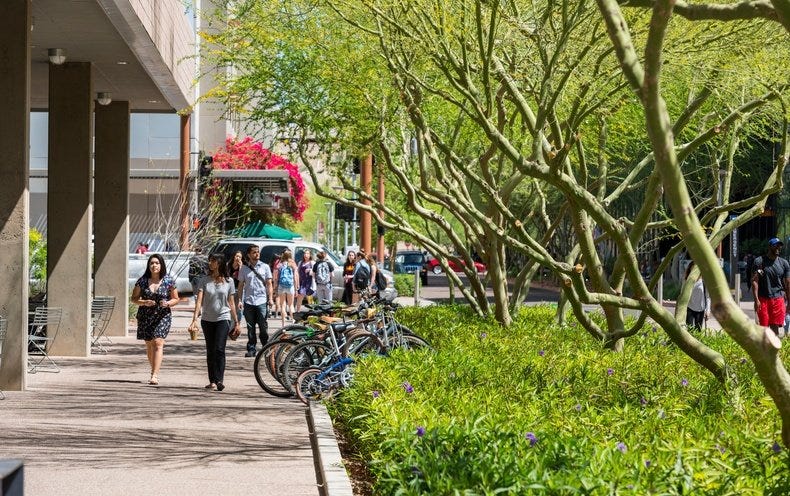
In downtown Phoenix, investments in urban greening
have been made to reduce the impact of heat waves. 


Stories like Juarez’s are not unusual in Phoenix, the nation’s fastest-warming big city, which hit triple-digit temperatures on 128 days last year — and where at least 172 people died of heat-related causes in 2017. With the urban heat island effect acting in concert with global warming, U.S. cities could be up to 10 degrees Fahrenheit warmer in the afternoon and 14 degrees warmer at night by the end of the century, according to a recent study in Nature Climate Change. As temperatures spike, researchers and urban planners worry heat deaths will rise across the country.


Read the story from Scientific American by Keridwen Cornelius - “How Phoenix Is Working to Beat Urban Heat.”

17 January, 2018

Why we need to 'climate proof' our sports stadiums

For many Australians summer is synonymous with cricket and tennis. But as Australian summers become more prone to extreme heat conditions, sustainable and climate-adaptable stadium design has become a leading consideration for both sporting codes and governments.
The SCG was measured at 57.6 degrees
Celsius on Sunday during the fifth Ashes Test.
The final Ashes Test played at the Sydney Cricket Ground recently showed that the cricketing community must adapt to heatwaves made worse by climate change.

And in recent years the Australian Open has produced many stories of both tennis players and spectators suffering in extreme heat. And more are expected over the two weeks of the current tournament.

As the New South Wales Government embarks on a hugely expensive rebuild of major stadiums across Sydney, now is a good time to ask whether major Australian sports venues are adequately "climate-proofed" for a warming future.


Read the story on ABC News from The Conversation by Macquarie University’s Paul J Govind - “Why we need to 'climate proof' our sports stadiums.”