Showing posts with label living. Show all posts

04 May, 2019

Lessons From a Genocide Can Prepare Humanity for Climate Apocalypse

Catastrophic global climate change, however, is not an event at all, and we’re not waiting for it. We’re living it right now. In August 2018, in a summer of forest fires and shattered heat records, the strongest, oldest ice in the Arctic Sea broke up for the first time on record, presaging the final throes of the Arctic death spiral.
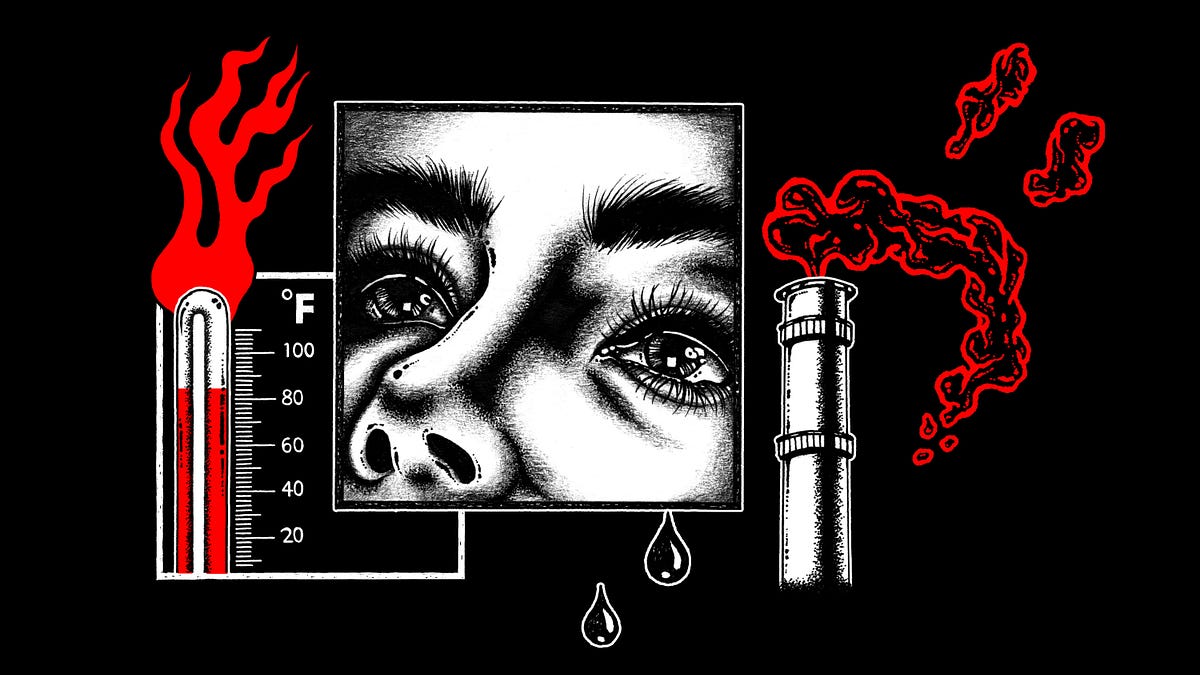


The fantasy version of apocalypse always begins with the longawaited event a missile launch, escaped virus, zombie outbreak and moves swiftly through collapse into a new, steady state. Something happens, and the morning after you’re pushing a squeaking shopping cart down a highway littered with abandoned Teslas, sawed-off shotgun at the ready. The event is key: it’s a baptism, a fiery sword separating past and present, the origin story of Future You.

In September 2018, the secretary general of the United Nations, António Guterres, gave a speech warning: “If we do not change course by 2020, we risk missing the point where we can avoid runaway climate change.” The months following saw the US government crippled by a fight over whether to build a wall on the southern border to keep out climate change refugees, news that greenhouse-gas emissions have not decreased but in fact have accelerated upward, and a populist revolt in France sparked by opposition to a gas tax.


Read the story from MIT Technology Review by Roy Scranton - “Lessons From a Genocide Can Prepare Humanity for Climate Apocalypse.”

10 April, 2018

After a downpour, where does all the water go?

Slowly and steadily a great flood is trickling its way across the outback.
Floodwater from a number of river systems
 drain into Lake Eyre in Central Australia.
Birdsville is being surrounded and the Channel Country is finally living up to its name.

In March great torrents of water crashed down on the tropical coasts and the Hunter Valley also had a drenching.

Why are these systems so different and why do some floods happen fast and others slow?

To work it out, you need to understand how the waters flow across this wide brown land.


Read the ABC News story by Kate Doyle - “After a downpour, where does all the water go?

A new wave of rock removal could spell disaster for farmland wildlife

My (DM’s) perception of threatened species habitats changed the first time I encountered a population of endangered lizards living under small surface rocks in a heavily cleared grazing paddock. That was 20 years ago, at a time when land managers were well aware of the biodiversity values of conservation reserves and remnant patches of native vegetation. But back then we knew very little about the biodiversity values of the agricultural parts of the landscape.

Rocks being removed to make way for farming.
Much has changed. Research has clearly shown the important ecological roles of different elements of the landscape for maintaining biodiversity on farms, especially for vertebrates such as carnivorous marsupials, frogs, snakes and lizards. Rocky outcrops and areas of surface rock, often termed bush rock, are among them.

Areas of bush rock are biological hotspots. They represent island refuges for specialised plants and animals, and help ecosystems to thrive even in heavily cleared landscapes. In Australia, more than 200 vertebrate species depend on rocky outcrops to survive, and many of these species are found only in agricultural areas.


Read the piece from The Conversation - “A new wave of rock removal could spell disaster for farmland wildlife.”

23 March, 2018

Off-Grid Living Festival both unique and vibrant

The Off-Grid Living Festival is a unique and vibrant one day festival displaying the best of off-grid living and sustainable lifestyles. 

With traditional crafts demonstrations, talks and workshops, latest sustainable technologies, alternative living ideas, delicious off-grid food stalls, entertainment and hands on play space for the kids.

For just one glorious day Centennial Park in Eldorado (North-East Victoria) will be transformed into a melting pot of intriguing delights to see, touch, taste, share and enjoy.


Learn more about the festival.

24 November, 2017

The reality of climate change

This talk was given at a local TEDx event, produced independently of the TED Conferences. David Puttnam looks at Climate Change through different lenses, all of which reveal the unsustainable ways in which we are living. Climate Change is real, but throughout history humans have failed to set political and economic concerns aside for our greater good. Will we ignore this latest warning? 
Lord David Puttnam.
Lord David Puttnam produced award-winning films including Chariots of Fire, Bugsy Malone, and The Mission. 

He now works at the intersection between education, media, and policy. In 2007 he was appointed Chairman of the Joint Parliamentary Committee on the Draft Climate Change Bill.


Watch the TEDx Dublin talk by David Puttnam - “The reality of climate change”.

15 November, 2017

On climate change, there aren’t ‘two sides.’ So why do some feel otherwise?

“Do you believe in climate change?”

Canada’s Foreign Minister Chrystia Freeland (R)
 reaches out to shake hands with new U.S.
Ambassador to Canada Kelly Craft during a meeting
at the Lester B. Pearson Building in Ottawa,
Ontario, Canada October 23, 2017.
Kelly Knight Craft, the newly minted U.S. ambassador to Canada, did not take long after arriving in Ottawa to make waves. The same day she presented her credentials to Canada’s Governor General Julie Payette, she sat down for an interview with a CBC journalist where she was asked this question.

“I think that both sides have their own results, from their studies, and I appreciate and I respect both sides of the science,” she replied. Her alarming answer paid lip service to the toxic myth that there is a legitimate debate over the reality of climate change, and that both sides deserve equal consideration—as if there were “two sides” to gravity, and whether we fall or float when we step off the cliff somehow depends on our perspective, our opinion, and our politics rather than on the facts.

I’m a Canadian climate scientist living in Texas, the heart of oil country. I spend a lot of time talking to people who share Craft’s perspective, and am often asked if I believe in climate change, too. My answer to them is no. I crunch the data myself, I run the models, and the evidence is clear. I don’t believe in climate change—I know it’s real.


Read Katharine Hayhoe’s story on Maclean’s - “On climate change, there aren’t ‘two sides.’ So why do some feel otherwise?

07 October, 2017

Can We Save The Reef?

Professor Emma Johnson.
Off Australia's northeast coast lies a wonder of the world; a living structure so big it can be seen from space. 

Professor Emma Johnston meets the intrepid scientists racing to understand & save the Great Barrier Reef.


Watch the ABC’s Catalyst - “Can We Save The Reef?

03 September, 2017

Tropical Storm Harvey: Fire ants join together to make living raft in floodwaters — and it could happen here

If you needed another reason not to enter floodwaters, this is a good one.

Fire ants survive flooding by combining and
linking together to become a floating life raft.
Fire ants inundated by Tropical Storm Harvey's floodwaters in Texas have latched together to form a living, floating life raft to survive.

And, according to one expert, it could happen in Australia too.

How do they float?

All insects have a water-repellent waxy layer over the surface of their exoskeleton, as well as water-repellent hairs on the surface of their body, said Jonathan Majer, adjunct professor at Curtin University and the University of Western Australia.

Professor Majer, who has studied ants for almost 50 years, said these hairs "trap" air on the surface of the insect, allowing them to float.