Showing posts with label Rio de Janeiro. Show all posts

29 January, 2020

Brazil downpours displace tens of thousands

Rio de Janeiro: More than 30,000 people have been displaced by heavy rains in south-east Brazil that also killed 54 people and left 18 missing.
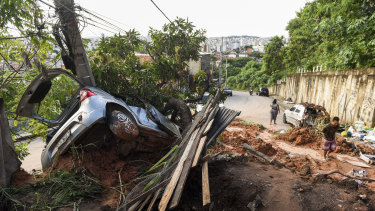
A vehicle lies half-buried in the mud after a landslide caused by heavy rains in Belo Horizonte, Brazil.
A vehicle lies half-buried in the mud after a landslide
 caused by heavy rains in Belo Horizonte, Brazil. 
The storms in recent days caused floods and landslides, submerging entire neighbourhoods and sending homes tumbling down hillsides in the states of Minas Gerais, Espirito Santo and Rio de Janeiro. Rains subsided by Monday, but were expected to resume later this week in some areas.
Flooded roads created violent rapids, sweeping up victims, cars and other debris.
Those evacuated were being housed in makeshift shelters in churches, schools and fire stations. Local authorities have asked for donations of clothes, sheets and mattresses for the victims.
Read the story from The Age by Anna Jean Kaiser - “Brazil downpours displace tens of thousands.”


(The climate crisis produces distinctly different weather, from droughts and downpours such as this one - Robert McLean)

29 May, 2019

More than 200,000 hectares of Amazon forest have been destroyed in just nine months

Rio de Janeiro: A non-government group that monitors the Amazon rainforest says the pace of deforestation is increasing.
A deforested area near Novo Progresso in Brazil's northern state of Para.
Imazon said that satellite imagery show the region lost 2169 square kilometres (216,900 hectares) of forest in the most recent August-through-April period.

That's a 20 per cent jump from the 1807 square kilometres lost over the same nine-month period the previous year.

Analysts blame uncontrolled logging and land invasion for much of the loss, some of which occurred in protected areas and Indigenous reserves.


28 April, 2017

French and Australian experts on solving the world’s sustainability challenge

Since the Earth Summit in Rio de Janeiro in 1992, sustainable development has gradually become a key issue for public policy in many countries. Despite many global efforts - for example - to reduce carbon dioxide emissions into the atmosphere, most small initiatives are being taken at the local level.
Take the example of sustainable mobility in cities. The majority of urban agglomerations have been designed or redeveloped for cars. In order to limit the use of cars, various devices have been put in place, such as the introduction of urban road tolls (for example in Singapore, London and Stockholm), the removal of parking lots in inner city centres, or more recently the installation of eco stickers (road tax) for polluting vehicles in Paris.

In parallel, many French cities have seen a reduction in car use in favour of more sustainable forms of transport. As well as public transport such as trains, buses or trams, bikes and walking are alternative solutions to cars. However, depending on the urban environment, bicycling or walking is not always possible, or is dangerous.