Showing posts with label investments. Show all posts

19 May, 2018

5 Ways to Reduce the Drivers of Climate Change.

Climate change is fundamentally a development issue. It threatens to exacerbate poverty and hurt economic growth. At the same time, how countries grow and the investments they make to meet the energy, food and water needs of an expanding population can fuel climate change, raising risks worldwide, or contribute to solutions.
Bus rapid transit has reduced traffic and
increased connectivity in Guangzhou, China.
In a lecture to students at Georgetown University in Washington, D.C., on March 18, World Bank Group President Jim Yong Kim laid out five key areas where policies and growth choices can help reduce the drivers of climate change.

“We have to keep the economy growing – there is no turning back on growth,” President Kim told the student audience. “What we have to do is decouple growth from carbon emissions.”

Read the report from The World Bank - “5 Ways to Reduce the Drivers of Climate Change.”

27 December, 2017

$180bn investment in plastic factories feeds global packaging binge

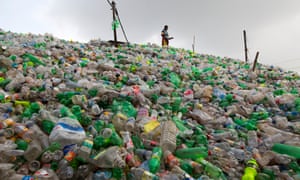
The global plastic binge which is already causing widespread damage to oceans, habitats and food chains, is set to increase dramatically over the next 10 years after multibillion-dollar investments in a new generation of plastics plants in the US.
One million plastic bottles are bought around the world every minute, with most ending up in landfill or in the sea.
One million plastic bottles are bought around the world every
 minute, with most ending up in landfill or in the sea. Photograph:
Fossil fuel companies are among those who have ploughed more than $180bn since 2010 into new “cracking” facilities that will produce the raw material for everyday plastics from packaging to bottles, trays and cartons.
The new facilities – being built by corporations like Exxon Mobile Chemical and Shell Chemical – will help fuel a 40% rise in plastic production in the next decade, according to experts, exacerbating the plastic pollution crisis that scientist warn already risks “near permanent pollution of the earth.”


Read Matthew Taylor’s story on The Guardian - “$180bn investment in plastic factories feeds global packaging binge.”

10 November, 2017

Deutsche Bank maps climate change risks for investments

Deutsche Bank has developed a tool to forecast where its investments across the globe may be impacted by natural disasters brought on by climate change.
"Factors such as sea level rise, droughts, flooding and
cyclones pose an immediate and measurable threat to
 investment portfolios," Deutsche Bank Asset Management said.
Although tools have existed in the insurance industry to model the impact of climate change, this is the first time this sort of data has been systematically applied to investments.

Deutsche Asset Management created the map with climate change intelligence firm Four Twenty Seven, covering more than one million individual locations in order to see how changes to climate will threaten its investment portfolios. The group currently has about €711 billion ($1.06 trillion) under management.

Economic modelling estimates that if carbon emissions aren't reduced throughout this century, per capita GDP will decrease by 23 percent from what it otherwise would be.


Read Cole Latimer’s story in today’s Melbourne Age - “Deutsche Bank maps climate change risks for investments.”

19 July, 2017

Almost exponential': Green bank eyes rapid renewables growth as doubts linger.

Investments by the government's $10 billion clean energy fund are growing at an "almost exponential" rate but growth could shudder to a halt if the industry's post-2020 policy is not settled, according to the agency's new head, Ian Learmonth.

Renewable energy is having a bumper year - despite the political uncertainties.
Renewable energy is having a bumper year
 - despite the political uncertainties.
Mr Learmonth, who took on the role of chief executive of the Clean Energy Finance Corp, said the fund had about 50 transactions in the pipeline worth about $4 billion of its own funds. Based on previous years' results, partners joining the CEFC would lift the total investment value to $10 billion.

Read Peter Hannam’s story in today’s Melbourne Age - “‘Almost exponential': Green bank eyes rapid renewables growth as doubts linger.”

21 May, 2017

Experts reject Bjørn Lomborg's view on 2C warming target

Experts have challenged a claim by Bjørn Lomborg’s Copenhagen Consensus Centre that holding global temperature rises to 2C is a poor investment.

Academics say Bjørn Lomborg’s Copenhagen Consensus
Centre’s assessment on global warming is superseded by
renewable energy advances and Paris climate agreement.
In 2015 the education department abandoned plans for Lomborg to set up an Australian Consensus Centre, but gave the Copenhagen centre $640,000 to support its Smarter UN Post-2015 Development Goals project.

The project assessed dozens of development goals and found investment in keeping global temperature rises below 2C would return less than $1 for every $1 spent, which it rated “poor” compared with other possible investments.

The claim was based on a 2014 assessment paper by Isabel Galiana. The finding on the 2C limit was one of the project’s most controversial, and has been cited in the political debate about whether such targets are worthwhile, as concerns are raised that president Donald Trump will lead the United States out of the Paris agreement.


Read Paul Karp’s story on The Guardian - “Experts reject Bjørn Lomborg's view on 2C warming target.”

23 June, 2015

Global momentum on climate change will leave many Australian assetts stranded


B

illions of dollars of investments in Australia's fossil fuel industries are at risk of becoming white elephants as global momentum builds to address climate change.

As Fairfax Media today begins a series examining climate change policies and politics, experts have spoken out about the growing financial risk posed by investments in fossil fuels.

They say it is now likely the nation will be lumbered with costly unviable assets, especially in coal, as major economies take action to limit global warming to 2 degrees Celsius – an undertaking endorsed this month by G7 nations.

It is claimed that the cost of over-investment during the recent mining boom may already outweigh what would have been the cost of Australia's share in climate action to 2050.

04 June, 2015

Global warming so big the world's govenments need to step in


G

lobal warming has dimensions and complications that exceed the abilities and capacities of the individual.

Subsequently, resolving the dilemma, or at least activating methods of mitigation, falls squarely in the lap of the world’s governments.

And writing in the New York Times, Eduardo Porter discusses the need for the use of a “big stick”.

Discussing failures as achieving any useful mitigation agreements, he said, “Such failure indicates that getting countries to make the costly but necessary investments to reduce their greenhouse gas emissions will require more than diplomacy. It will require a big stick.”

Read Eduardo Porter’s story - “Climate Deal Badly Needs a Big Stick”.