Showing posts with label New York Times. Show all posts

10 December, 2019

The world has reacted to Australia being swallowed by flames

Media outlets around the world continue to react to the dozens of blazes burning across the country with the New York Times taking aim at Australian Prime Minister Scott Morrison.
Smoke haze seen during a sunrise over inner west suburb of Erskineville in Sydney, NSW on December 6, 2019. Picture: Victoria Nielsen/news.com.au
Smoke haze seen during a sunrise over inner west suburb
 of Erskineville in Sydney, NSW on December 6, 2019.
With 96 bush and grass fires still burning in NSW - 47 of which are not contained - photos of Sydney’s sepia-toned sky and blood red sun continue to dominate social media feeds.
Global publications and angered readers have shown no mercy, blaming the Australian government and their failure to address the current climate crisis while calling the nation “the indirect architect of its own demise”.

Read the story from The Courier Mail - “The world has reacted to Australia being swallowed by flames.”

29 May, 2019

Trump’s New Climate Plan Involves a Guy Who Compared Pollution to ‘Jews Under Hitler’

Withdrawing the United States from the Paris Agreement was only the beginning. According to a new report from the New York Times, the Trump administration is poised to enter a dangerous, politically motivated new front of its war on climate science. “It reminds me of the Soviet Union,” Philip Duffey, an expert who served on the National Academy of Sciences, told the paper.
Vehicles move along the the New Jersey Turnpike in 2017
while a factory emits smoke. The United States is still c
ontributing to the global greenhouse gas emissions as
the Trump administration has dismantled the U.S.
foreign policy to reduce carbon pollution.
In the coming months, the White House is expected to officially vanquish what’s left of Obama-era regulations to curb emissions from tailpipes and power plants. Though the scientific community agrees that to pumping carbon dioxide into the environment will be catastrophic for future generations, the administration isn’t very concerned with the state of the planet beyond the president’s potential lifespan. According to the Times, U.S. Geological Survey Director James Reilly — a former petroleum geologist appointed by Trump — has ordered his office to only study the effects of climate change up to 2040. Doing so would paint a relatively rosy picture of the effects of climate change, as the rate of warming isn’t expected to increase precipitously until the middle of the century.


20 February, 2019

Climate Change: The Antidote To Democracy’s Mid-life Crisis

Last month, the New York Times published a mammoth article on the early history of US climate politics. ‘In the decade that ran from 1979 to 1989,’ argues the piece’s author, Nathaniel Rich, ‘we had an excellent opportunity to solve the climate crisis… During those years, the conditions for success could not have been more favorable.’
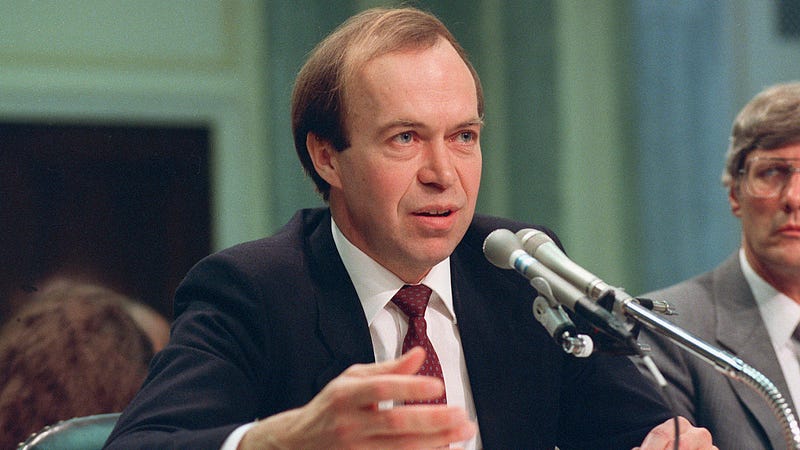
Climate scientist James Hansen giving
evidence at a US Senate hearing in 1988.


This sentence prompted Naomi Klein to pen a fierce rejoinder. ‘On the contrary,’ Klein writes, ‘one could scarcely imagine a more inopportune moment in human evolution for our species to come face to face with the hard truth that the conveniences of modern consumer capitalism were steadily eroding the habitability of the planet. Why? Because the late ’80s was the absolute zenith of the neoliberal crusade, a moment of peak ideological ascendency for the economic and social project that deliberately set out to vilify collective action in the name of liberating “free markets” in every aspect of life.’

Where Rich sees a missed window of opportunity a brief historical interlude in which the basic science was settled and the fossil fuel lobby hadn’t yet begun to deliberately muddy the waters by funding climate denialists Klein sees ‘an epic case of historical bad timing.’


Read the story from Volans by Richard Roberts - “Climate Change: The Antidote To Democracy’s Mid-life Crisis.”

15 September, 2018

Why Growth Can’t Be Green

Warnings about ecological breakdown have become ubiquitous. Over the past few years, major newspapers, including the Guardian and the New York Times, have carried alarming stories on soil depletion, deforestation, and the collapse of fish stocks and insect populations. These crises are being driven by global economic growth, and its accompanying consumption, which is destroying the Earth’s biosphere and blowing past key planetary boundaries that scientists say must be respected to avoid triggering collapse.
Joan Wong illustration for Foreign Policy
Many policymakers have responded by pushing for what has come to be called “green growth.” All we need to do, they argue, is invest in more efficient technology and introduce the right incentives, and we’ll be able to keep growing while simultaneously reducing our impact on the natural world, which is already at an unsustainable level. In technical terms, the goal is to achieve “absolute decoupling” of GDP from the total use of natural resources, according to the U.N. definition.


Read the Foreign Policy story by Jason Hickel - “Why Growth Can’t Be Green.

15 October, 2017

How to stop climate change and reverse global warming

Two books published this year on the same day (April 18) and on the same subject, climate change. 


Two books that could change our lives, our children’s lives and how we view the challenge of climate change.

Two books that make reversing global warming look like it’s within reach. At last.

So far, we’ve heard too much doom and gloom. And we still do, as attested by a recent Op-Ed from environmental activist Bill McKibben, the founder of 350.org.  Published on the New York Times last month, it has a scary title: The Planet Can’t Stand This Presidency, with a subtitle that doubles down on the message: “Trump is in charge at a critical moment for keeping climate change in check. We may never recover.” And the opening sentence is a scary reminder that coal pollution kills.

But it’s time to try a different approach. Let’s be positive: Global warming can be arrested, and better still, we may be able to reverse it. It will require a lot of effort and goodwill, but it can be done. And it won’t be costly, on the contrary, it will jump start a new age of prosperity and well being.


Read the Impakter story by  Claude Forthhomme - “How to stop climate change and reverse global warming.”

26 April, 2017

New York Times Defends Hiring of Climate Science Denier Bret Stephens, Claiming 'Intellectual Honesty’

The New York Times has been defending the paper’s hiring of a climate science denier, fighting off its critics with what it claims is a standard fashioned from hardened “intellectual honesty.”
The New York Times defends its intellectual
honesty by serving up "word soup".
The controversial hire in question is that of Bret Stephens, formerly of the Wall Street Journal, who has joined the NYT as a columnist and deputy editorial page editor.

While at the WSJ, Stephens consistently undermined and disparaged climate change, one time describing it as an “imaginary enemy” and another comparing it to religion with a “doomsaying prophecy and faith in things unseen.”

Stephens' new boss, editorial page editor James Bennett, told the paper’s public editor Liz Spayd: “The crux of the question is whether his work belongs inside our boundaries for intelligent debate, and I have no doubt that it does. I have no doubt he crosses our bar for intellectual honesty and fairness.”

Suffice to say, there are plenty who disagree. One climate scientist has already canceled his subscription in protest, with others watching closely. 
  
No doubt that Stephens can write — he won a Pulitzer in 2012 for lots of opinions on stuff other than climate.
But like other conservative columnists admired for their poetic prose and strident opinions while attacking climate change, the methods used by Stephens might be compared to those of a fake chef producing a lumpy and unsatisfying word soup.


09 December, 2016

Trump Picks Scott Pruitt, Climate Change Denialist, to Lead E.P.A

Dr Luke Kemp talks today at the University
of Melbourne about Donald Trump.
The idea of “U.S.-proofing the Paris climate agreement” was discussed today at the University of Melbourne.

A lecturer in climate and environmental policy at both the Fenner School of Environment and Society and Crawford School of Public Policy, Dr Luke Kemp, articulated the idea.

He was the special guest at a session staged by the university’s Australian-German Climate and Energy College and about 50 people listened as he explored the implications of Donald Trump being named as the U.S president-elect.

Donald Trump is an outspoken climate change denier who has threatened that upon taking office he will see that America withdraws from the Paris agreement.

Dr. Kemp sees himself as a Donald Trump pessimist and although unwilling to make predictions about what the president-elect might do, he did suggest that  it was not only possible that America could withdraw from the Paris agreement, there is also the potential of it stepping away from the Intergovernmental Panel on Climate Change.

He explained that under the rules of the Paris agreement, withdrawal could take up to four years, all of Mr. Trump’s first term in office.

Ideally, Dr. Kemp preferred to see the U.S. withdraw completely from the agreement as it would not longer be able to disrupt negotiations from the inside, but once outside the formal structure could find itself facing complex trade restrictions from trade groups still working within the agreement.

26 November, 2016

A Portrait of a Man Who Knows Nothing About Climate Change

Pointing to one historic hot day
becomes irrelevant when the record
shows steadily increasing temperatures.
In his interview with the New York Times, Donald Trump expressed more flexibility on climate change, which he has previously called a hoax created by China.

That is the good news. The bad news is that Trump’s lack of commitment to the cause of climate-science denial is rooted in a comprehensive failure to grasp the issue. The few snippets of concrete factual information he has to ground his beliefs are mostly false. His New York Times interview forced the president-elect to grapple with the issue in more depth than he did at any time during the campaign (the three debates had no questions on this issue, and climate-change policy in general received vanishingly little attention from the media). The portrait that comes out of the interview is one of almost complete ignorance.

Trump began by promising “an open mind.” Then he began to defend his denialist position:

You know the hottest day ever was in 1890-something, 98. You know, you can make lots of cases for different views. I have a totally open mind.

The hottest single day on record is not relevant to a problem centered on increased average temperatures.

Read the Daily Intelligency story - “A Portrait of a Man Who Knows Nothing About Climate Change.”

04 September, 2016

Biomass lobbyists create website to 'correct the record'

Lobbyists for the biomass industry have created a new website, Biomass101.org, with the seemingly laudable goal of “Correcting the record and getting the facts out on carbon-neutral biomass energy.”

Mary Booth of the Partnership for Policy Integrity (PFPI) says there’s one major problem with that, however: burning biomass — wood or wood pellets and other plant matter — for energy is anything but carbon neutral.

So Booth and PFPI have launched their own website, Biomess101.org, to get the real facts out about the “facts” the biomass lobbyists are pushing.

At first, Booth told DeSmog, she and her colleagues were content to ignore Biomass101.org, which frequently publishes blog posts that purport to expose flaws in reporting by media outlets such as the New York Times, the Washington Post, and NPR. “They’d call people out, and call us out, and we didn’t respond, or draw attention to it,” she said.

Read the DeSmog Blog story - “Fact-Checking The Biomass Lobby’s New Website.”

26 July, 2016

'Astonishing' NY Times article prompts response from Stanford University Professor

Mark Jacobson.
The New York Times published an astonishing article last week that blames green power for difficulties countries are facing to mitigate climate change.

The article by Eduardo Porter, How Renewable Energy is Blowing Climate Change Efforts Off Course, serves as a flagship for an on-going attack on the growth of renewables. It is so convoluted and inaccurate that it requires a detailed response.

As Mark Jacobson, director of Atmosphere/Energy Program at Stanford University, pointed out to me via email:

The New York Times article "suffers from the inaccurate assumption that existing expensive nuclear that is shut down will be replaced by natural gas. This is impossible in California, for example, since gas is currently 60 percent of electricity supply but state law requires non-large-hydro clean renewables to be 50 percent by 2030. This means that, with the shuttering of Diablo Canyon nuclear facility be 2025, gas can by no greater than 35-44 percent of California supply since clean renewables will be at least 50 percent (and probably much more) and large hydro will be 6-15 percent. As such, gas must go down no matter what. In fact, 100 percent of all new electric power in Europe in 2015 was clean, renewable energy with no new net gas, and 70 percent of all new energy in the U.S. was clean and renewable, so the fact is nuclear is not being replaced by gas but by clean, renewable energy.


(A corporate-owned newspaper pushing an idea that only corporations can benefit from, steering the solution away from community-owned renewable energy systems – Robert McLean.)

'Astonishing' NY Times article prompts response from Stanord University Professor

Mark Jacobson.
The New York Times published an astonishing article last week that blames green power for difficulties countries are facing to mitigate climate change.

The article by Eduardo Porter, How Renewable Energy is Blowing Climate Change Efforts Off Course, serves as a flagship for an on-going attack on the growth of renewables. It is so convoluted and inaccurate that it requires a detailed response.

As Mark Jacobson, director of Atmosphere/Energy Program at Stanford University, pointed out to me via email:

The New York Times article "suffers from the inaccurate assumption that existing expensive nuclear that is shut down will be replaced by natural gas. This is impossible in California, for example, since gas is currently 60 percent of electricity supply but state law requires non-large-hydro clean renewables to be 50 percent by 2030. This means that, with the shuttering of Diablo Canyon nuclear facility be 2025, gas can by no greater than 35-44 percent of California supply since clean renewables will be at least 50 percent (and probably much more) and large hydro will be 6-15 percent. As such, gas must go down no matter what. In fact, 100 percent of all new electric power in Europe in 2015 was clean, renewable energy with no new net gas, and 70 percent of all new energy in the U.S. was clean and renewable, so the fact is nuclear is not being replaced by gas but by clean, renewable energy.


(A corporate-owned newspaper pushing an idea that only corporations can benefit from, steering the solution away from community-owned renewable energy systems – Robert McLean.)

09 June, 2016

Donald Trump a climate change advocate - what!

Donald Trump once advocated for action
for action against climate change.
As negotiators headed to Copenhagen in December 2009 to forge a global climate pact, concerned U.S. business leaders and liberal luminaries took out a full-page ad in the New York Times calling for aggressive climate action.

In an open letter to President Obama and the U.S. Congress, they declared: “If we fail to act now, it is scientifically irrefutable that there will be catastrophic and irreversible consequences for humanity and our planet.”

One of the signatories of that letter: Donald Trump.

Also signed by Trump’s three adult children, the letter called for passage of U.S. climate legislation, investment in the clean energy economy, and leadership to inspire the rest of the world to join the fight against climate change

23 March, 2016

Catastrophic changes justy decades away - James Hansen

The great aspiration of the Paris climate accord is to keep global warming from exceeding two degrees Celsius above preindustrial levels. But according to a new paper, even two degrees of warming would mean the disintegration of large sections of the polar ice sheets, boulder-spewing storms stronger than any since prehistory, and the drowning of most coastal cities by the end of the century.

“We’re in danger of handing young people a situation that’s out of their control,” the paper’s author, retired NASA climate scientist James Hansen, told the New York Times on Tuesday.

Using computer models, evidence from ancient episodes of climate change, and modern observations, Hansen and his team arrived at one essential conclusion: The melting of the Greenland and Antarctica ice sheets will set off a vicious cycle that dramatically accelerates the pace of climate change. The key concept here is ocean “stratification,” a process by which cold, fresh meltwater rises to the ocean surface while warmer salt water is pushed beneath. (The Washington Post notes that an “anomalously cold ‘blob’ of ocean water” has been detected off the southern coast of Greenland.) That warmer salt water would eventually reach the base of the ice sheets, melting them from below, thus spurring more stratification, which would then spur more melting, which would then spur more stratification, which would spur more warming, until our grandchildren are all swallowed by the sea.

Read the New York Times Magazine story - ”New Paper Suggests Catastrophic Climate Shifts May Be Decades Away.”

12 March, 2016

Climate change is THE defining issue for public health

Climate change is the defining issue for public health in the 21st century, according to the Director-General of the World Health Organization, Dr Margaret Chan.

In a keynote address at the Human Rights Council panel discussion on climate change and the right to health in Geneva last week, Chan said WHO would host a second global conference on health and climate this year, hopefully in July.

She also said the WHO and the UN Framework Convention on Climate Change would jointly roll out climate and health profiles for individual countries (this will be one to watch, given that we are attracting headlines in the New York Times like, “Australia turns its back on climate science”).

09 March, 2016

Outsourcing solutions to 'greatest challenge facing the planet'

CSIRO is considering outsourcing climate modelling work to Britain - a step a senior executive conceded would reduce Australia's strengths in the field.

Grilled by Labor and Greens senators at a Senate inquiry in Hobart over cuts to up to half its climate research workforce, CSIRO executive Alex Wonhas said the organisation was considering contracting some work to counterparts in the British Met Office.

It is understood CSIRO executives hope signing a contract with leaders in international climate change research at the Met Office will blunt international criticism of its climate research cuts.

That criticism included a New York Times editorial on Friday, which described the cuts as based on "a deplorable misunderstanding of the importance of basic research into what is arguably the greatest challenge facing the planet".

Read the story by Peter Hannam and Adam Morton in today’s Melbourne Age - “CSIRO looks to Britain to outsource climate research.”

03 November, 2015

Paris promises much, but it won't be enough - Michael McCathy


I
t is now 27 years since the danger of climate change burst upon the global consciousness: in June 1988, in the middle of a drought so fierce that the Mississippi seemed to be drying up, Dr James Hansen of Nasa told a US senate committee that global warming had begun, and his words covered most of the front page of the next day’s New York Times.

Since then we have seen the issue become one of the world’s principal preoccupations, with increasingly refined science suggesting that if we continue to emit the carbon dioxide produced by our factories and motor vehicles, the Earth will undergo an atmospheric temperature rise this century that will destabilise the planet and human society with it.

Read the piece in The Independent by Michael McCarthy - “The Paris Climate Conference will bring change - but I doubt it will be enough.”

30 June, 2015

Heat and humidity are deadliest weather-related disasters


T

HE most deadly weather-related disasters aren’t necessarily caused by floods, droughts or hurricanes. They can be caused by heat waves, like the sweltering blanket that’s taken over 2,500 lives in India in recent weeks.

Temperatures broke 118 degrees in parts of the country. The death toll is still being tallied, and many heat-related deaths will be recognized only after the fact. Yet it’s already the deadliest heat wave to hit India since at least 1998 and, by some accounts, the fourth- or fifth-deadliest worldwide since 1900.

These heat waves will only become more common as the planet continues to warm.

Read the New York Times story - “The Deadly Combination of Heat and Humidity”.

04 June, 2015

Global warming so big the world's govenments need to step in


G

lobal warming has dimensions and complications that exceed the abilities and capacities of the individual.

Subsequently, resolving the dilemma, or at least activating methods of mitigation, falls squarely in the lap of the world’s governments.

And writing in the New York Times, Eduardo Porter discusses the need for the use of a “big stick”.

Discussing failures as achieving any useful mitigation agreements, he said, “Such failure indicates that getting countries to make the costly but necessary investments to reduce their greenhouse gas emissions will require more than diplomacy. It will require a big stick.”

Read Eduardo Porter’s story - “Climate Deal Badly Needs a Big Stick”.

17 May, 2015

We are becoming 'fact- resistant' - New York Times


H

umans have long used facts to stay alive, but strangely we are becoming increasingly resistant to this life sustaining force.

The New York Times tells us that we are becoming “fact-resistant”, ignoring those things we do that actually threaten our survival.

In the story -“Scientists: Earth Endangered by New Strain of Fact-Resistant Humans” – Andy Borowitz tells us that “Research, conducted by the University of Minnesota, identifies a virulent strain of humans who are virtually immune to any form of verifiable knowledge, leaving scientists at a loss as to how to combat them.”

13 May, 2015

Is it about acting personally, or acting to change the laws?


S

ome argue that rather than act to reduce personal carbon dioxide emissions, we should be acting to change the laws bringing even greater reductions.

It is one of those “chicken and egg” or “cart before the horse” type discussions, but one that we critically need to think our way through if we are to at least equal to this unfolding climate challenge.

The New York Times discusses an aspect of that conversation in it story - “A Climate-Modeling Strategy That Won’t Hurt the Climate”.

The Times considers the equations around the creation of a super-computer that will allow us to accurately understand the evolving conditions of climate change.

It ponders that question as to whether or not it is worth spending some $20 billion a year to ultimately save the world community trillions of dollars.