Showing posts with label published. Show all posts

05 April, 2020

Don’t be fooled by Morrison’s benevolence – soon it’s back to tax cuts and smaller government

Australian Prime Minister Scott Morrison speaks to the media during a press conference at Parliament House in Canberra, April 3, 2020.
Doubling Newstart? Free childcare? A wage
 subsidy that is very close to a universal
 basic income? All previously dismissed as
unaffordable or even “communist” are
now government policy.’

This week the latest job vacancy figures were released, and as with so much economic data they were laughably out of date the moment they were published.
In the February quarter the number of job vacancies barely fell, but the number of unemployed in that time fell by a bit more. It meant the average number of unemployed per job vacancy across Australia dropped from 3.1 to 3 persons.
It’s ludicrous, of course.
Now the numbers are nowhere near that.
Just how bad they are is tough to estimate. Callam Pickering, economist at global job site Indeed, estimates that currently job adverts are running about 33% below what they were last year.

It would actually be surprising if they don’t drop by more – during the 1990s recession they fell by half.

05 March, 2020

Climate change boosted Australia bushfire risk by at least 30%

Scientists have published the first assessment quantifying the role of climate change in the recent Australian bushfires.
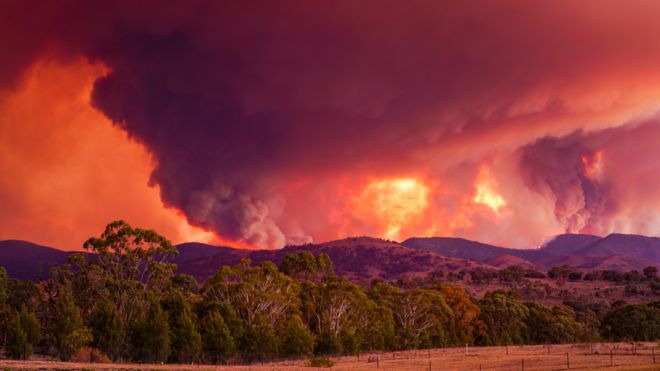
Massive smoke clouds turn the sky red above above a blaze south of Canberra in January 2020
The 2019-2020 fire season was particularly challenging for Australia.
Global warming boosted the risk of the hot, dry weather that's likely to cause bushfires by at least 30%, they say.
But the study suggests the figure is likely to be much greater.
It says that if global temperatures rise by 2C, as seems likely, such conditions would occur at least four times more often.
The analysis has been carried out by the World Weather Attribution consortium.

Read the BBC story by Pallab Ghosh - “Climate change boosted Australia bushfire risk by at least 30%.”

20 February, 2019

Climate Change: The Antidote To Democracy’s Mid-life Crisis

Last month, the New York Times published a mammoth article on the early history of US climate politics. ‘In the decade that ran from 1979 to 1989,’ argues the piece’s author, Nathaniel Rich, ‘we had an excellent opportunity to solve the climate crisis… During those years, the conditions for success could not have been more favorable.’
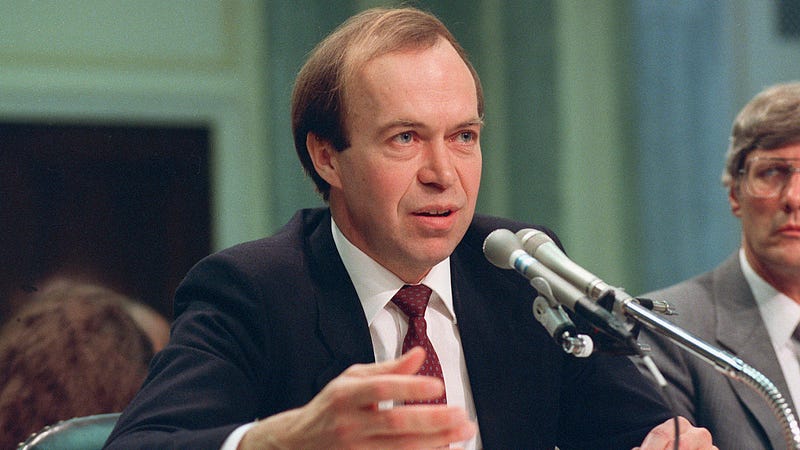
Climate scientist James Hansen giving
evidence at a US Senate hearing in 1988.


This sentence prompted Naomi Klein to pen a fierce rejoinder. ‘On the contrary,’ Klein writes, ‘one could scarcely imagine a more inopportune moment in human evolution for our species to come face to face with the hard truth that the conveniences of modern consumer capitalism were steadily eroding the habitability of the planet. Why? Because the late ’80s was the absolute zenith of the neoliberal crusade, a moment of peak ideological ascendency for the economic and social project that deliberately set out to vilify collective action in the name of liberating “free markets” in every aspect of life.’

Where Rich sees a missed window of opportunity a brief historical interlude in which the basic science was settled and the fossil fuel lobby hadn’t yet begun to deliberately muddy the waters by funding climate denialists Klein sees ‘an epic case of historical bad timing.’


Read the story from Volans by Richard Roberts - “Climate Change: The Antidote To Democracy’s Mid-life Crisis.”

03 August, 2018

Adapt or perish: UK leads the way in protecting citizens against climate change

Despite the distraction and political chaos of Brexit negotiations, the United Kingdom has just published a far-reaching and thoroughly impressive plan to manage risks from climate change.
To the World Health Organisation, climate change
 is the greatest health threat of this century.
This follows on from their broader 25-year Environment Plan, released in January. It aims to "help the natural world regain and retain good health", to enable it to better cope with climate change.

The recently released climate plan is a strategy to save lives from heat, flood and fire — yes, fire, even in the UK!

It should be compulsory reading for the Australian Government, because we have no such plan. Considering the lives that will be lost, this is negligence in medical terms.


Read the opinion piece from ABC News by David Shearman - “Adapt or perish: UK leads the way in protecting citizens against climate change.”

04 March, 2018

Ancient carbon discovered coming from Arctic soil

Scientists have published new evidence that old or even ancient carbon, pulled out of the atmosphere and stored in the bodies of plants hundreds or thousands of years ago, is being set loose again from soils in the Arctic region.
The discovery is a potentially worrying indicator that "permafrost"
soils may already be worsening the problem of climate change.
It's a potentially worrying indicator that these "permafrost" soils may already be worsening the problem of climate change. However, scientists are still debating just how much old carbon Arctic soils should release normally even without climate change, leaving the ultimate significance of the findings unclear.


Read Chris Mooney’s story in The Age - “Ancient carbon discovered coming from Arctic soil.”

09 December, 2017

Cities of hope: Tim Flannery on tackling the challenge of climate change

Our understanding of the way the Earth’s system works has grown significantly over the past decade. Earlier this year, scientists published an equation called the Anthropocene Equation. For the past four billion years, the factors that have affected the Earth’s climate are listed in that equation. They are the astronomical forces, the geophysical forces, and the internal dynamics of the system. But over the past 40 years, we must add another factor into that equation, which is the H factor – the human factor. Because of that factor, the impact of industrialised societies, we are now driving Earth’s climate system at rates 170 times faster than the natural factors have done, historically. So, H is big. We are a big influence, now, on Earth’s climate system.

Tens of thousands of people around Australia have marched
 for credible climate change action, with over 10,000 taking
 to the streets in Melbourne in 2014.
Why are we such a big influence? Because we are shifting so much carbon from the Earth’s crust into the atmosphere. The atmosphere is one of the smaller organs of our planet – it’s about 1/500th the size of the oceans. So, it’s small, and very dynamic, and we are moving lots of carbon into it. As of 2010, we are emitting 49 gigatons of CO2 equivalent every year. Data that has just come out for 2016 shows that, in fact, emissions have grown again, by about three percent. So, we are well in excess of 50 gigatons of CO2 equivalent now.


Read the Fore-ground story by Tim Flannery - “Cities of hope: Tim Flannery on tackling the challenge of climate change.”

01 December, 2017

Revealing the Methods of Climate-Doubting Blogs

Thousands of scientific papers about climate change are published in journals each year. Far fewer discuss how skepticism toward mainstream climate science spreads.


A group of scientists has now plunged into one of the habitats where so-called climate change skeptics have prospered -- the blogosphere. They found that climate science-doubting blogs cite a small cast of alternative “experts” rather than those with views aligning with the scientific consensus, and seek to undermine all of climate science by casting doubt around limited, hot-button issues.

Nearly all climate scientists agree that Earth’s climate is rapidly warming, that humans are causing it and that if nothing is done, climate change could have catastrophic consequences in the coming decades.

A lively countercurrent of thought exists, however, on internet blogs. Many blogs question how much Earth is warming, how much humans are causing it and whether the warming warrants a major societal response. These blogs are read by millions of people each month, and are often cited by conventional media outlets and by policymakers. So persuasive have climate doubters been that between a third and a half of Americans believe the globe is not warming, or that it is but humans are not the primary cause, according to recent surveys.


Read the Inside Science story - “Revealing the Methods of Climate-Doubting Blogs.”

15 October, 2017

How to stop climate change and reverse global warming

Two books published this year on the same day (April 18) and on the same subject, climate change. 


Two books that could change our lives, our children’s lives and how we view the challenge of climate change.

Two books that make reversing global warming look like it’s within reach. At last.

So far, we’ve heard too much doom and gloom. And we still do, as attested by a recent Op-Ed from environmental activist Bill McKibben, the founder of 350.org.  Published on the New York Times last month, it has a scary title: The Planet Can’t Stand This Presidency, with a subtitle that doubles down on the message: “Trump is in charge at a critical moment for keeping climate change in check. We may never recover.” And the opening sentence is a scary reminder that coal pollution kills.

But it’s time to try a different approach. Let’s be positive: Global warming can be arrested, and better still, we may be able to reverse it. It will require a lot of effort and goodwill, but it can be done. And it won’t be costly, on the contrary, it will jump start a new age of prosperity and well being.


Read the Impakter story by  Claude Forthhomme - “How to stop climate change and reverse global warming.”

19 December, 2016

Scientists confirm that warm ocean water is melting the biggest glacier in East Antarctica

The 120km-long Totten Glacier is
showing signs of melting from below.
Scientists at institutions in the US and Australia on Friday published a set of unprecedented ocean observations near the largest glacier of the largest ice sheet in the world: Totten glacier, East Antarctica. And the result was a troubling confirmation of what scientists already feared – Totten is melting from below.

The measurements, sampling ocean temperatures in seas over a kilometre  deep in some places right at the edge of Totten glacier's floating ice shelf, affirmed that warm ocean water is flowing in towards the glacier at the rate of 220,000 cubic metres per second.

These waters, the paper asserts, are causing the ice shelf to lose between 63 and 80 billion tonnes of its mass to the ocean per year, and to lose about 10 metres of thickness annually, a reduction that has been previously noted based on satellite measurements.

Read Chris Mooney’s story in today’s Melbourne Age - “Scientists confirm that warm ocean water is melting the biggest glacier in East Antarctica.”

13 October, 2016

Jorgen Randers: updating ‘2052’

Jorgen Randers elaborating
 on the 2052 forecast.
Today, in Cambridge, a meeting was held with several of the authors of the "Glimpses" that were part of the "2052" book by Jorgen Randers. The idea was to update the forecasts that were published in 2012.

Randers showed the update of his model, obtained with new data and with some modifications of the model itself. In five years, there have been modest changes and the basic results of the initial model are confirmed.

1. Randers' model sees the growth of both the economy (in terms of GDP) and of the population up to 2052; although the forecasted population is less than 9 billion people, much lower than the UN predictions.

2. Randers' model doesn't see scarcity for any resource, at least up to 2052

3. Inequality and poverty will remain as significant problems.

4. The model clearly says that we are NOT staying below the 2 degrees limits. Renewables will be growing fast, but so will do fossil fuels at least for another couple of decades. Randers' climate model (a different one) doesn't produce a "climate tipping point" for the rest of the century, but the raising temperatures will do enormous damage to the world's economy and to people.

Read this piece from Cassandra’s Legacy - “Jorgen Randers: updating ‘2052’.”