Showing posts with label warming. Show all posts

12 September, 2019

The ‘South Atlantic blob’: The vulnerability of the world’s warming oceans

The entire global ocean is warming, but some parts of it are changing much faster than others – like a hot spot off Uruguay that was first identified by scientists in 2012. There, researchers have observed mass die-offs of clams, dangerous ocean heat waves and algal blooms, and changes in Uruguay’s fish catch. 

Image result for the washington post logoThe South Atlantic region is part of a global trend: Around the planet, enormous ocean currents are traveling to new locations. As they relocate, waters are growing warmer. 

“Scientists have basically correlated the clam decline and a lot of other things that have happened at the same time with the really quick warm-up of temperatures that have happened in this region,” says environmental reporter Chris Mooney. 

He and data reporter John Muyskens have been examining how temperatures have changed around the world since the late 1800s. 

Mooney, along with photographer Carolyn Van Houten, met clammers directly affected by climate change in Barra del Chuy, Uruguay. Out on the sand, the harvesters demonstrated how difficult it has become for them to maintain their traditions and livelihoods as the clams die out.

“People essentially live off the fruits of the sea,” Van Houten says. “That’s a very long-standing thing for people to do. But it has received quite a jolt in this region. And it’s not clear that it will ever be the same.”


08 August, 2019

‘Warning flag': IPCC finds rapid land warming threatens food security

Image
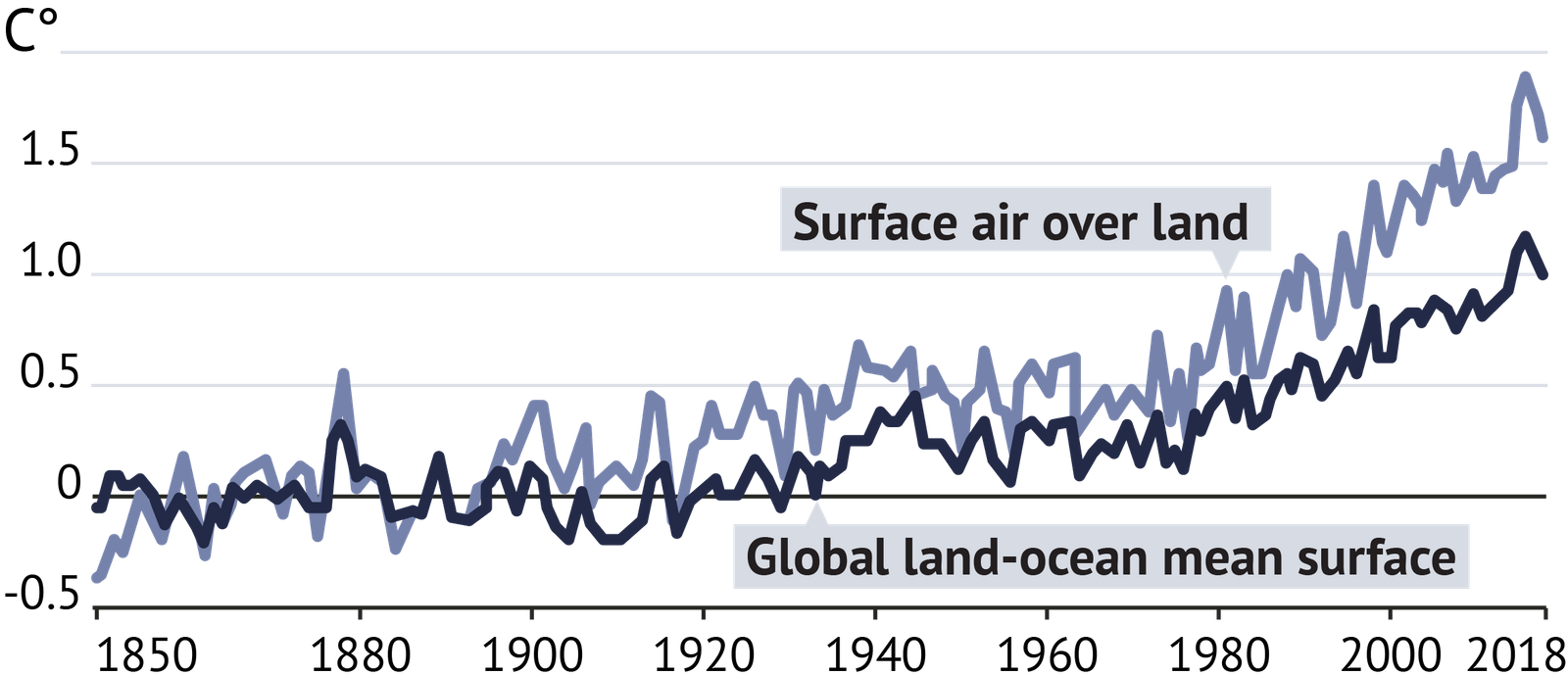
Temperatures over the world's land areas are warming at about twice the global rate, expanding deserts in Australia, Africa and Asia, and hitting food security hard, a new UN report finds.
Image
Temperatures are rising over land much faster than the global average with climate change. Australia is one nation where arid regions are expanding, the IPCC says in a new report.
Temperatures are rising over land much faster than
 the global average with climate change. Australia is
one nation where arid regions are expanding, the
IPCC says in a new report.
The Intergovernmental Panel on Climate Change (IPCC) found that surface air temperatures between 2006 and 2015 were 1.53 degrees warmer than the pre-industrial average of 1850-1900. By contrast, the combined warming of land and oceans was 0.87 degrees, the IPCC's special report on land said.
Compared with current conditions, though, land areas have warmed by about 1.8 degrees, and global mean temperatures by 1.1 degrees, said Stefan Rahmstorf from the Potsdam Institute for Climate Impact Research.
Read the story from The Age by Peter Hannam - “‘Warning flag': IPCC finds rapid land warming threatens food security.”

22 April, 2019

Climate’s Troubling Unknown Unknowns

Donald Rumsfeld famously popularized the term “unknown unknowns” in a 2002 news briefing when describing the challenges of linking Iraq to weapons of mass destruction. Troublingly, climate change may also be strewn with such unknowns, and they pose daunting tests for how we face the future.
Dirty air blanketing the New York skyline at sunset.
One is choosing among policy alternatives. Should we minimize tomorrow’s risks now by reducing greenhouse gas emissions, or save money today and spend it on adapting to the effects of planetary warming once threats emerge more fully, like rising seas or prolonged droughts? The policy debate increasingly tilts toward adaptation.

But we can’t adapt to perils from unknown unknowns. In such cases, adaptation will largely fail; only mitigation will be effective.


Read the opinion piece from The New York Times by William B. Gail - “Climate’s Troubling Unknown Unknowns.”

28 January, 2019

3 Radical Steps to Prevent Capitalism and Climate Change From Killing Us All

We’re on the brink of a man-made apocalypse; here’s what we can do about it.
We’re on the brink of a man-made apocalypse; 
here’s what we can do about it.

While the sky isn’t falling (per se), global temperatures are warming and sea levels are rising — mostly likely by a few degrees and feet, respectively, according to sensible projections. Doesn’t sound like much but the likely consequences are the hallmarks of a dystopian science fiction: food and water shortages, mass-exodus from coastal cities and other vulnerable areas, airborne pandemics, infrastructure stress, and violent storm surges cascading into an acutely challenged existence to say the very least. With about 11 years of runway to stave off climate change’s worst impacts, we’re truly marching toward an existential crisis, and with each passing day of shameful inaction, the outlook grows unspeakably macabre for future generations. So… what are we going to do about it?

Answering that question first requires us to acknowledge our role in this fuckery (myself included; I’m part of the problem). Frankly, it’s our unchecked consumerism and gratuitous wanting that’s landed us in this hot mess. Simply put, there’s a lot of people on this planet, all of whom want more things — things of increasing production complexity, resource requirements and carbon footprints. And so we burn fossil fuels, cut down rainforests, farm more land, and raise livestock — activities with enormous environmental impacts — to satiate consumer choice and meet the demand for bigger, badder, faster things. This is why many climate scientists agree that one of the biggest levers for fighting climate change is educating women; their inclusion in the workforce (other than inherently being the right thing to do) leads to fewer children, fewer people needing and wanting things.


Read the story from Medium by Swannie Morgan - “3 Radical Steps to Prevent Capitalism and Climate Change From Killing Us All.”

21 January, 2019

6 Glimmers of Climate Optimism for the End of a Dark Year

In 2018, we learned from the UN’s Intergovernmental Panel on Climate Change that we have around 30 years to fully decarbonize or risk widespread global devastation from warming and sea-level rise. We also learned that current emissions patterns are nowhere near in line with that goal. Even though the Trump administration tried to bury the U.S.’s own findings on climate, the 1,656-page National Climate Assessment backed up the IPCC report, and called for a doubling down on climate protection policies to prevent damage (which is already underway) to the environment and the country’s infrastructure.
We have about 30 years to fully decarbonize or
risk widespread global devastation from warming
and sea-level rise.
The consensus among scientists, researchers, and sustainability experts following this years’ reports is that while stopping climate change will require an undoubtedly Herculean effort, the biggest hurdle is political, not technical. In other words, if all the innovations in sustainable technology and science were harnessed and directed at reducing emissions and environmental collapse, we might stand a chance at meeting the goals laid out in the reports.

Read the Fast Company story by Ellie Anzilotti - “6 Glimmers of Climate Optimism for the End of a Dark Year.”

12 January, 2019

Oceans warming faster than thought, new research finds

Washington: Scientists say the world's oceans are warming far more quickly than previously thought, a finding with dire implications for climate change because almost all the excess heat absorbed by the planet ends up stored in their waters.
Rising seas: People sit in a flooded St Mark's Square in Venice,
Italy, as high tides inundated the city in March 2018.
CREDIT:
A new analysis, published on Thursday in the journal Science, found that the oceans are heating up 40 per cent faster on average than a UN panel estimated five years ago. The researchers also concluded that ocean temperatures have broken records for several straight years.

"2018 is going to be the warmest year on record for the Earth's oceans," said Zeke Hausfather, an energy systems analyst at independent climate research group Berkeley Earth and an author of the study. "As 2017 was the warmest year, and 2016 was the warmest year.”

As the planet has warmed, the oceans have provided a critical buffer. They have slowed the effects of climate change by absorbing 93 per cent of the heat trapped by the greenhouse gases humans pump into the atmosphere.

Read the story from The Age by Kendra Pierre-Louis - “Oceans warming faster than thought, new research finds.”

28 December, 2018

6 Glimmers of Climate Optimism for the End of a Dark Year

In 2018, we learned from the UN’s Intergovernmental Panel on Climate Change that we have around 30 years to fully decarbonize or risk widespread global devastation from warming and sea-level rise. We also learned that current emissions patterns are nowhere near in line with that goal. Even though the Trump administration tried to bury the U.S.’s own findings on climate, the 1,656-page National Climate Assessment backed up the IPCC report, and called for a doubling down on climate protection policies to prevent damage (which is already underway) to the environment and the country’s infrastructure.
A grim year, but glimmers of hope.
The consensus among scientists, researchers, and sustainability experts following this years’ reports is that while stopping climate change will require an undoubtedly Herculean effort, the biggest hurdle is political, not technical. In other words, if all the innovations in sustainable technology and science were harnessed and directed at reducing emissions and environmental collapse, we might stand a chance at meeting the goals laid out in the reports.
Don’t get us wrong: It will take a heroic, global effort if we’re even going to come close to limiting global warming to 1.5 degrees Celsius–the point after which, according to the reports, large swaths of the planet will become uninhabitable, and issues like mass starvation will become widespread. And the lack of leadership from the United States, under climate change denier Donald Trump, is making cohesive political action difficult.


Read the FastCompany story from Medium by Eillie Anzolotti - “6 Glimmers of Climate Optimism for the End of a Dark Year.”

04 October, 2018

How to understand 1.5°C climate science

Questions of the IPCC 1.5°C report.

What will the much awaited IPCC 1.5 degree report reveal and what analysis is critical for its release? 

With 1.5 degrees of warming potentially only a decade away, and dangerous climate already reached, there is no carbon budget left.


Read the Breakthrough's story and download their short guides - “How to understand 1.5°C climate science.”

15 June, 2018

Leaked UN draft report warns of urgent need to cut global warming

The world is on track to exceed 1.5C of warming unless countries rapidly implement “far-reaching” actions to reduce carbon emissions, according to a draft UN report leaked to Reuters.
 Countries can fight climate change and keep warming below 1.5C
if they take immediate measures, says the leaked UN draft report.
The final draft report from the UN’s intergovernmental panel on climate change (IPCC) was due for publication in October. It is the guiding scientific document for what countries must do to combat climate change.

Human-induced warming would exceed 1.5C by about 2040 if emissions continued at their present rate, the report found, but countries could keep warming below that level if they made “rapid and far-reaching” changes.


Read the story from The Guardian by Lisa Cox - “Leaked UN draft report warns of urgent need to cut global warming.”

06 April, 2018

5 Plants and Animals Utterly Confused by Climate Change

Every year, as the seasons change, a complex ballet unfolds around the world. Trees in the Northern Hemisphere leaf out in the spring as frost recedes. Caterpillars hatch to gorge on leaves. Bees and butterflies emerge to pollinate flowers. Birds leave the Southern Hemisphere and fly thousands of miles to lay eggs and feast on insects in the north.
Lauren Kolesinskas for The New York Times
All of these species stay in sync with each other by relying on environmental cues, much as ballet dancers move to orchestral music.

But global warming is changing the music, with spring now arriving several weeks earlier in parts of the world than it did a few decades ago. Not all species are adjusting to this warming at the same rate, and, as a result, some are falling out of step.  


Read the story by Livia Abeck-Ripka and brad Plumer from The New York Times - “5 Plants and Animals Utterly Confused by Climate Change.”

15 March, 2018

Warmer Arctic winters linked to more 'Snowzillas' in US north-east

The warming Arctic Ocean is linked to a two-to four-fold increase in the frequency of severe winter storms in the eastern US, according to a new study by American scientists.
Extreme snow storms have been on the increase in
north-eastern US, particularly since 1990, new research shows.
The massive storms regularly get dubbed evocative names such as "Snowzilla" or "Snowcopalypse" when they hit populated regions such as New York, stirring debate over the role of climate change.

The new study, published Wednesday in Nature Communications, noted human-induced global warming was "widely expected to increase certain weather extremes, including more intense and frequent heat waves and droughts”.


Read Peter Hannam’s story from The Age - “Warmer Arctic winters linked to more 'Snowzillas' in US north-east.”

12 December, 2017

Global warming will weaken wind power, study predicts

Wind farms are key to tackling climate change but warming will significantly cut the power of the wind across northern mid-latitudes, including the US, the UK and the Mediterranean, according to new research. However, some places, including eastern Australia, will see winds pick up.
 In central US, the power of the wind could fall by nearly a fifth. 
The research is the first global study to project the impact of temperature rises on wind energy and found big changes by the end of the century in many of the places hosting large numbers of turbines.

Wind farms have grown more than fivefold in the last decade and plunging costs have made them a key way of reducing carbon emissions from fossil fuel burning. But in the central US, for example, the power of the wind could fall by nearly a fifth.

“We found some substantial changes in wind energy,” said Kristopher Karnauskas at the University of Colorado Boulder, US. “But it does not mean we should not invest in wind power.” It does mean such changes need to be taken into account in planning future wind farms, he said, and also in assessing how much wind farms overall can cut global emissions.


Read The Guardian story by Damian Carrington - “Global warming will weaken wind power, study predicts.”

23 August, 2017

World has missed chance to avoid dangerous global warming – unless we start geo-engineering the planet

The world has missed the chance to avoid dangerous global warming – unless we start geo-engineering the atmosphere by removing greenhouse gases, according to new research.

Planet Earth - do we resort to geo-engineering?
Scientists used computer models to assess what needs to be done to restrict global warming to between 1.5 and 2 degrees Celsius, the limits adopted by the Paris Agreement on climate change.

They found that the world was likely to overshoot this temperature but could bring it back down to 1.2C by the end of this century by using techniques to remove carbon dioxide from the air.

Giant biological machines could be created to do this by growing vegetation which absorbs carbon, then burning the resulting biomass in power stations that capture the emissions.


01 July, 2017

Climate change will hit these U.S. economies hardest

Unmitigated climate change will make the United States poorer and more unequal, predict researchers. The poorest third of counties could sustain economic damages costing as much as 20 percent of their income if warming proceeds unabated.


States in the South and lower Midwest, which tend to be poor and hot already, will lose the most, with economic opportunity traveling northward and westward. Colder and richer counties along the northern border and in the Rockies could benefit the most as health, agriculture, and energy costs are projected to improve.

“Unmitigated climate change will be very expensive for huge regions of the United States,” says Solomon Hsiang, associate professor of public policy at the University of California, Berkeley. “If we continue on the current path, our analysis indicates it may result in the largest transfer of wealth from the poor to the rich in the country’s history.”


08 February, 2017

Standing Up to Pernicious New Attacks on Federal Climate Scientists

The time-tested climate denial strategy of attacking the reputations of prominent climate scientists in order to sow doubt about the evidence and risks of climate change is being trotted out again.
Peter Frumhoff is a
 global change ecologist
and serves as chief
scientist for the UCS
 climate campaign.

Exhibit A: The Daily Mail, a British tabloid, has published a screed by David Rose alleging serious scientific misconduct by Dr. Tom Karl, a leading climate scientist recently retired from the National Oceanographic and Atmospheric Administration (NOAA).

A writer with a history of inaccurate reporting on climate science, Rose claims that Karl and coauthors deliberately used misleading global temperature data, side-stepped NOAA scientific integrity policies, and “rushed to publish” a 2015 paper in the prestigious journal Science in order to influence the climate negotiations held that year in Paris. His piece draws in part on a blog post by former NOAA scientist John Bates.

The Science paper is one of several recent studies refuting the notion that the rate of global warming had slowed down, or “paused”, in recent decades, an idea that opponents of climate policies have often used to justify inaction on reducing emissions. 
Karl and coauthors showed the apparent “pause” in warming was simply an artifact of how earlier studies had over time incorporated data on ocean surface temperatures from different sources (satellites, ships, buoys and so on); when temperature data sources and quality were properly taken into account, no slowdown was detectable.


Read the Union of Concerned Scientists story by Peter Frumhoff - “Standing Up to Pernicious New Attacks on Federal Climate Scientists.”

11 January, 2017

Earth on the edge: Record breaking 2016 was close to 1.5°C warming

The first global analysis of the whole of 2016 has confirmed last year as the warmest on record and saw the planet near a 1.5°C warming, according to the Copernicus Climate Change Service (C3S).

The latest figures from C3S, part of the EU’s Copernicus earth observation programme, show that 2016’s global temperature exceeded 14.8°C, and was around 1.3°C higher than typical for the middle years of the 18th century. 2016 was close to 0.2°C warmer than 2015, which was previously the warmest year on record. 

Countries agreed in Paris in 2015 to holding the increase in the global average temperature to well below 2 °C above pre-industrial levels and to pursue efforts to limit the temperature increase to 1.5 °C above pre-industrial levels, recognizing that this would significantly reduce the risks and impacts of climate change.

10 November, 2016

Will Trump go down in history as the man who pulled the plug on a livable climate?


-       by Joe Romm

Donald Trump - the pugilist is about to
deliver a knockout blow to climate action.
The shocking election of Donald Trump on Tuesday night is a turning point in the history of climate action, and therefore the history of homo sapiens. That’s because whatever warming, sea level rise, ocean acidification, and Dust-Bowlification we commit to is irreversible on a timescale of a thousand years.

Tragically, America has elected a man who has repeatedly called global warming a “hoax” and who put a climate science denier in charge of his EPA transition team. We’ve elected a man who has vowed to kill the Paris climate deal, end all efforts to help other countries deal with climate change, stop domestic climate action, reinvigorate coal, and zero out all research into climate science and clean energy.

I’ve always tried to face unpleasant facts head on. And while I had become considerably more optimistic about the possibility of averting catastrophe in the last two years, it was always the case that a quarter century of dawdling and ignoring the ever more dire warnings of climate scientists had left the climate on life support with no room for error.

08 August, 2016

'Andrew Bolt too hyperbolic to be factual' - regulator

Andrew Bolt's show The Bolt Report did not
 breach the television
code of conduct in a November, 2015, episode.
Andrew Bolt's comments about climate change on his television show were so hyperbolic and subjective that no reasonable person would think he was providing a "concluded scientific position", the television regulator has found.

The Australian Communications and Media Authority (ACMA) found The Bolt Report did not breach the Commercial Television Industry's Code of Practice when Mr Bolt presented facts about global temperatures in an episode aired on Southern Cross Ten in late 2015.

In particular, by showing a graph of global temperatures from 1997 to present, Mr Bolt was correct to say "there has been no real warming of the atmosphere for some 18 years now". However, the full chart goes back to 1979 and shows an increase in temperatures from 1979 to 1997.

ACMA noted that, while climate change was occurring, the code's requirements for accuracy only applied to statements of fact, not statements of opinion

Read Lucy Battersby’s story in today’s Melbourne Age - “Regulator says Andrew Bolt too hyperbolic to be factual.”

04 May, 2015

'Lukewarmers' frustrate strong mitigation policies


T

he “lukewarmers” who don’t deny, but pay lip service to climate change are probably the biggest obstacle to the implementation of strong greenhouse gas mitigation policies.


Tamsin Edwards -
"knee-deep"
in climate change.
Tamsin Edwards discusses the emergence of this definitive class in a Guardian article, “The lukewarmers don’t deny climate change. But they say the outlook’s fine”.

She writes: “Lukewarmers have much more mainstream views than the easy stereotype of the denier.

“They agree carbon dioxide is a greenhouse gas, that the world is warming, and that a significant fraction of this is down to humans

“In terms of policy, they typically support adaptation to climate change. But they differ from mainstream views because they’re not convinced there’s a substantial risk that future warming could be large or its impacts severe, or that strong mitigation policies are desirable.”