Showing posts with label sea level rise. Show all posts

01 February, 2020

Unprecedented data confirms that Antarctica’s most dangerous glacier is melting from below

Warm ocean water has been discovered underneath a massive glacier in West Antarctica, a troubling finding that could speed its melt in a region with the potential to eventually unleash more than 10 feet of sea-level rise.

A joint U.S.-British research team has discovered warm ocean water beneath the Thwaites Glacier in remote West Antarctica. (David Vaughan, British Antarctic Survey)
A joint U.S.-British research team has discovered warm ocean
water beneath the Thwaites Glacier in remote West Antarctica.
The unprecedented research, part of a multimillion-dollar British and U.S. initiative to study the remote Thwaites Glacier, involved drilling through nearly 2,000 feet of ice to measure water temperatures in a narrow cavity where the glacier first connects with the ocean. This is one of the most difficult-to-reach locations on Earth.

At a region known as the “grounding line,” where the ice transitions between resting on bedrock and floating on the ocean, scientists measured water temperatures of about 0 degrees Celsius (32 degrees Fahrenheit). That is more than 2 degrees warmer than the freezing point in that location, said David Holland, a New York University glaciologist. He performed the research with Keith Nicholls of the British Antarctic Survey.


Read the story from The Washington Post by Chris Mooney - “Unprecedented data confirms that Antarctica’s most dangerous glacier is melting from below.”

12 December, 2019

Climate Change Is Ravaging the Arctic, Report Finds

Temperatures in the Arctic region remained near record highs this year, according to a report issued on Tuesday, leading to low summer sea ice, cascading impacts on the regional food web and growing concerns over sea level rise. 
Average temperatures for the year ending in September were the second-highest since 1900, the year records began, scientists said. While that fell short of a new high, it fit a worrying trend: Over all, the past six years have been the warmest ever recorded in the region. 
“It’s really showing that we have a system that’s under duress,” said Donald K. Perovich, a professor of engineering at the Thayer School of Engineering at Dartmouth College and the lead author of the report’s chapter on sea ice. 
The results are from the annual Arctic report card, a peer-reviewed assessment produced by the National Oceanic and Atmospheric Administration that takes a broad look at the effects of climate change in the region and compares current findings with the historical record. The Arctic is of interest to researchers because it is warming twice as fast as the rest of the planet, causing changes both in the ocean and on land. 

Read the story from The New York Times by Kendra Pierre-Louis - “Climate Change Is Ravaging the Arctic, Report Finds.”

07 November, 2019

Sea levels set to keep rising for centuries even if emissions targets met

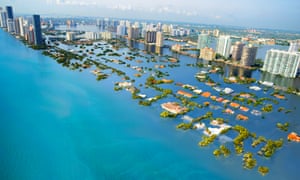
Sea level rise is set to challenge human civilization for centuries to come, even if internationally agreed climate goals are met and planet-warming emissions are then immediately eliminated, researchers have found.
A potential scenario of future sea level rise in South Beach, Miami, Florida, with a global temperature rise of 2C.
A potential scenario of future sea level rise in South
Beach, Miami, Florida, with a global temperature rise of 2C.
The lag time between rising global temperatures and the knock-on impact of coastal inundation means that the world will be dealing with ever-rising sea levels into the 2300s, regardless of prompt action to address the climate crisis, according to the new study.
Even if governments meet their commitments from the landmark 2015 Paris climate agreement, the first 15-year period of the deal will still result in enough emissions that would cause sea levels to increase by around 20cm by the year 2300.

Read the story from The Guardian by Oliver Milman - “Sea levels set to keep rising for centuries even if emissions targets met.”

09 February, 2019

The green new deal shows just how grand climate politics can be

If it’s hard to imagine the sweeping changes proposed in the “Green New Deal” actually happening, don’t blame the Green New Deal. It’s just that it has been so long since any politician suggested something so grand. The wildfires, hurricanes, droughts, and sea level rise that climate scientists have long promised are here, but we could get accustomed to that. We could forget that the world of five years ago or a decade ago was any different. And we got used to elected representatives saying predictable things about it too—doubt and denial, or expressions of concern that climate change is too complicated and too expensive to deal with. We grow accustomed to their farce.

US representative Alexandria Ocasio-Cortez
 (D-New York), along with Senator Ed Markey
(D-Massachusetts), introduced the ambitious
 "Green New Deal" resolution on Thursday.
So it’s jarring when something breaks the pattern. A resolution from the US House of Representatives that proposes national, urgent action on climate change and more—well, we’re not used to that. A vast set of policies to fight climate change, prepare for its effects, address income inequality, and save working-class jobs, fronted by a brand-new congressperson with a national profile—Alexandria Ocasio-Cortez, New York’s AOC? That’s new. The so-called Green New Deal reads like a wholesale reset to the Democratic Party platform, weaving the existential threat of a warming planet into old-school liberal themes. Defend the working class. Clean up pollution. Give people health care and housing.


Read the Wired story by Adam Rogers - “The green new deal shows just how grand climate politics can be.”

29 December, 2018

Vital ecosystems in tidal flats lost to development and rising sea levels

Coastal development and sea level rise are causing the decline of tidal flats along the world’s coastlines, according to research that has mapped the ecosystems for the first time.
Australia’s Gulf of Carpentaria. 
Scientists from the University of New South Wales (UNSW) and the University of Queensland used machine-learning to analyse more than 700,000 satellite images to map the extent of and change in tidal flats around the globe.

The study, published in Nature, found tidal flat ecosystems in some countries declined by as much as 16% in the years from 1984 to 2016.


Read the story from The Guardian by Lisa Cox - “Vital ecosystems in tidal flats lost to development and rising sea levels.”

28 December, 2018

After Back-to-Back Hurricanes, North Carolina Reconsiders Climate Change

After North Carolina was hit by two major hurricanes within two years and flooding rainfall from a third, the state that once spurned the science of sea level rise in its zoning rules is starting to take climate change more seriously.
Days of rain from Hurricane Florence flooded homes
across a wide area of North Carolina in September
2018. In Spring Lake, nearly 100 miles from the coast,
 Bob Richling carried items from a home as the Little River flooded. 
A new governor has a different policy agenda that incorporates the risks from climate change, and polls suggest a growing number of North Carolina residents are concerned about climate change and want policies that help protect them from extreme weather.


Read the Inside Climate News story by James Bruggers - “After Back-to-Back Hurricanes, North Carolina Reconsiders Climate Change.”

01 November, 2018

Venice is flooded, but other cities are in much greater danger

Venice has flooded. But while worry about the worst floods in a decade and warnings about the impacts of climate change and sea level rise dominate most of the media coverage, there’s a more complex story to be told.
Piazza San Marco during Venice’s acqua alta (flooding).
In Venice, floods are a feature, not a bug. The city was founded by people fleeing the Huns. They were safe in the lagoon (a word borrowed from Venetian), where horses and armoured men could not advance: the soggy ground would slow the enemy, the tide would wash them out.

Halfway between land and sea, trade is the only way to make a living. And so Venetians became successful merchants and built a magnificent city, with dazzling palaces and splendid churches filled with delightful works of art.


Read the report from The Conversation by the Professor of Economics from the  University of Sussex, Richard Tol - "Venice is flooded, but other cities are in much greater danger.”

30 May, 2018

Why blowing the 1.5C global warming goal will leave poor tropical nations sweating most of all

Almost all of us are going to be worse off as climate change takes hold, whether through heatwaves, changing rainfall patterns, sea level rise, or damage to ecosystems. But it’s the world’s poorest people who will suffer the biggest disruptions to their local climate, as our new study, published in Geophysical Research Letters today, explains.
Poor tropical nations are likely to feel the
effects of climate change most acutely.
The Paris Agreement aims to keep global warming well below 2℃ above pre-industrial levels, and ideally no more than 1.5℃. Meeting the more ambitious 1.5℃ target will be extremely challenging, given that we have already had more than 1℃ of global warming so far, and global greenhouse emissions are still rising.


18 March, 2018

It’s 50 years since climate change was first seen. Now time is running out

Fifty years ago, the Stanford Research Institute (SRI) delivered a report titled Sources, Abundance, and Fate of Gaseous Atmospheric Polluters to the American Petroleum Institute (API), a trade association for the fossil fuel industry.
 ‘Scientists attribute 15-40% of the epic rain
 of Hurricane Harvey to climate change.’
The report, unearthed by researchers at the Center for International Environmental Law, is one of the earliest attempts by the industry to grapple with the impacts of rising CO2 levels, which Stanford’s researchers warned if left unabated “could bring about climatic changes” like temperature increases, melting of ice caps and sea level rise.

The year was 1968, and the term “global warming” would not appear in a peer-reviewed academic journal until 1975. Famed Nasa scientist James Hansen would not testify before Congress that “global warming has begun” for another 20 years. And the US would not enter into – only to later pull out of – the Paris climate accord for nearly half a century.


Read the climate change opinion piece on The Guardian by Richard Wiles - “It’s 50 years since climate change was first seen. Now time is running out.”

04 May, 2017

NYC Creates Climate Change Roadmap for Builders: Plan for Rising Seas

The nation's largest city has a message for the architects and engineers planning the New York of tomorrow: Fortify new buildings against the ravages of climate change or risk rebuilding as global warming worsens.
To help plan future buildings and infrastructure that avoids the hazards
of sea level rise, the city designed an interactive flood risk map looking
ahead to the end of the century. This image shows how the flood plain
is expected to expand across more city blocks between 2020
 (light blue) and 2080 (white).
New guidelines issued last week by the office of New York City Mayor Bill De Blasio are some of the most comprehensive for how builders should protect infrastructure against rising seas, more powerful storms and climbing temperatures. They draw on science published in 2015 by a city panel of experts that estimates rainfall, sea level rise and other climatic shifts expected for the city in the decades ahead.

For now, developers are not required to follow the recommendations, but the plan is for all city agencies to be using the guidelines for new projects by the end of the year, according to Susanne DesRoches, deputy director of infrastructure policy for the mayor's Office of Recovery and Resiliency.


10 November, 2016

Will Trump go down in history as the man who pulled the plug on a livable climate?


-       by Joe Romm

Donald Trump - the pugilist is about to
deliver a knockout blow to climate action.
The shocking election of Donald Trump on Tuesday night is a turning point in the history of climate action, and therefore the history of homo sapiens. That’s because whatever warming, sea level rise, ocean acidification, and Dust-Bowlification we commit to is irreversible on a timescale of a thousand years.

Tragically, America has elected a man who has repeatedly called global warming a “hoax” and who put a climate science denier in charge of his EPA transition team. We’ve elected a man who has vowed to kill the Paris climate deal, end all efforts to help other countries deal with climate change, stop domestic climate action, reinvigorate coal, and zero out all research into climate science and clean energy.

I’ve always tried to face unpleasant facts head on. And while I had become considerably more optimistic about the possibility of averting catastrophe in the last two years, it was always the case that a quarter century of dawdling and ignoring the ever more dire warnings of climate scientists had left the climate on life support with no room for error.

09 June, 2016

Arctic drilling collapse good news for World Oceans Day

It’s often hard to find good news when it comes to the world’s oceans. Overfishing, coral bleaching, dead zones, acidification, pollution, oil spills, melting sea ice, sea level rise, the odd Cold War-era Russian rocket crashing into Baffin Bay with some leftover toxic fuel in the tank: There are as many marine bad news stories as there used to be fish in the overfished sea.

So on World Oceans Day a bit of positive news is a breath of fresh air — or gill-full of clean water.

Repsol, a Spanish oil company which owned a significant portion of the drilling leases for Alaska’s Chukchi Sea, abandoned 55 of them last week and plans to drop the remaining 38 next year.

“Repsol is in the process of relinquishing its Chukchi Sea acreage position offshore Alaska,” Repsol spokeswoman Jan Sieving said in a statement.

24 April, 2016

Hansen warns of Ice melt, sea level rise and superstorms

James Hansen.
Listen/watch to the former head of the NASA Goddard Institute for Space Studies in New York City, James Hansen,talk about “Ice Melt, Sea Level Rise and Superstorms”.

Hansen, an adjunct professor in the Department of Earth and Environmental Sciences at Columbia University, is best known for his research in climatology, his 1988 Congressional testimony on climate change that helped raise broad awareness of global warming, and his advocacy of action to avoid dangerous climate change.

In recent years, Hansen became a climate activist to mitigate the effects of climate change, on a few occasions leading to his arrest.

23 July, 2015

HItherto unseen cooperation needed to avoid catastrophic sea level rise


A

Hite
voidance of catastrophic climate change depends upon hitherto unseen cooperation among individuals, communities, towns, cities, nations and the world community.

A plea of that nature has come from pre-eminent climate scientist, James Hansen whose immediate focus is on preventing what he see as “catastrophic sea level rise”.

19 October, 2014

Deadly combination claiming Southest Louisiana


The deadly combination of sea level rise and subsidence threatens huge sections of coastline in Southeast Louisiana.

The dilemma is explained in an article published on The Lens, which focusses on New Orleans and the Gulf Coast.

Headed: “New measurements show sea level rise swallowing Grand Isle at record rate” the story says the rate is so high because the entire southeast portion of the state is sinking while seas are rising worldwide due to global warming.