Showing posts with label dominate. Show all posts

04 November, 2019

How we feel about our cars means the road to a driverless future may not be smooth

There is a reasonable expectation that autonomous vehicles will dominate the future of transport. Utopian visions suggest these driverless vehicles will lead to dramatic changes to our cities and their transportation. 
Autonomous vehicles operating on a network would allow traffic to move safely and seamlessly through cities. They would use less space per vehicle. Traffic flow would be unhindered by traffic lights or other traditional driver signals. 
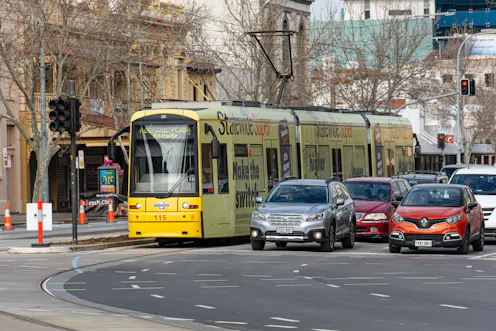
Image result for How we feel about our cars means the road to a driverless future may not be smooth
Car owners’ attachment to driving and the willingness
of others to switch from public transport could confound
 rosy predictions for autonomous vehicles.
More efficient transportation would use less fuel. Urban spaces could be repurposed as parking needs virtually disappear.
But this utopian vision depends on a range of factors. In particular, these predictions largely rely on how current car drivers respond to the advent of autonomous vehicles. 
Our research suggests people’s attitudes to driving and their cars could limit the predicted benefits to traffic flow and city efficiency, at least during the initial transition to driverless vehicles. 

Read the story from The Conversation by a Senior Lecturer from the University of Adelaide, Raul A. Barreto -  “How we feel about our cars means the road to a driverless future may not be smooth.”

01 November, 2018

Venice is flooded, but other cities are in much greater danger

Venice has flooded. But while worry about the worst floods in a decade and warnings about the impacts of climate change and sea level rise dominate most of the media coverage, there’s a more complex story to be told.
Piazza San Marco during Venice’s acqua alta (flooding).
In Venice, floods are a feature, not a bug. The city was founded by people fleeing the Huns. They were safe in the lagoon (a word borrowed from Venetian), where horses and armoured men could not advance: the soggy ground would slow the enemy, the tide would wash them out.

Halfway between land and sea, trade is the only way to make a living. And so Venetians became successful merchants and built a magnificent city, with dazzling palaces and splendid churches filled with delightful works of art.


Read the report from The Conversation by the Professor of Economics from the  University of Sussex, Richard Tol - "Venice is flooded, but other cities are in much greater danger.”

26 April, 2018

China stakes claim on electric car market with 100 new models at auto show

Chinese car brands are staking a leadership claim in the global race to dominate electric vehicles, unveiling and promoting more than 100 new models at the country's annual auto show.
The LSEV is touted as the first mass-producible
3D-printed electric car in the world.
More than two-thirds of the hybrid and fully electric plug-in cars on display in Beijing are from Chinese brands, despite international car giants trying hard to court the huge local market with the unveiling of several new electric SUVs.

New energy vehicles (NEVs) aren't just fashionable in China's big cities — they are also being actively pushed by China's government through subsidies for manufacturers and a planned cap-and-trade quota system that will force car companies to make at least 10 per cent of their output NEVs or face fines.


Read the Bill Birtles story from ABC News - “China stakes claim on electric car market with 100 new models at auto show.”

29 March, 2018

The BOM outlook for the weather over the next three months is ‘neutral’ – here’s what that really means.

Today the Bureau of Meteorology releases its end-of-month seasonal outlook for April to June, updating the initial outlook released on March 15. But you might not have seen much media coverage of it, because we’re not seeing big swings towards the attention-grabbing climate drivers like El Niño or the Indian Ocean Dipole, which can dominate Australia’s climate.

The rainfall outlook map for April–June 2018, issued March 15 (left), shows
most of Australia in the neutral/50:50 range (so coloured white). In contrast, the rainfall outlook map for October 2015 (right) shows a low chance of exceeding the
median (so brown dominates the map).
There are times when the main drivers of our climate are not strong enough to push us towards a season dominated by unusually wet or dry, or hot or cool, weather. This can also happen if different climate drivers are having opposite impacts – they can cancel each other out.

Without a strong push one way or another, our outlook maps are often white. This is a neutral or “50:50” outlook map.


20 March, 2018

GE to build the world’s largest offshore wind turbines

GE plans to build the world’s largest offshore wind turbines, which are so tall they would dominate Melbourne's skyline.
The offshore wind turbines are nearly 300 metres tall.
The wind towers will stand 260 metres tall, almost the same height as the Sydney Tower or 120 Collins Street in Melbourne and well above the world’s current largest wind turbines at 247m. The blades alone are 107 metres long.

Known as the Haliade-X, the 12-megawatt turbines can generate up to 67 gigawatts of power annually, enough to run up to 16,000 homes. Australia consumed 180,750-gigawatt hours of electricity in 2016-17, the equivalent of 2700 of these turbines. The world’s current largest wind turbine capacity is only 9 megawatts.


Read Cole Latimer’s story from The Age - “GE to build the world’s largest offshore wind turbines.”

10 March, 2018

'Contrary to Reason' - George Monbiot

One of the curiosities of our age is the way in which celebrity culture comes to dominate every aspect of public life. Even the review pages of the newspapers sometimes look like a highfalutin version of gossip magazines. Were we to judge them by the maxim “great minds discuss ideas; average minds discuss events; small minds discuss people”, they would not emerge well. Biography dominates, ideas often seem to come last. Brilliant writers like Sylvia Plath become better known for their lives than their work: turning her into the Princess Diana of literature does neither her nor her readers any favours.
Jeremy Lent's  "The Patterning Instinct" is worth reading.
Even when ideas are given prominence, they no longer have standing in their own right; their salience depends on their authorship. Take, for example, the psychology professor Stephen Pinker, who attracts the kind of breathless adulation that would seem more appropriate in the pages of Hello magazine.

I am broadly sympathetic to his worldview. I agree with him that scientific knowledge is a moral imperative, and that we must use it to enhance human welfare. Like him, I’m enthusiastic about technologies that horrify other people, such as fourth-generation nuclear reactors and artificial meat. So I began reading his new book Enlightenment Now with excitement.


Read the latest column by Guardian columnist, George Monbiot - “Contrary to Reason.”

31 July, 2016

Archibald portraits reveal much about Australia's world view

John Frydenberg ("Mr Coal") as
 portrayed by Simon Bosch.
Among the 50-odd portraits in this year's Archibald, two are stand-out, although not in a good way. Both depict sitting politicians but together they reveal us, or what is embarrassingly close to becoming an Australian world-attitude: dominate, exploit, go. Eat, shoot, leave (the rubbish).

Contemporary portraiture peers into the sitter's soul. Abandoning the bombast and braggadocio of traditional portraiture, it seeks some inner truth, even frailty. To browse the Archies, therefore, is to be brushed with sadness and self-doubt as much as charm, cheek and chutzpah. This is its redemption.

Read Elizabeth Farrelly’s story in The Sydney Morning Herald - “These two portraits reveal much about Australia's world view.”

31 May, 2015

Human domination of Earth goes almost unnoticed


H

umans dominate the Earth to an extent few are really aware of.
 
Biodiversity is diminishing, and our extinction crisis is in no small part down to our clearing of ever more wilderness to further develop the human enterprise.

If survival of any part of the web of life is dependent upon the whole, then we are playing a dangerous game.

Deep ecology holds that the all life – human and nonhuman – holds intrinsic value, independent of any utility for human purposes. As the richness and diversity of life are integral to the flourishing of the biosphere as a whole, it is only acceptable to disturb nature to the extent necessary to satisfy vital needs.

Allowing the natural world to slip from the perceived grasp of human control and re-wild itself requires surrender to the reality that we do not have ultimate control. Author and activist Derrick Jensen advocates for this ecocentric approach, arguing that we will need to relinquish our perceived position as superior to nature, and recognize ourselves as simply a part of it.

Jensen invites us to tune in to nature’s frequency – to observe and listen to what the natural world is telling us. Most westerners interpret the idea of listening to nature as just a metaphor, but Jensen insists that it is literal, making reference to indigenous cultures whose way of life is in tune with their landbase, who understand the world as a network of living beings with whom we can enter into a relationship. It is therefore within reach for us to genuinely commune with nature, and not just take from it.

This short piece – “Preservation of the wilderness” - is from Shift magazine.