Showing posts with label research. Show all posts

11 September, 2019

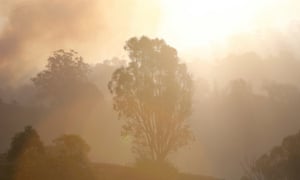
I never thought I'd see the Australian rainforest burning. What will it take for us to wake up to the climate crisis?

These days as a climate scientist, the line of separation between the research I do in my professional life and the events unfolding in the world at large is growing ever thinner.
Bushfire on the Gold Coast
‘The extreme events that our community has been
talking about for decades are now are becoming a
part of our lived experience, season after season,
year after year across the entire planet.’
The extreme events that our community has been talking about for decades are now becoming part of our lived experience, season after season, year after year across the entire planet. What we are seeing play out now is much faster than many of us ever imagined.
Barely a week after sweltering through an Intergovernmental Panel on Climate Change (IPCC) lead author meeting discussing the UN group’s sixth global climate assessment report during an unseasonable European heatwave, it’s been surreal to return home to find much of Australia’s eastern seaboard engulfed in unprecedented bushfires crisis. In spring.

26 August, 2019

RISC3 is about climate change action and research

RISC3 is a climate change action and research consultancy firm, established in 2018 and based in Barcelona.

It is a non-profit group that supports governments, organisations and companies to achieve their climate change committments through adaptation and mitigation projects and action plans. 

On its website, 
RISC3 says: “Our work combines programmes as well as consultancy services and comparative studies to provide the most appropriate and up-to-date support to partners and clients.

“We operate within a core network of two very experienced specialists in climate public policy, climate economics, regulations, strategy planning, climate research, environmental impact assessment and sustainable development. 


“We have a strong track record in developing and integrating climate change models to assess policy risk, opportunity and impact, in addition to establishing a financial structure of climate projects, due diligence, contract negotiations, grant application and portfolio management for both public and private sectors, governments and academia,” it says.

08 May, 2019

Finally, Some Good News For Climate Science

Despite countless political setbacks, climate science technology and research continues to march forward. NASA’s Orbiting Carbon Observatory 3 (OCO-3), an instrument that measures atmospheric carbon dioxide arrived at the International Space Station early Monday morning.
OCO-3 in the clean room at Jet Propulsion Laboratory, Pasadena, CA
The science instrument had already been built when President Trump, in his FY2018 budget, cut funding for satellites that study Earth and climate science. Thankfully though, congress restored the funding and this past Saturday OCO-3 along with approximately 5,500 pounds of NASA cargo and other science investigations launched aboard SpaceX’s Dragon spacecraft.


Read the story from Forbes by contributor Laura Tenenbaum - “Finally, Some Good News For Climate Science.”

06 April, 2019

A New Language for Grappling With Climate Change

This month, a major UN report on climate change declared that humanity has just a few short years to make the drastic changes needed to stave off an environmental catastrophe. While news outlets reacted with shock and alarm, those who regularly write, research or advocate on climate change were more resigned. For them, the report — which synthesized existing research — merely aggravated the psychic wound formed by continually reckoning with the end of the world.
What's ahead for kids like me?
Responding to the report, climate writer Eric Holthaus encouraged readers to talk about their feelings with friends, though he said that he has “no idea whether or not this is the right advice for everyone.” Environmental reporter Zoë Schlanger expressed similar ambivalence, writing that “in 2018, life can feel in need of a dirge for the whole world, with scarcely the language to write it.”

Perhaps as the climate changes, so must our vocabulary. We need new words to grapple with these new challenges. What does it feel like when your home leaves you? When the seasons shift and rains dry up or turn to deluge? How do you capture the sense of this new abnormal? And how do you cope?


Read the story from NexusMedia by Phil Newell - “A New Language for Grappling With Climate Change.”

12 March, 2019

Carbon emissions may be reaching levels not seen for 56-million-years

Total human carbon dioxide emissions could match those during Earth’s last major greenhouse warming event in fewer than five generations, new research finds.
Carbon dioxide emissions growing quickly.
A new study finds humans are pumping carbon dioxide into the atmosphere at a rate nine to 10 times higher than the greenhouse gas was emitted during the Paleocene-Eocene Thermal Maximum (PETM), a global warming event that occurred roughly 56 million years ago.

The results suggest if carbon emissions continue to rise, the total amount of carbon dioxide injected into the atmosphere since humans started burning fossil fuels could equal the amount released during the PETM as soon as 2159.


Read the story from SCISCO Media by Robert Lea - “Carbon emissions may be reaching levels not seen for 56-million-years.”

08 February, 2019

Australia can meet Paris targets if government doesn't hinder progress, report claims

New research finds Australia is installing renewable energy faster than any other country, a trend that will allow Australia to meet its economy-wide Paris targets five years ahead of schedule if politics doesn’t derail the trend, according to new research from the Australian National University.
Emissions have been falling in the electricity sector
because of the closure of ageing coal plants and
the rapid uptake of renewables.
While emissions have been rising across the economy since the Abbott government repealed the carbon price after winning government in 2013, they have been falling in the electricity sector because of the closure of ageing coal plants and the rapid uptake of renewables.

The lead researcher, ANU professor Andrew Blakers, says Australia is currently installing renewable power four or five times per capita faster than the European Union, Japan, China and the United States. That finding is based on preliminary data available for installations globally last year.


Read the story from The Guardian by Katharine Murphy - “Australia can meet Paris targets if government doesn't hinder progress, report claims.”

29 December, 2018

Vital ecosystems in tidal flats lost to development and rising sea levels

Coastal development and sea level rise are causing the decline of tidal flats along the world’s coastlines, according to research that has mapped the ecosystems for the first time.
Australia’s Gulf of Carpentaria. 
Scientists from the University of New South Wales (UNSW) and the University of Queensland used machine-learning to analyse more than 700,000 satellite images to map the extent of and change in tidal flats around the globe.

The study, published in Nature, found tidal flat ecosystems in some countries declined by as much as 16% in the years from 1984 to 2016.


Read the story from The Guardian by Lisa Cox - “Vital ecosystems in tidal flats lost to development and rising sea levels.”

13 June, 2018

Rail access improves liveability, but all regional centres are not equal

Our research on the liveability of regional cities in Victoria has identified an important element: liveability in these areas requires fast, reliable and frequent rail connections to capital cities.
Shepparton residents are clearly disadvantaged by having far
fewer daily train services to Melbourne than other regional centres.
Previous research has established that we need better models of early transport delivery in growth areas of Melbourne. Public transport, in particular, is an essential ingredient for a liveable community. 

Less attention has been paid to transport in regional areas, particularly regional areas with growing populations.


03 June, 2018

Arctic Methane Leaks Go Undetected Because Equipment Can’t Handle the Cold

The most widely-used technology for detecting methane leaks from oil and gas operations does not work reliably in extremely cold weather—like on Alaska's North Slope, according to recent research and the industry's own reports.
Infrared cameras are critical for detecting methane leaks in oil and gas
facilities, but they struggle in cold temperatures. Here, an infrared
camera reveals a giant methane leak from Aliso Canyon in California.
The gas appears as a rising yellow plume beyond the hills. 
When the weather hits the extreme lows common around Prudhoe Bay, when the winds whip and the sun dips below the horizon for a few months, the infrared technology required to look for methane leaks isn't always able to find them.

"A lot of the equipment just doesn't function well at -40 or -50," said James Plosay, who manages the air permits program for the Alaska Department of Environmental Conservation's Division of Air Quality.


Read the Inside Climate News story by Sabrina Shankman - “Arctic Methane Leaks Go Undetected Because Equipment Can’t Handle the Cold.”

31 May, 2018

Safety, lack of proper lanes, turn many off cycling, says city counci

Fears over safety, potential conflict with cars and pedestrians, and poorly planned bike lanes discourage many from getting on a bicycle, Melbourne City Council research has found.
Lord mayor Sally Capp and councillor Nicolas Frances
Gilley, the chair of the MCC's transport portfolio.
The city council will on Thursday release a discussion paper on cycling that will help inform its next transport strategy, due out by the end of this year.


Read the story Clay Lucas from The Age - “Safety, lack of proper lanes, turn many off cycling, says city council.”

10 February, 2018

13 top universities form ‘Climate Change Coalition’

Leading universities across North America have launched the ‘University Climate Change Coalition’ to leverage their research and resources to spur local climate action.
Universities band together to spur local climate action.
The coalition, also known as UC3, was announced by Janet Napolitano, President of the University of California and former Homeland Security secretary under the Obama administration.

With universities from the United States, Canada, and Mexico, the new initiative will aim to fill the rising gap in local climate action, especially after the US government is making deep cuts to numerous science agencies and rolling back environmental regulations aimed at mitigating climate change. 


Read the ClimateAction story - “13 top universities form ‘Climate Change Coalition’.”

22 January, 2018

Great Barrier Reef to get $60m rescue package from government

Malcolm Turnbull has announced a $60m rescue package for the Great Barrier Reef which includes research on developing “resilient” coral, and paying farmers to pollute less.

Australia's Great Barrier Reef - one of the world's wonders.
The package, to be spent over 18 months, will also include an increased number of reef officers and vessels targeting crown of thorns starfish outbreaks.

More than half the package, $36.6m, will be spent on “supporting farmers stopping runoff off their properties” in order to improve water quality, the prime minister said.

Turnbull said there was a “very strong link” between water pollution and crown of thorns starfish outbreaks.

Read Helen Davison’s story from The Guardian - “Great Barrier Reef to get $60m rescue package from government.”


(The rhetoric and money will convince many that the Turnbull Government is serious about saving/protecting the Great Barrier Reef, but it is simply more smoke and mirrors - warming oceans brought on by climate change is the root problem and despite Mr Turnbull’s declarations, today’s announcement does nought to save the reef, one of the world’s wonders, from the ravages of a disturbed climate system - Robert McLean)

18 January, 2018

Study narrows range of Earth's warming response as greenhouse gases rise

New research has sharply narrowed the likely estimate of how much the Earth will warm with a doubling of carbon dioxide in the atmosphere, potentially honing estimates that have stood for a quarter century.
Estimating how much the planet will warm as we lift
greenhouse gas levels has been an active area of research.
The long-standing estimate for the so-called equilibrium climate sensitivity used by the Intergovernmental Panel on Climate Change had been that surface temperatures would rise between 1.5 and 4.5 degrees for each doubling of CO2 or equivalent greenhouse gases.


Read Peter Hannam’s story in today’s Melbourne Age - “Study narrows range of Earth's warming response as greenhouse gases rise.”

23 November, 2017

Australian red meat sector sets 2030 carbon neutral target at Alice Springs producer forum

Research and marketing group Meat and Livestock Australia (MLA) says the country's red meat industry could be carbon neutral by 2030.

Richard Norton says the target will prove farming
 red meat is environmentally sustainable.
The challenge was set for the cattle and sheep sectors by managing director Richard Norton during his address at the MLA annual general meeting in Alice Springs on Wednesday.

It follows the start of a CSIRO research project in the past 12 months, funded by MLA, to identify ways the industry could become carbon neutral.

In 2015, a separate study by CSIRO found cattle and sheep produced almost 70 per cent of Australian agriculture's greenhouse gas emissions.


(The idea that Australia’s red meat industry - particularly red meat from sheep and cattle - will ever be carbon neutral is fanciful as all the evidence points precisely in the wrong direction - Robert McLean)

02 October, 2017

Australia’s dryness may be its new energy source

Australia is the driest inhabited continent on earth, but new research might allow us to use this to create energy.
"Evaporation comes with a natural battery,"
study co-author Ahmet-Hamdi Cavusoglu says. 
Scientists in the US have developed a machine that can harness evaporation to create kinetic energy, which can be transformed into power.

Early modelling indicates this technology could generate almost 325 gigawatts if used in the US. In the National Electricity Market – which encompasses the entire east coast of Australia – in 2016-17 there was a maximum demand of 34.4 gigawatts.

Dubbed an "evaporation-driven engine", it is already achieving positive results and can double as a water-saving device.


Read Cole Latimer’s story in today”s Melbourne Age - “Australia’s dryness may be its new energy source.”

03 August, 2017

House slashes funding for clean energy, restores funding for fossil fuel research

Mark Hand.
The House of Representatives voted Thursday to approve a large spending bill for fiscal year 2018 that slashes clean energy spending and approves keeping fossil fuel research at current levels.

In a spending package known as the “minibus,” the House voted to set the Office of Energy Efficiency and Renewable Energy’s (EERE) budget at $1.1 billion, a 45 percent cut from the office’s fiscal 2017 budget of more than $2 billion. The Trump administration requested an even bigger cut for the Department of Energy office that would have lowered its budget to $636 million, or 70 percent, below the 2017 budget.

The funding measure passed 235–192, with five Democrats voting for, five Republicans voting against, and six representatives abstaining. It still needs approval from the Senate before it passes into law — a thin possibility, given the largely partisan House vote.


Funding & direction of Australian climate science research needs an overhaul: Academy of Science

Fran Kelly.
Australian climate science research is not currently providing the answers that farmers, local councils and all levels of government need to make decisions on future climate variability and risk.

That's one of the key findings of a climate science capability review, released this morning by the Australia Academy of Science.

The review was set up after the controversial cuts to climate science programs at the CSIRO last year.

The independent review recommends 80 new research positions should be funded, together with an overhaul of the administration and oversight of Australia's climate science programs.


Listen to the discussion on RN Breakfast with Fran Kelly - “Funding & direction of Australian climate science research needs an overhaul: Academy of Science.”

22 May, 2017

China to partly fund new CSIRO climate research centre

CSIRO's re-embracing of climate change research will be stressed on Monday when the national science agency announces a new centre partly funded by Chinese interests.

CSIRO research ship Investigator.
Based in Hobart, the $20 million centre will examine the role oceans will play in future climate change, including their influence on floods and drought. It will be half funded by China's Qingdao National Laboratory for Marine Science and Technology.

The Centre for Southern Hemisphere Oceans Research will also look at the capacity of seas to keep absorbing carbon dioxide – more than 90 per cent of heat has been taken up by oceans in recent decades – and the expected impact of melting Antarctic ice shelves.

The announcement comes a year after CSIRO came under fire for a proposed restructure that involved a shift away from "science for science sake" and towards corporate partnerships and work that could be sold.


Read Adam Morton’s story in today’s Melbourne Age - “China to partly fund new CSIRO climate research centre.”

28 January, 2017

Changing climate has stalled Australian wheat yields: study

The distribution of the annual change in wheat yield
potential from 1990 to 2015. Each dot represents 
one of the 50 weather stations used in the study. 
Australia’s wheat yields more than trebled during the first 90 years of the 20th century but have stalled since 1990. In research published today in Global Change Biology, we show that rising temperatures and reduced rainfall, in line with global climate change, are responsible for the shortfall.

This is a major concern for wheat farmers, the Australian economy and global food security as the climate continues to change. The wheat industry is typically worth more than A$5 billion per year – Australia’s most valuable crop. Globally, food production needs to increase by at least 60% by 2050, and Australia is one of the world’s biggest wheat exporters.

There is some good news, though. So far, despite poorer conditions for growing wheat, farmers have managed to improve farming practices and at least stabilise yields. The question is how long they can continue to do so.

Read what a trio of CSIRO thinkers have to say on The Conversation - “Changing climate has stalled Australian wheat yields: study.”

22 January, 2017

Sea levels could rise by six to nine metres over time, new study warns


Sea levels respond directly to global temperatures,
 both through the melting of ice shelves and through
 the expansion of water as it warms.
Sea surface temperatures today are strikingly similar to those during the last interglacial period, when sea levels were six to nine metres above their present height, according to research.

The findings provide compelling evidence that Greenland and Antarctica’s continental ice sheets are highly sensitive to slight increases in ocean temperatures, and raise the prospect of sea levels continuing to rise for many centuries.

Previous research had shown that sea levels rose by several metres during the last interglacial (LIG), between 129,000 to 116,000 years ago, but until now the picture of how sea temperatures had varied over the same period had remained patchy.

The latest research, based on marine sediment core records from 83 sites, concludes that sea temperatures towards the end of the LIG were comparable to those seen today.

Rob DeConto, a climate scientist at the University of Massachusetts, Amherst, who was not involved in the research said: “This tells us that the big ice sheets are really sensitive to just a little bit of warming. That’s a really powerful message.”