Showing posts with label Asia. Show all posts

26 December, 2019

Heat wave-choked Australia sticks out like a sore thumb in a map of world weather

(CNN) It's ferociously cold in pockets of North America and Asia and relatively mild in the summery Southern Hemisphere. This map tells you as much. 
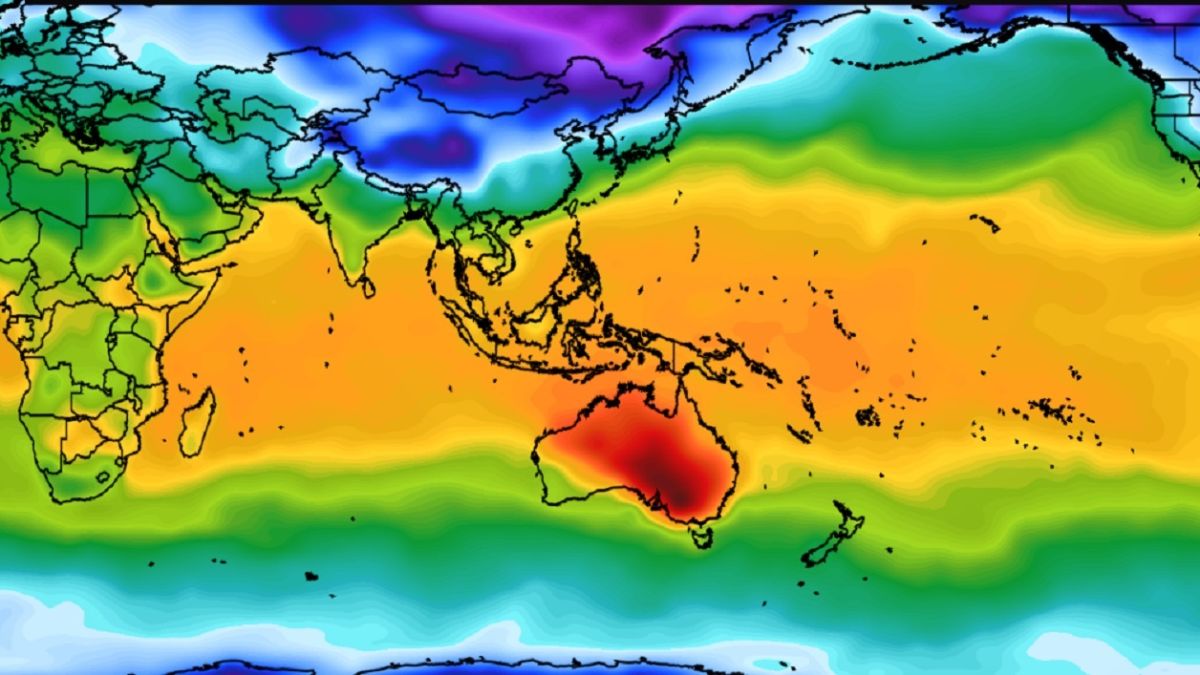
Image result for Heat wave-choked Australia sticks out like a sore thumb in a map of world weather
Australia sticks out like a sore thumb.
But that blazing patch of red that separates the Indian and Pacific Oceans is an anomaly, choked by the hottest December weather anywhere on Earth
That's because Australia is baking under a blistering heat wave. On Thursday, temperatures averaged 105.6 degrees Fahrenheit across the continent. 

Some areas saw the heat climb even higher: In Port Augusta, in south Australia, temperatures peaked at 121 degrees -- the hottest December temperature recorded of any country. 

It's summer in December in Australia, so warmer weather is fairly common this time of year. But it's never this hot, and never for so long. 


Read the CNN story by Brandon Miller and Scottie Andrew - “Heat wave-choked Australia sticks out like a sore thumb in a map of world weather.”

08 August, 2019

‘Warning flag': IPCC finds rapid land warming threatens food security

Image
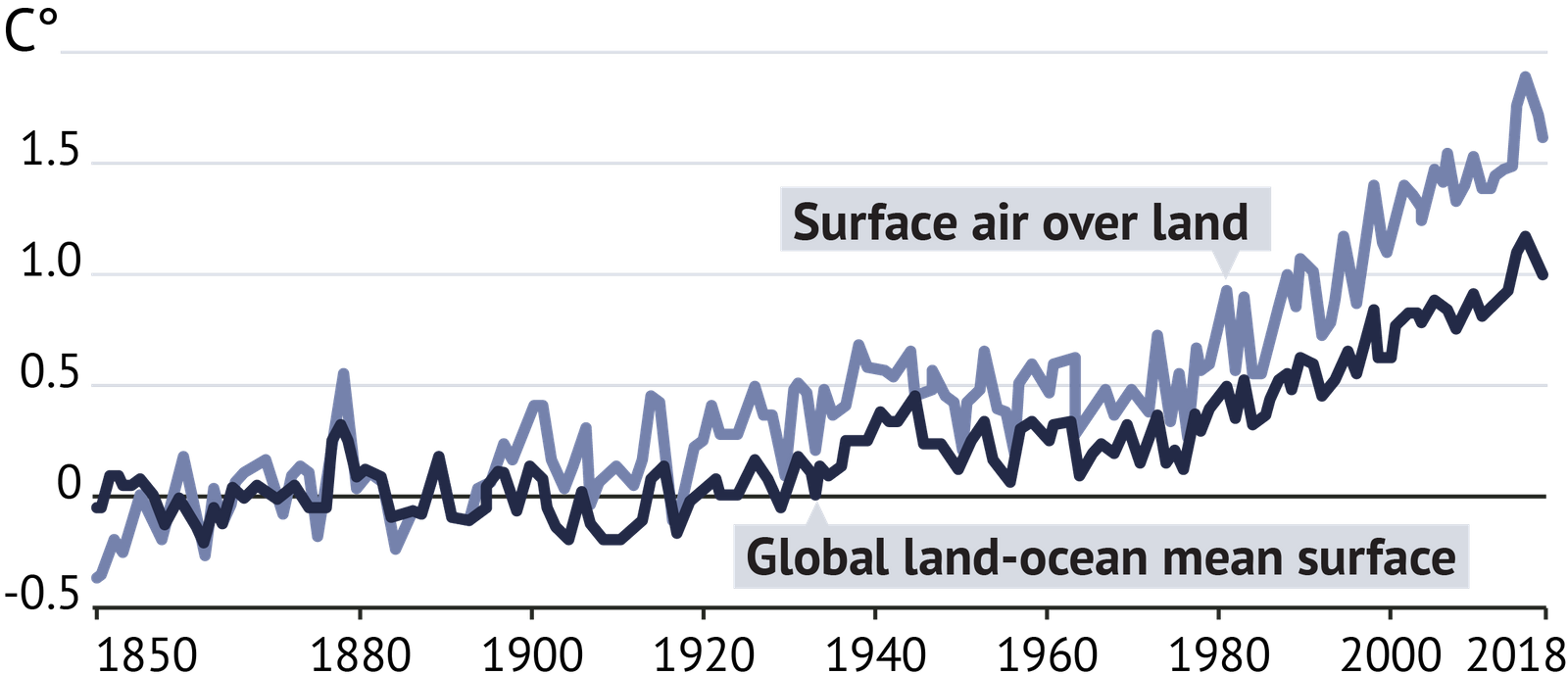
Temperatures over the world's land areas are warming at about twice the global rate, expanding deserts in Australia, Africa and Asia, and hitting food security hard, a new UN report finds.
Image
Temperatures are rising over land much faster than the global average with climate change. Australia is one nation where arid regions are expanding, the IPCC says in a new report.
Temperatures are rising over land much faster than
 the global average with climate change. Australia is
one nation where arid regions are expanding, the
IPCC says in a new report.
The Intergovernmental Panel on Climate Change (IPCC) found that surface air temperatures between 2006 and 2015 were 1.53 degrees warmer than the pre-industrial average of 1850-1900. By contrast, the combined warming of land and oceans was 0.87 degrees, the IPCC's special report on land said.
Compared with current conditions, though, land areas have warmed by about 1.8 degrees, and global mean temperatures by 1.1 degrees, said Stefan Rahmstorf from the Potsdam Institute for Climate Impact Research.
Read the story from The Age by Peter Hannam - “‘Warning flag': IPCC finds rapid land warming threatens food security.”

18 March, 2018

Queensland is one of the world’s worst places for deforestation

MOST deforestation takes place in poor countries. In richer places, trees tend to multiply. Australia is an unhappy exception. Land clearance is rampant along its eastern coast, as farmers take advantage of lax laws to make room for cattle to feed Asia. WWF, a charity, now ranks Australia alongside Borneo and the Congo Basin as one of the world’s 11 worst “fronts” for deforestation.
Queensland is losting the equivalent of 1,000
rugby pitches’ worth of forest disappear every day.
The worst damage occurs in the north-eastern state of Queensland, which has more trees left to fell than places to the south, where agriculture is more established. It has been responsible for over half of Australia’s land clearance since the 1970s. Its bulldozers are at present busier than they have been for a decade. They erased 395,000 hectares of forest, including huge tracts of ancient vegetation, between 2015 and 2016—the equivalent of 1,000 rugby pitches a day. As a share of its forested area, Queensland is mowing down trees twice as fast as Brazil.


10 February, 2018

NGOs to Singapore banks: Act on climate change and stop funding coal

A few weeks after the Singapore government launched an initaitive declaring 2018 the Year of Climate Action, a coalition of international green groups has issued an open letter calling on the country’s powerful banks to stop financing coal power in Asia.
A dump truck at a coal mine owned by Banpu Public
 Company Ltd in a paddy field in Kerta Buana village
in Kutai Kartanegara, East Kalimantan. 
In a letter published on Wednesday, NGOs including Australia’s Market Forces, Friends of the Earth US and Japan, and Indonesian group Wahli said that if global warming is to be capped below 2˚C below pre-industrial levels to avoid the worst consequences of climate change, Singapore’s banks must follow the lead taken by their European and North American counterparts and stop funding new coal power plants. 


01 April, 2016

Climate change transforming the world's weather patterns, but is business ready?

Extreme weather brings unusual sights
resulting from extreme circumstances.
Climate change is transforming weather patterns around the world.

From Indonesia’s devastating forest fires at the end of last year, exacerbated by El NiƱo, to aid agencies calling for urgent action as droughts and floods trigger widespread food shortages in Africa, Asia and the Caribbean, it’s in the developing world where the impacts are most felt.

In our new extreme weather hub, we’ll be digging into what’s happening in some of the countries hardest hit by extreme weather events: from micro-insurance schemes in India to climate change lawsuits in Vanuatu and Peru.

Our aim? To look at the role businesses and financial institutions are having (or should have) in building resilience and helping prevent and mitigate the effects.