Showing posts with label previously thought. Show all posts

17 December, 2019

Greenland’s ice sheet melting seven times faster than in 1990s

Greenland’s ice sheet is melting much faster than previously thought, threatening hundreds of millions of people with inundation and bringing some of the irreversible impacts of the climate emergency much closer.
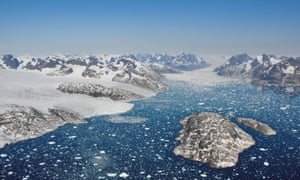
Glaciers calving icebergs in south-west Greenland
Glaciers calving icebergs in south-west Greenland,
 which has lost 3.8tn tonnes of ice since 1992, and
the rate of ice loss has risen from 33bn tonnes a
year in the 1990s to 254bn tonnes a year in the past decade.
Ice is being lost from Greenland seven times faster than it was in the 1990s, and the scale and speed of ice loss is much higher than was predicted in the comprehensive studies of global climate science by the Intergovernmental Panel on Climate Change, according to data.
That means sea level rises are likely to reach 67cm by 2100, about 7cm more than the IPCC’s main prediction. Such a rate of rise will put 400 million people at risk of flooding every year, instead of the 360 million predicted by the IPCC, by the end of the century.

Read the story from The Guardian by Fiona Harvey - “Greenland’s ice sheet melting seven times faster than in 1990s.”

30 October, 2019

Rising Seas Will Erase More Cities by 2050, New Research Shows

Rising seas could affect three times more people by 2050 than previously thought, according to new research, threatening to all but erase some of the world’s great coastal cities. 
The authors of a paper published Tuesday developed a more accurate way of calculating land elevation based on satellite readings, a standard way of estimating the effects of sea level rise over large areas, and found that the previous numbers were far too optimistic. The new research shows that some 150 million people are now living on land that will be below the high-tide line by midcentury. 
Southern Vietnam could all but disappear. 
The first map shows earlier expectations of submerged land by 2050. But the new outlook, the second map, indicates that the bottom part of the country will be underwater at high tide. 
More than 20 million people in Vietnam, almost one-quarter of the population, live on land that will be inundated. 

Read the story from The New York Times by Denise Lu and Christopher Flavelle - “Rising Seas Will Erase More Cities by 2050, New Research Shows.”

12 August, 2019

The carbon footprint of tourism revealed (it’s bigger than we thought)

The carbon footprint of tourism is about four times larger than previously thought, according to a world-first study published today in Nature Climate Change. 

Image result for The carbon footprint of tourism revealed (it’s bigger than we thought
There's a huge carbon cost with flying.
Researchers from the University of Sydney, University of Queensland and National Cheng Kung University – including ourselves – worked together to assess the entire supply chain of tourism. This includes transportation, accommodation, food and beverages, souvenirs, clothing, cosmetics and other goods.

Put together, global tourism produces about 8% of global greenhouse gas emissions, much more than previous estimates. 


(Climate Conversations considers the environmental cost of flying, including tourism)

12 January, 2019

Oceans warming faster than thought, new research finds

Washington: Scientists say the world's oceans are warming far more quickly than previously thought, a finding with dire implications for climate change because almost all the excess heat absorbed by the planet ends up stored in their waters.
Rising seas: People sit in a flooded St Mark's Square in Venice,
Italy, as high tides inundated the city in March 2018.
CREDIT:
A new analysis, published on Thursday in the journal Science, found that the oceans are heating up 40 per cent faster on average than a UN panel estimated five years ago. The researchers also concluded that ocean temperatures have broken records for several straight years.

"2018 is going to be the warmest year on record for the Earth's oceans," said Zeke Hausfather, an energy systems analyst at independent climate research group Berkeley Earth and an author of the study. "As 2017 was the warmest year, and 2016 was the warmest year.”

As the planet has warmed, the oceans have provided a critical buffer. They have slowed the effects of climate change by absorbing 93 per cent of the heat trapped by the greenhouse gases humans pump into the atmosphere.

Read the story from The Age by Kendra Pierre-Louis - “Oceans warming faster than thought, new research finds.”

21 February, 2018

Climate change 'will push European cities towards breaking point’

Major British towns and cities, including Glasgow, Wrexham, Aberdeen and Chester, could be much more severely affected by climate change than previously thought, according to new research.

 A rescue boat in a flooded street of Nemours,
 near Paris, France, after downpours in June 2016.
The study, by Newcastle University, analysed changes in flooding, droughts and heatwaves for every European city using all climate models.

Looking at the impact by the year 2050-2100, the team produced results for three possible outcomes – low, medium and high-impact scenarios.

But even the most optimistic case showed 85% of UK cities with a river, including London, would face increased flooding.

In the high-impact scenario, some cities and towns in the UK and Ireland could see the amount of water per flood as much as double. The worst affected is Cork, which could see 115% more water per flooding, while Wrexham, Carlisle, Glasgow, and Chester could all see increases of more than 75%.


Read Tom White’s story on The Guardian - “Climate change 'will push European cities towards breaking point’.”

11 February, 2018

Polar Bears Wearing Cameras and Fitbits Reveal an Arctic Struggle for Survival.

It's not easy out there for a polar bear in the era of climate change, and according to a study released today, it's even harder than previously thought.
"As the sea ice goes, so goes the polar bear":
A camera the scientists attached to a female
polar bear captures a close-up of another bear
on the Arctic sea ice.
When scientists studied polar bears they had captured, outfitted with cameras and released, they found that the bears' metabolism was 1.6 times higher than previously thought, making it harder for the animals to find enough food. In short: too many calories burned and not enough calories consumed.

The study, released Thursday in the journal Science, provides the clearest view yet of polar bear physiology. By approaching the study in a novel way—examining the bear's body condition and affixing cameras with GPS—the scientists were able to see how polar bears spend their time, how successful they are on hunts and how much time they spend walking, swimming or resting.


Read the Inside Climate News story by Sabrina Shankham - “Polar Bears Wearing Cameras and Fitbits Reveal an Arctic Struggle for Survival.”