Showing posts with label flooding. Show all posts

23 June, 2019

Rising sea, erosion to wreak havoc in low-lying suburbs: report

Rising seas are threatening to encroach on low-lying parts of Melbourne within 20 years, causing flooding and erosion in suburbs including St Kilda, Point Cook, Mordialloc, Seaford and Frankston.
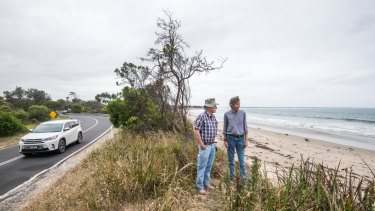
Locals Dave Sutton (left) and Phillip Heath on the remaining strip separating the surf beach from the road at Inverloch, where erosion has caused major problems.
Locals Dave Sutton (left) and Phillip Heath on the remaining
strip separating the surf beach from the road at Inverloch,
 where erosion has caused major problems.
Other places at risk include areas around Queenscliff and Barwon Heads on the Bellarine Peninsula; the south-west Victorian towns of Port Fairy and Portland; and Tooradin, Lang Lang and Seaspray in the state's south-east.
A report tabled in Victoria's Parliament last week examines the myriad threats to the state’s fragile coastline, painting an alarming picture of damage to the environment and suburban Melbourne if no action is taken.
The Victorian Environmental Assessment Council report cites a 20-centimetre sea-level rise by 2040 and between 40 centimetres and one metre by century’s end.

Read the story from The Age by Benjamin Preiss and Adam Carey - “Rising sea, erosion to wreak havoc in low-lying suburbs: report.”

20 February, 2019

Townsville homes may become 'uninsurable' due to flooding from climate change

Houses in flood-hit Townsville and other parts of north Queensland are “on track to become uninsurable”, according to analysis that shows the risk to homes from flooding will more than double under climate change.
 Homeowners in north Queensland will find difficulty
getting insurance as flood risk rises with climate change. 
The modelling, based on current global emissions trajectories, says flooding in Townsville is already about 20% more to likely to occur than previously thought. The total flood risk in the region is likely to increase by 130% by the end of the century.

Climate Valuation, which advises the property and finance industry, said the result would be that more homes would find flood cover difficult to obtain and too expensive.

Home and business owners have reported being caught out by the scale of this month’s flooding in Townsville. Many say they did not have specific flood cover, and that the city planning codes rated properties outside the “one in 100 years” flood zone as effectively flood-free.


Read the story from The Guardian by Ben Smee - “Townsville homes may become 'uninsurable' due to flooding from climate change.”

02 January, 2019

Millions in Australia's east face natural disaster risk

More than 400,000 Melbourne residents face high risks of flooding, bushfires or both, new analysis shows, with warnings that without pre-emptive action even more people will face threats posed by natural disasters.
Governments need to do more to mitigate natural
disasters, says SGS principal Terry Rawnsley.
CREDIT:
Analysis mapping insurance data and risk levels from natural perils across local government areas in Victoria, NSW and Queensland reveals millions of residents across the three states are living with some sort of risk from floods, storms, bushfires and earthquakes.

Compiled by SGS Economics and Planning and released exclusively to The Age, the data breaks down the risk to local council areas and the potential economic impact from natural disasters.

SGS national partner Terry Rawnsley said much of the Australian population was at some form of natural peril.


Read the story from The Age by Shane Wright and Felicity Caldwell - “Millions in Australia's east face natural disaster risk.”

07 June, 2018

Too much of a good thing: Solar power surge is flooding the grid

The rising number of solar rooftop installations is creating concerns that too much energy is flooding into the electricity grid, and could cause blackouts as the system struggles to control the excess power.
The rise of rooftop solar is a boon for households but
creating a headache for electricity distributors.
"Solar spill", when high levels of energy are generated by rooftop installations in the middle of the day when demand is low, is becoming a problem for Australia’s electricity networks, according to Andrew Dillon, the head of the grid representative body Energy Networks Australia.


Read the story by Cole Latimer from The Age - “Too much of a good thing: Solar power surge is flooding the grid.”

16 February, 2018

Cyclone Kelvin blue alert issued as apocalyptic clouds bring heavy rainfall to Broome

Broome has had the first taste of the storm system expected to develop into the strongest cyclone of the season, with a blue alert issued for a tropical storm which has already caused widespread flooding.
A low-slung storm front approaches Cable Beach in Broome on Thursday.
The system is forecast to develop into Tropical Cyclone Kelvin, bringing wind gusts of up to 165 kilometres per hour and isolated rainfall of up to 500 millimetres.

The blue alert applies to people between Cape Leveque and De Grey in the Kimberley and Pilbara, including the tourist town of Broome, with a severe tropical cyclone likely to develop later today or tomorrow.

People in the district are being warned to prepare their properties and take shelter.


04 February, 2018

The Pentagon Warned That Climate Change Threatens Half of America's Military Installations

Nearly 50% of U.S. military installations across the globe face increased risk of a slew of climate change-related threats including extreme temperature, flooding and drought, according to a Pentagon report.

The report, which comes in response to a request from Congress to study the issue, comes as the Trump Administration has sought to discredit the science of climate change including by removing the issue from its National Security Strategy last year.

But the report, which relied on a survey of military officials located at bases across the globe, outlines in detail the specific threats facing a variety of outposts as well as military installations that harmed by past extreme weather events linked to climate change. Sites along the West, East and Gulf coasts all face flooding from storm surge. Drought threatens facilities across the country with a particularly high concentration in California and parts of the prairie states. Wildfires pose threats across the Mountain West.


01 December, 2017

Victoria storm: keep off the roads, stay at home and prepare for flooding

Keep off the roads, stay at home and prepare for flooding. That was the message from Victorian premier Daniel Andrews, as torrential rain hit the state on Friday.
About 100mm of rain has been forecast for Melbourne between 1 and 3 December.
“With some common sense and looking out for each other, I know Victorians will get through this very difficult period,” Andrews told reporters in Melbourne, as he urged people to leave work early.

He warned Victorians not to become complacent and to check on neighbours and loved ones with more heavy falls to come on Friday night and into Saturday.

In the 24 hours up to 5pm on Friday, the state’s highest rainfall of 73mm was recorded at Arcadia, near Shepparton.


01 July, 2017

Climate change is making cities sick and we need to act

Urban Canadians are feeling the impact of climate change. Flooding in Quebec this spring damaged nearly 1,900 homes in 126 municipalities, causing widespread psychological distress. Summer heatwaves are predicted to become more frequent and severe each year, putting more people at risk of injury and death. Vancouver and Toronto are working to manage these risks. Most Canadian cities need to work harder to include climate change in public health planning.


The Climate Change Adaptation Research Group at McGill University looks at how climate change is impacting human society, and what solutions we can design to protect ourselves. Drawing on evidence from our research into cities in Canada and around the world, we propose that cities will need to integrate climate change concerns into public health and the health-care sector more seriously.
Cities must also focus on the most vulnerable groups (such as low-income households and older adults) and emphasize the participation of citizens and the community in planning for climate change impacts.


Read the piece by three authors on The Conversation - “Climate change is making cities sick and we need to act.”

19 March, 2017

Death toll hits 72 as Peru's floods confirmed the worst for two decades

Authorities in Peru have declared that the intense rains, overflowing rivers, mudslides and flooding being experienced in the country are the worst seen in two decades, with the death toll since the beginning of the year having hit 72.
Residents salvage belongings from
 their destroyed home in Huachipa
in the capital Lima.

The highly unusual rains follow a series of storms that have struck hard along Peru's northern coast, with voracious waters inundating hospitals and leaving some small villages isolated.

The storms are being caused by a warming of the surface waters in the Pacific Ocean and are expected to continue for another two weeks, with the disaster affecting more than half the nation.

The Peruvian Government said that 374 people were killed in 1998 during a similar period of massive rains and flooding blamed on the El Nino climate pattern.


01 January, 2016

Incompetence, ignorance and concessions have us 'going downhill fast' - Monbiot


George Monbiot.
These floods were not just predictable. They were predicted. There were clear and specific warnings that the management of land upstream of the towns now featuring in the news would lead to disaster.

On December 9, one of my readers told me this. “I live in the middle of Foss drainage board land above York, where flooding would not harm a single property but water is sent down as fast as possible to York”. A few days later, another reader wrote to me, warning that “upstream flood banks now protect crops, not the City of York.” On December 26th, the Foss exploded into York.

Read the piece by George Monbiot - “Going Downhill Fast.”

(The incompetence, ignorance and concessions to favoured interests George Monbiot writes about here will be repeated around the world as people, communities and nations wrestle with the consequences of the seriously disrupted world climate system – Robert McLean.)

31 December, 2015

Considering floods, climate change and flood defence


The Paris climate talks are in full swing. And over the weekend of December 5-6 our increasingly erratic climate has shown its ability to impact even a rich country like the UK. ‘Storm Desmond’ has deposited very large quantities of rain over Scotland, northern England and north Wales, causing widespread flooding – particularly in Cumbria.

The Met Office say that Honister Pass has set a UK rain record for any 24-hour period, of 341.4 mm. Provisional data has a new 48 hour rain record at Thirlmere of at least 405mm – that’s 16 inches.

Read the Friends of the Earth report - “Floods, climate change and flood defence investment.”

(This is a little dated, but still interesting – some of the rainfall numbers are astounding – Robert McLean.)

07 March, 2015

Climate change, heavier storms and more river flooding


Climate change will bring heavier and more intense rain storms meaning, of course, more river flooding.

The World Resources Institute has considered this and reports on new analysis shows that approximately 21 million people worldwide are affected by river floods each year on average.

“That number”, it says, “could increase to 54 million in 2030 due to climate change and socio-economic development.”

These details are noted in a story headed: “World’s 15 Countries with the Most People Exposed to River Floods”.