Showing posts with label erosion. Show all posts

23 June, 2019

Rising sea, erosion to wreak havoc in low-lying suburbs: report

Rising seas are threatening to encroach on low-lying parts of Melbourne within 20 years, causing flooding and erosion in suburbs including St Kilda, Point Cook, Mordialloc, Seaford and Frankston.
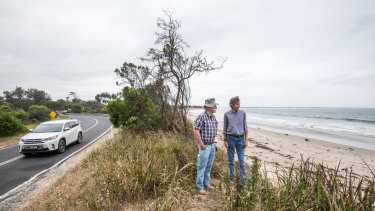
Locals Dave Sutton (left) and Phillip Heath on the remaining strip separating the surf beach from the road at Inverloch, where erosion has caused major problems.
Locals Dave Sutton (left) and Phillip Heath on the remaining
strip separating the surf beach from the road at Inverloch,
 where erosion has caused major problems.
Other places at risk include areas around Queenscliff and Barwon Heads on the Bellarine Peninsula; the south-west Victorian towns of Port Fairy and Portland; and Tooradin, Lang Lang and Seaspray in the state's south-east.
A report tabled in Victoria's Parliament last week examines the myriad threats to the state’s fragile coastline, painting an alarming picture of damage to the environment and suburban Melbourne if no action is taken.
The Victorian Environmental Assessment Council report cites a 20-centimetre sea-level rise by 2040 and between 40 centimetres and one metre by century’s end.

Read the story from The Age by Benjamin Preiss and Adam Carey - “Rising sea, erosion to wreak havoc in low-lying suburbs: report.”

14 June, 2019

Climate crisis: Alaska is melting and it’s likely to accelerate global heating

A city in western Alaska has lost a huge stretch of riverbank to erosion that may turn it into an island, amid renewed warnings from scientists over the havoc triggered by the accelerating melting of the state’s ice and permafrost.
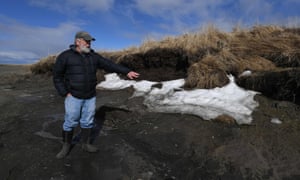
Rick Knecht, an archeologist, shows a site threatened by climate breakdown erosion caused by melting permafrost on the Yukon Delta in Alaska.
Rick Knecht, an archeologist, shows a site threatened
by climate breakdown erosion caused by melting
permafrost on the Yukon Delta in Alaska.
Residents of the small city of Akiak were alarmed to find the Kuskokwim River suddenly much closer to housing after approximately 75ft to 100ft of riverbank disappeared over the course of just a few hours.
The erosion, which occurred late last month, stripped away the riverbank for the entire length of Akiak, which has a population of around 340.

Read the story from The Guardian by Oliver Milman - “Climate crisis: Alaska is melting and it’s likely to accelerate global heating.”

15 March, 2018

Left to Louisiana’s tides, a village fights for time

JEAN LAFITTE, LA. — From a Cessna flying 4,000 feet above Louisiana’s coast, what strikes you first is how much is already lost. Northward from the Gulf, slivers of barrier island give way to the open water of Barataria Bay as it billows toward an inevitable merger with Little Lake, its name now a lie. Ever-widening bayous course through what were once dense wetlands, and a cross-stitch of oil field canals stamp the marsh like Chinese characters.
Vanishing wetlands near the east bank of the Mississippi River. 
Saltwater intrusion, the result of subsidence, sea-level rise and erosion, has killed off the live oaks and bald cypress. Stands of roseau cane and native grasses have been reduced to brown pulp by feral hogs, orange-fanged nutria and a voracious aphid-like invader from Asia. A relentless succession of hurricanes and tropical storms — three last season alone — has accelerated the decay. In all, more than 2,000 square miles, an expanse larger than the state of Delaware, have disappeared since 1932.


Read The NewYork Times story - “Left to Louisiana’s tides, a village fights for time.”

18 February, 2018

Sea Level Rise Is Accelerating: 4 Inches Per Decade (or More) by 2100

The rate of sea level rise is accelerating so fast that some coastal communities could confront an additional 4 inches per decade by the end of the century—a growing concern now confirmed by thorough measurements from space.
Rising sea levels increase the risk of storm surge flooding in coastal cities
like Charleston, South Carolina, shown here after Hurricane Matthew.
 
At that rapid pace of change, vulnerable communities might not be able to keep up. Storm surges will increase erosion and damage homes, businesses and transportation infrastructure in some areas. In other places, seawater will intrude on freshwater aquifers. In South Asia and the islands, people will lose the land where they live and farm. And the changes will arrive much faster than they do today.

Scientists have been warning about this speed-up for many years based on computer climate simulations. A new study released Monday confirms the modeled trend with a detailed analysis of satellite observations spanning a quarter of a century.


Read the Inside Climate News story by Bob Berwyn - “Sea Level Rise Is Accelerating: 4 Inches Per Decade (or More) by 2100.”

10 April, 2017

Five Pacific islands lost to rising seas as climate change hits

Five tiny Pacific islands have disappeared due to rising seas and erosion, a discovery thought to be the first scientific confirmation of the impact of climate change on coastlines in the Pacific, according to Australian researchers.
Add caption
The submerged islands were part of the Solomon Islands, an archipelago that over the last two decades has seen annual sea levels rise as much as 10mm (0.4in), according to research published in the May issue of the online journal Environmental Research Letters.

The missing islands, ranging in size from 1 to 5 hectares (2.5-12.4 acres) were not inhabited by humans.

But six other islands had large swaths of land washed into the sea and on two of those, entire villages were destroyed and people forced to relocate, the researchers found.