Showing posts with label climate policies. Show all posts

12 December, 2019

Scott Morrison acknowledges smoke haze concerns as he stands by climate policies

The Prime Minister has sought to reassure Australians he understands community concerns about bushfires and smoke haze as the Federal Government faces criticism for its climate policies.
People walk across a bridge in the Sydney CBD, the sky is orange and hazy with Sydney tower in the background.
Sydney was trapped in an orange haze due to the
 number of fires surrounding NSW at one stage.
Scott Morrison acknowledged that climate change was a factor contributing to increasingly intense bushfire seasons.
But he ruled out strengthening Australia's emissions reduction target, despite New South Wales Government plans to take greater action.
"I know, because I'm a Sydneysider, how unusual it is to see that haze across my city, and I know how distressing that would be, particularly for young people who haven't seen that before," Mr Morrison said.
"So that is why I think it is important to have a sense of calm on these matters on the basis of information."

21 November, 2019

Scott Morrison's pea-and-thimble trick

Did you notice that the Morrison government has slashed Australia's Paris climate target in half, a detail that somehow escaped scrutiny in the flurry of climate policies announced this week?
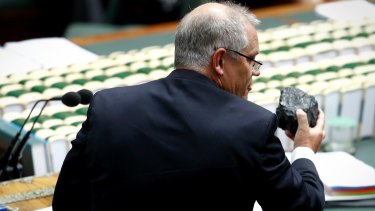
Backing black: Then federal Treasurer Scott Morrison brought a lump of coal to question time in February 2017.
Backing black: Then federal Treasurer Scott Morrison
brought a lump of coal to question time in February 2017.
No? Well, neither did most of the country.

On paper, Australia remains committed to cutting 2005-level emissions 26 per cent by 2030.

According to environment department officials called to Senate estimates last week, that means the nation has to reduce - abate - a total of 695 million tonnes of carbon dioxide-equivalent in the decade of 2021-2030.


Read the story from The Sydney Morning Herald by Peter Hannam - “Scott Morrison's pea-and-thimble trick.”

17 May, 2019

The costs for climate (in) action

As the federal election approaches, debate over the climate policies of the major parties continues – along with a lot of misinformation over how to evaluate the relative merits and shortcomings of what each party is offering.
Flooded intersection of Eagle and Charlotte Streets, Brisbane floods 2011. 
With recent polling showing that the majority of Australians see climate change as the number one threat, we need to understand whether the climate policies pledged by the major parties would get Australia on track to meet its Paris commitments, and how these climate policies compare to what other countries are doing.


Read the Pursuit story from the University of Melbourne by Kate Dooley - “The costs for climate (in) action.”

30 October, 2018

German Government Faces Lawsuit Over Its Failure Meet Climate Goals

Three families in Germany are suing their government hoping to compel it to cut carbon emissions as it has promised, joining a growing trend of citizens worldwide taking legal action against national governments over insufficient climate policies.
Germany's government, and Chancellor Angela
Merkel (center) face a lawsuit by three farming
families over the country's climate policy. 
Greenpeace Germany filed the lawsuit last week on the families’ behalf. The complaint alleges that the government’s failure to meet its 2020 climate target violates the families’ rights to life and health. In 2007, the German government pledged to cut its emissions by 40 percent below 1990 levels by 2020, but now says it will not meet that target.

The three families—the Backsens, the Blohms, and the Lütke Schwienhorsts—are organic farmers whose livelihoods are threatened by climate change.

The German government now says the country’s emissions will fall only 32 percent by 2020 and said instead of working toward meeting that goal it will instead focus on meeting its 2030 goal of a 55 percent reduction.   


Read the story by Dona Drugmand from Climate Liability News - “German Government Faces Lawsuit Over Its Failure Meet Climate Goals.”

15 August, 2018

Climate Case Gets Green Light from European Union Court

A lawsuit dubbed the People’s Climate Case, which challenges the European Union’s 2030 emissions reduction target and other climate policies, was given the green light by a court on Monday and is moving forward.
One of the plaintiffs in a climate case against the European
Union was a victim of the wildfires that ravaged Portugal in 2017.
The European General Court accepted the case brought by 10 families from Portugal, Germany, France, Italy, Romania, Kenya and Fiji and a youth association in Sweden. The case was first filed in May, but the court’s acceptance means that the defendants, the European Parliament and the Council of the European Union, have two months to file their response.

The families contend that the EU’s current target to reduce emissions—40 percent below 1990 levels by 2030—is insufficient and fails to protect their fundamental rights. They also demand that three regulatory acts designed to implement that target be nullified as a more stringent target is set.


Read the Climate Liability News story by Dana Drugmand - “Climate Case Gets Green Light from European Union Court.”

19 January, 2018

Formula E could be the only viable motorsport series by 2040

Alejandro Agag, the founder and CEO of Formula E championship has predicted that, given the current climate policies, the electric vehicles racing series will be the motorsport of the future.
Formula E will be the motorsport of the future.
Mr. Agag said that advanced technological developments, the direction of climate policies in restricting carbon emissions and the increasing decline in conventional combustion engine vehicles manufacturing will soon take over the motorsports industry too.

"I think Formula E is going to get really, really big. I believe that in 20, 30, 40 years, we will be the only motorsport out there”, he said.


Read the Climate Action story - “Formula E could be the only viable motorsport series by 2040.”

21 January, 2017

A clear and present danger - to the world

Donald Trump - climate change plans "go dark".
On January 20, Donald Trump was sworn in as the 45th president of the United States. Minutes later, the White House website switched handsand previous pages detailing President Obamas climate change plans went dark.

The new website features, instead, a page dedicated to “An American First Energy Plan,” which details the new administration’s stance towards energy and (a lack of) climate policy. The plan tracks almost exactly with promises made by Trump during the campaignto unleash more fossil fuel extraction, especially on federal lands, cancel Obama-era climate policies like the Climate Action Plan and the Waters of the United States rule, and invest in “clean coal” technology.

Trump has yet to explain how his plan would succeed in both supporting the natural gas fracking boom and bringing back coal jobs. Energy policy experts largely agree that the increased availability of cheap natural gas has contributed to much of the recent downturn in coal’s prospectswhich would make Trumps promise to embrace the shale oil and gas revolution antithetical to its promise to revive Americas coal industry.

02 January, 2017

Australian climate politics in 2017: a guide for the perplexed

If you thought the climate debate has
 been ugly, you haven't seen anything
yet - Marc Hudson.
If you thought the climate debate has been ugly, you haven’t seen anything yet. In 2017 Australia will review its climate policies, and the process is not off to a good start.

To recap: with the release of the climate review’s terms of reference at the end of 2016, the federal environment and energy minister, Josh Frydenberg, appeared to place on the table an emissions intensity scheme (a widely supported form of carbon pricing). He then wisely went to Antarctica.

After its day in the sun, Prime Minister Malcolm Turnbull swiftly backtracked in part due to pressure from conservatives within the Coalition. By allowing a small group of politicians to take the most cost-effective policy off the table at the outset, Turnbull has made the coming year(s) that much harder to manage.

In the same week, Chief Scientist Alan Finkel reported his initial findings on the security of the National Electricity Market. He stated that his review “will continue to analyse all the options to ensure future security of power supply and compliance with climate obligations”.

And that was only 2016…

Read the piece on The Conversation by a PhD Candidate from the Sustainable Consumption Institute at the University of Manchester, Marc Hudson - “Australian climate politics in 2017: a guide for the perplexed.”

26 September, 2016

Attacks on wind and solar policies turn to state initiatives

The assault on climate policies and renewable energy initiatives has taken a new form: having obliterated almost all of the effective policies at federal level, the focus is now switching to state-based targets, using the old arguments of higher costs and little abatement as the basis for the attack.

The new stance is being led by conservative institutions such as the Grattan Institute – with the enthusiastic support of the lobby groups that represent the coal and gas-fired generators, and the federal government, which shows no inclination to move on from Abbott-era policies.

The Grattan Institute over the weekend released another major report analysing events in South Australia in recent months. Parts of it were immediately seized upon by those seeking to place renewables, and wind and solar in particular, in a poor light and promote the interests of the gas industry.

The report is one of many that have highlighted the complexities of the situation in Australia, and the poor policy framework.

Read the thoughts of Giles Parkinson on RenewEconomy -“Attacks on wind and solar policies turn to state initiatives.”

12 September, 2016

Garbage in, garbage out: Why the CCA got it so wrong

Giles Parkinson explains why
the CCA got it so wrong.
 
If Australia continues to rely on a renewable energy target to help meet its share of the global goal of capping global warming by 2°C, it is likely to result in new coal plants being built in the 2040s.

Sound implausible? Does it sound completely crazy? Yes, but this is the advice that was given to the Climate Change Authority and presumably helped them form their controversial stance on climate policies that was delivered to the government last week.

The idea that Australia, in a world aiming at cutting missions, would be likely to open new coal plants at a time when it should be hitting a zero net carbon target seems extraordinary.

Yet that is what consultancy Jacobs is suggesting, even though its modelling shows that 90 per cent of Australia’s generation by 2040 would come from renewables under an extension of the RET.

Read the story by Giles Parkinson in RenewEconomy - “Garbage in, garbage out: Why the CCA got it so wrong.”

01 September, 2016

Frydenberg not listening to calls to toughen emissions limits


(Many have heaped praise on what happened in Paris last December when the world’s nations agreed to limit global warming to 1.5 degrees above pre-industrial levels, and so although that praise is not necessarily misplaced to see it as a solution to climate change is, at best, mischievous. Even if the world’s nations all achieve their Intended Nationally Determined Contributions (INDCs) as submitted at Paris and which are not binding, the global temperatures are predicted to rise by nearly three degrees. Understanding that, we need to be cautious of any comments from Mr Frydenberg arguing that Australia is achieving its targets and beyond that, suggesting we should subsequently ignore any calls from the government appointed Climate Change Authority for tougher climate policies – Robert McLean)

Minister for Energy and Environment, Josh
Frydenberg - known to some as "Mr Coal".
The Coalition’s energy and environment minister, Josh Frydenberg, has hit back at a report from the Climate Change Authority calling for Australia to toughen its climate policies.

Frydenberg said the government had no plans to tighten limits on emissions by the biggest polluters and the Climate Change Authority’s advice to introduce two emissions trading schemes was a “report to, not by, government” and committed only to a review of its policies in 2017.

On Wednesday the Climate Change Authority advised the Australian government to institute two emissions trading schemes and strengthen regulations in order to meet Australia’s 2030 emission reduction targets and to allow it to lift those targets in line with international climate change obligations.

25 June, 2016

If you despair of Australia’s lacklustre climate policies, you might take heart from the Greens’ stated goal of limiting global warming to 1.5. But are the partys own policies up to the job?

Shortly after announcing this target late last year, the Greens launched an ambitious renewables policy, promising to achieve 90% renewable electricity by 2030 and save money in the process.

But as wonderful as it sounds, even this plan is insufficient to meet a 1.5 target.

The arithmetic is simple. According to the Intergovernmental Panel on Climate Change (IPCC), to preserve a two-thirds chance of avoiding 1.5 warming, future carbon dioxide emissions must not exceed 200 billion tonnes. As annual global emissions are now around 40 billion tonnes, we will blow the budget within five years.

Read the piece on The Conversation  by the Senior Lecturer in International Relations at Macquarie University, Jonathan Symons -  Are the Greens really the climate radicals we need?