Showing posts with label across Australia. Show all posts

25 December, 2019

Yes, Australia has always had bushfires: but 2019 is like nothing we've seen before

As the area burned across Australia this fire season pushes beyond five million hectares, an area larger than many countries, stories of destruction have become depressingly familiar.
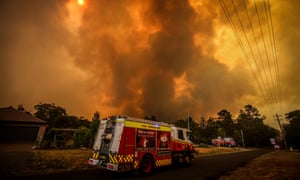
Scientists say the lack of moisture in the landscape is a key reason this year’s bushfire have been so severe.
Scientists say the lack of moisture in the landscape
 is a key reason this year’s bushfire have been so
severe and the climate crisis is behind the lengthening
 of the fire season.
At the time of writing, nine people have been killed. Balmoral, in the New South Wales southern highlands, is the latest community affected in a state where up to 1,000 homes have been destroyed. A third of the vineyard area and dozens of homes were razed in the Adelaide Hills. It is too early for a thorough examination of the impact on wildlife, including the many threatened species in the fires’ path.
Does this qualify as unprecedented? Plenty of experts say yes, but not all politicians and newspaper columnists are convinced. Last week the acting prime minister, Michael McCormack, assured the nation that “we’ve had these smoke hazes before. We’ve had bushfires before.” After returning from Hawaii, Scott Morrison, acknowledged the fires were severe, but also adopted a familiar line: Australia has always had bushfires.

Read the story from The Guardian by Adam Morton - “Yes, Australia has always had bushfires: but 2019 is like nothing we've seen before.”

17 March, 2019

150,000 students strike for climate action around Australia.

15 March 2019: An estimated 150,000 students and adult supporters across Australia joined massive, vibrant, nationwide climate strikes today, in over 60 cities and towns across the nation, demanding immediate and urgent leadership from Australian politicians to tackle climate change. Internationally, students in over 100 countries also took action. 
The Sydney School Strike at Town Hall - one of over 60 - March 15.
Next steps: Students are discussing further strikes if they don’t see the action they need from politicians. Other plans include #ClimateElection KickStart meetings at the end of March to make plans to pressure politicians to show climate leadership, and local climate change candidate forums where candidates will be challenged by school students to commit to stop Adani and act on climate change. 

Read the School Strike for Climate Action, Australia - “150,000 students strike for climate action around Australia.

02 December, 2018

Climate Change Protest Draws Thousands of Australian Students.

MELBOURNE, Australia — As wildfires raged across the country, a heat wave again threatened the Great Barrier Reef and a mining giant announced it would push ahead with a huge coal project, thousands of students across Australia quit school for the day on Friday to protest government inaction on climate change.
Milou Albrecht, 14, center, speaking to students attending
 a rally for climate change action at the Old Treasury
Building in Melbourne, Australia, on Friday.
The students — ranging in age from 5 to 18 — came from more than 200 schools to demand that the federal government block construction of the Adani Carmichael coal mine, block any new coal or gas projects and require 100 percent renewable energy use by 2030.

“I am here because I am terrified,” Harriet O’Shea Carre, 14, told a crowd of thousands of student marchers outside the Old Treasury Building in Melbourne. Protesters spilled out onto the road with signs saying “civil disobedience requires no permission slip” and “don’t be a fossil fool.”


Read The New York Times story by Livia Albeck-Ripka - “Climate Change Protest Draws Thousands of Australian Students.

20 June, 2018

Fracking: Labor pledges to tighten regulations to protect water resources

Regulations on unconventional gas development across Australia would be tightened up if Labor wins the next election.
A worker looks over a coal seam gas project in Narrabri.
Labor says shale gas projects should be subjected
 to the same level of environmental scrutiny.
Labor’s shadow minister for the environment Tony Burke says the party, if elected, will keep the commitment it took to the 2016 election to broaden the “water trigger” to include other forms of unconventional gas extraction. The current water trigger, introduced by the Gillard government in 2013, assesses water resources as a matter of national significance only in relation to coal seam gas and coal mining.

It means that much of the country isn’t covered by the legislation, even though the process used to extract shale and tight gas is similar to that used for coal seam gas mining.


Read the story from The Guardian by Lisa Cox - “Fracking: Labor pledges to tighten regulations to protect water resources.”

24 February, 2018

Standing Up for Rural Australia Means Standing Up on Climate Change

The farmers in this ad represent thousands from across Australia who are demanding rural and regional politicians do more to stop damage to our climate harming our livelihoods. 

We must act, to prevent a situation where our kids won’t have the choice to farm like we do.


25 August, 2017

Finkel’s Clean Energy Target plan ‘better than nothing’: economists poll

Few topics have attracted as much political attention in Australia over the past decade as emissions reduction policy.
Enough blue-sky thinking: economists back the
emissions policy that Alan Finkel has put on the table.
Amid mounting concern over electricity price increases across Australia and coinciding with blackouts in South Australia and near-misses in New South Wales, the Australian government asked Chief Scientist Alan Finkel to provide a blueprint for reform of the electricity industry, in a context in which emissions reduction policy was an underlying drumbeat.

In a new poll of the ESA Monash Forum of leading economists, a majority said that Finkel’s suggested Clean Energy Target was not necessarily a better option than previously suggested policies such as an emissions trading scheme. But many added that doing nothing would be worse still.


Read the piece on The Conversation by the Director of Carbon and Energy Markets at Victoria University, Bruce Mountain -  “Finkel’s Clean Energy Target plan ‘better than nothing’: economists poll.”

16 December, 2016

Climate change played a role in Australia’s hottest October and Tasmania’s big dry in 2015

Climate change made some of Australia’s 2015 extreme weather events more likely, according to research published today in the Bulletin of the American Meteorological Society.

As part of an annual review of global weather extremes, these studies focused on October 2015, which was the hottest on record for that month across Australia. It was also the hottest by the biggest margin for any month.

October 2015 was also the driest for that month on record in Tasmania, which contributed to the state’s dry spring and summer, and its bad fire season.

El Niño events usually drive global temperatures higher, and 2015 had one of the strongest on record. So were these records due to El Niño, or climate change? The research shows that while El Niño had some influence on Australia’s weather, it was not the only culprit.