Showing posts with label Alan Finkel. Show all posts

15 September, 2018

Scott Morrison needs a plan to cut emissions but all he has is a fairytale

It all starts as a bit of a fairytale,” the chief scientist, Alan Finkel, told a room full of renewable energy types in Canberra this week. “Once upon a time there was an independent review into the national energy market.”
‘Alan Finkel says a moment has arrived in Australia’s national
 story. But the Morrison government has nothing to say'.
Finkel did conduct that review at the behest of Malcolm Turnbull and the states when the objective was to fix the problems that have cascaded through the energy market since Tony Abbott opposed Labor’s carbon price to win an election.

The chief scientist proposed a clean energy target as the fix. Abbott and the deep feelings brigade inside the Coalition didn’t like it. It wouldn’t fly, so Turnbull and the energy minister, Josh Frydenberg, retreated and regrouped. They then got officials to produce the national energy guarantee, hoping that would work, given the Neg mechanism dealt with both reliability and emissions reduction, and that might subdue some of the conservative opposition.


Read the story from The Guardian by Katharine Murphy - “Scott Morrison needs a plan to cut emissions but all he has is a fairytale.”

10 September, 2018

The Driven Podcast: Chief scientist Alan Finkel on battery EVs and fuel cell EVs

Australia’s chief scientist Alan Finkel has had a close connection to electric vehicles for more than a decade.

He was the chief technology officer for the Better Place, the ambitious company that imagined swapping battery packs in standard models, but whose ambition was run over by the fall in the battery costs.

Finkel owns two electric vehicles of his own – a Nissan Leaf and a Tesla – and loves them. “It’s so much more exciting” driving an EV, he says. “You feel so much more connected than in a petrol power vehicle.”


Read/listen to the RenewEconomy story/podcast - “The Driven Podcast: Chief scientist Alan Finkel on battery EVs and fuel cell EVs."

17 January, 2018

Climate action in 2018: expect same, but different

As I predicted a year ago, 2017 was another vicious and bloody-minded year in Australian climate politics. Yet the political bickering belied the fact that it was actually a great year for green energy.
Illustration by Andrew Dyson.
Nowhere was that more in evidence than in South Australia, which got its big battery inside a 100-day deadline, with the world’s biggest solar thermal plant set to begin construction this year. Elsewhere, Prime Minister Malcolm Turnbull talked up the prospects of the Snowy 2.0 hydro storage project.

Yet the politics remain as rancorous as ever. The federal government unveiled its National Energy Guarantee (NEG) in November, after Chief Scientist Alan Finkel’s Clean Energy Target proved too rich for some in the Coalition. Just before Christmas, the long-awaited climate policy review was released, and was immediately branded as weak.

Both issues are unresolved, and are set to loom large on the landscape this year. But what else is on the horizon?


Read Marc Hudson’s comment in today’s Melbourne Age - “Climate action in 2018: expect same, but different.”

25 October, 2017

Back to square one in energy policy: we now have a plan to produce a plan

A year and a day — that’s how long it took Frydenberg to kill off “Finkel”.
Prime minister Malcolm Turnbull (left) and federal environment
and energy minister John Frydenberg during a press conference
at parliament house in Canberra on 17 October 2017.
On 7 October 2016, just nine days after a series of tornados took out at least 22 transmission pylons in South Australia and set off a cascading series of events resulting in a state-wide blackout, federal environment and energy minister John Frydenberg commissioned chief scientist professor Alan Finkel to review the stability of our energy system. Finkel’s expert team met with regulators around the world, considered 390 submissions, held 120 meetings and commissioned modelling from multiple experts.

On 8 October this year, word trickled out that the clean energy target (CET), Finkel’s centrepiece, was dead.

A week later, Frydenberg announced the national energy guarantee (Neg). In just three weeks, with no public process, no modelling, no consultation with the Coag energy council, whose approval it requires, the newly formed Energy Security Board (ESB) had knocked together an alternative “conceptual framework”, described in an eight-page letter and a media release, that proposes to push responsibility for reliability and emissions reduction to electricity retailers.


Read the story by Simon Holmes à Court on The Guardian - “Back to square one in energy policy: we now have a plan to produce a plan.”

15 October, 2017

Dumping clean energy target is 'dealbreaker' for Labor's support

Shadow climate change
minister Mark Butler.
The shadow climate change minister Mark Butler says Labor won’t support the Turnbull government’s new energy policy if it dumps the clean energy target recommended by the chief scientist, Alan Finkel.

With the Turnbull government expected to press ahead with its new energy policy this week after consideration by the cabinet and the party room, Butler issued a clear public warning on Sunday that the loss of the clean energy target meant there was no prospect of bipartisan agreement between the major parties.

Butler said Labor had been prepared to keep an open mind on the clean energy target, even though it was not the opposition’s preferred policy option, because the model had been thought through by the chief scientist and endorsed uniformly by stakeholders across the community.

Read Katharine Murphy’s story on The Guardian - “Dumping clean energy target is 'dealbreaker' for Labor's support.”

10 October, 2017

Chief Scientist Alan Finkel makes last ditch plea for clean energy target

Australia's Chief Scientist Alan Finkel has made a last-ditch plea to save the proposed clean energy target, even as the Turnbull government signalled it will reject the proposal by the end of the year.

Chief Scientist Dr Alan Finkel and South Australian Premier Jay Weatherill. 
South Australian premier Jay Weatherill responded on Monday to the apparent standstill, saying the states should "bypass the federal government and provide investment certainty for the electricity sector" by adopting their own target.

The Turnbull government asked Dr Finkel to review Australia's electricity market to set a policy path that would ensure reliability in the electricity system while also providing clear policy settings to drive investment in generation - something the business community has been demanding.

But in the face of strong opposition from sections of the Coalition backbench to the clean energy target, the Turnbull government delayed any decision on the target while adopting the other 49 recommendations in the Finkel review.


Read the story in today’s Melbourne Age by Cole Larimer and James Massola - “Chief Scientist Alan Finkel makes last ditch plea for clean energy target.”

03 October, 2017

The Energy Innovators: Alan Finkel’s vision for the future

There are few hotter issues in Australia in recent times than the energy system and our current and future energy needs. Alan Finkel is at the centre of just about all of it.

Dr Alan Finkel.
In the second of ARENA WIRE’s Energy Innovators series featuring leading minds in the field of renewables, Australia’s chief scientist, poses the question: Would you rather embrace the future or go backwards in time?

As with all episodes of this nine-part series, you can watch the speaker’s talk and then also separately view the fascinating Q&A session that followed.

Expanding on the key recommendations of his review into the National Electricity Market, which he handed to the Turnbull government in June, Professor Finkel says investors need policy certainty to take the plunge into renewables.

And he points to natural gas, proof-of-concept testing and retail pricing as areas of growing interest.

But just as importantly, he explores how the innovation we hear of today will convert into something real and tangible tomorrow. 


Read the ARENA Wire story and watch the interview with Australia’s chief scientist, Dr Alan Finkel - “The Energy Innovators: Alan Finkel’s vision for the future.

25 September, 2017

Can two clean energy targets break the deadlock of energy and climate policy?

Malcolm Turnbull’s government has been wrestling with the prospect of a clean energy target ever since Chief Scientist Alan Finkel recommended it in his review of Australia’s energy system. But economist Ross Garnaut has proposed a path out of the political quagmire: two clean energy targets instead of one.
Garnaut’s proposal is essentially a flexible emissions target that can be adapted to conditions in the electricity market. If electricity prices fail to fall as expected, a more lenient emissions trajectory would likely be pursued.

This proposal is an exercise in political pragmatism. If it can reassure both those who fear that rapid decarbonisation will increase energy prices, and those who argue we must reduce emissions at all costs, it represents a substantial improvement over the current state of deadlock.


Read the piece on The Conversation by the Director of Carbon and Energy Markets from Victoria University, Bruce Mountain - “Can two clean energy targets break the deadlock of energy and climate policy?

18 September, 2017

Alan Finkel urges Turnbull to adopt clean energy target before states act

Alan Finkel has urged the Australian government to swiftly commit to the final recommendation of his energy review, warning the longer that commitment takes, the more likely states and territories are to set up conflicting emissions reduction schemes.
 Australia’s chief scientist, Alan Finkel, says he does
not care whether coal remains part of the energy mix,
 as long as emissions keep heading down. 
Speaking at the Melbourne economic forum at Victoria University on Monday, Finkel, Australia’s chief scientist, said that a failure to establish a clean energy target would create more uncertainty for investors, who would have to navigate various state policies.

The Victorian government announced two days after the review had been released that it was prepared to implement its own clean energy target if the federal government didn’t commit.


Read Calla Wahlquist’s story on The Guardian - “Alan Finkel urges Turnbull to adopt clean energy target before states act.”

28 August, 2017

Renewable energy booming but could soon turn to bust, analysts warn

Australia produced enough renewable energy to power 70 per cent of households last financial year, new data shows, but advocates warn the booming industry will flounder unless the Turnbull government commits to a clean energy target.

Sunverge chief executive Ken Munson said
Australia's high penetration of rooftop solar,
where one in five homes use power from
 the sun, put the country at the forefront of
 the transforming energy industry. 
The government is sharply divided over whether to adopt the target, the central recommendation of Chief Scientist Alan Finkel's review of the national electricity market.

New data to be released on Monday shows Australia produced enough renewable energy to power 7.1 million homes, or 70 per cent of households, in the year to June.

This avoided carbon pollution equal to removing 8.1 million cars from the road for a year – more than half the cars in Australia.


Read Nicole Hasham’s story in today’s Melbourne Age - “Renewable energy booming but could soon turn to bust, analysts warn.”

25 August, 2017

Finkel’s Clean Energy Target plan ‘better than nothing’: economists poll

Few topics have attracted as much political attention in Australia over the past decade as emissions reduction policy.
Enough blue-sky thinking: economists back the
emissions policy that Alan Finkel has put on the table.
Amid mounting concern over electricity price increases across Australia and coinciding with blackouts in South Australia and near-misses in New South Wales, the Australian government asked Chief Scientist Alan Finkel to provide a blueprint for reform of the electricity industry, in a context in which emissions reduction policy was an underlying drumbeat.

In a new poll of the ESA Monash Forum of leading economists, a majority said that Finkel’s suggested Clean Energy Target was not necessarily a better option than previously suggested policies such as an emissions trading scheme. But many added that doing nothing would be worse still.


Read the piece on The Conversation by the Director of Carbon and Energy Markets at Victoria University, Bruce Mountain -  “Finkel’s Clean Energy Target plan ‘better than nothing’: economists poll.”

17 July, 2017

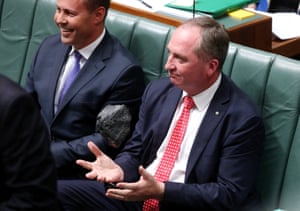
Barnaby Joyce: I'll support a clean energy target – if coal is included

The deputy prime minister Barnaby Joyce says he’s prepared to support a clean energy target such as the one recommended by the chief scientist, Alan Finkel, if the Liberals agree to set a threshold allowing high-efficiency coal in the mix.

Barnaby Joyce
Barnaby Joyce plays catch with a lump of coal in
parliament in February. The deputy prime minister and
 Nationals leader wants ‘better coal-fired power stations’. 
Joyce told Guardian Australia on Thursday he was prepared to take a positive recommendation to the Nationals party room on the clean energy target if it was set at a level at which coal was eligible for certificates.
But he said the Nationals were not able to take a formal decision on the central recommendation of the Finkel review until cabinet has resolved where to set the threshold.

Read Katherine Murphy’s story on The Guardian - “Barnaby Joyce: I'll support a clean energy target – if coal is included.”


(Is Barnaby Joyce, stupid, naive, ideological blind, crazy like a fox or just plain crazy? Most every climate scientist in the world, well 97% and that in any terms is “most”, are convinced by the science that coal must remain where it is - in the ground; and most certainly not dug up, shipped to power generators here in Australia and around the world, burnt and in the process releasing carbon dioxide and worsening the world’s near insurmountable challenge with climate change - Robert McLean)

16 June, 2017

Battery storage: How it could solve our energy problems

If chief scientist Alan Finkel gets his way, battery energy storage will be central to Australia's energy future.

More Australians are investing in battery
storage for their homes as the
technology gets cheaper
The move to battery technology is a worldwide trend and three state governments — South Australia, Victoria and Queensland — are already going it alone, commissioning their own battery storage to ensure energy security.

Batteries are used to store energy from renewable sources like solar and wind. Dr Finkel recommends all large scale wind and solar generators in Australia should have energy storage capacity.

The batteries will be particularly helpful on days when the sun doesn't shine and the wind doesn't blow.

"It can be used alongside a solar farm to help smooth the output and make any disruptions less likely and much more manageable," said Kobad Bhavnagri, head of Asia Pacific economics and policy at Bloomberg New Energy Finance.


15 June, 2017

On climate, the consumer’s vote will be more important than the party room’s

Chief scientist Alan Finkel got a lot of people very excited when he released his draft report into Australia energy security last December, less than three months after the September blackout put conservatives into a flap over wind and solar.
 Chief scientist Alan Finkel. 
We were in the midst of an unstoppable energy transition, he said, one based on cheap renewables, storage and smart software. And the technologies to address the reliability and security issues were at hand, though they were not being encouraged by the design of the market.

The energy system, Finkel went on, would need to shift dramatically from a centralised model (aka coal plants) to a decentralised model (aka rooftop solar and storage). The power, quite literally would return to the people. It was all rather exciting.

Fast forward to 9 June, and Finkel’s delivery of his final report to Council of Australian Governments leaders in Hobart, and many people are wondering what happened in between. Blame the full moon or Dark MOFO happening in the same city, but Finkel’s view of the energy future didn’t look much different to the one we’ve got now.


Read the story by Giles Parkinson on Inside Story - “On climate, the consumer’s vote will be more important than the party room’s.”

11 June, 2017

Clean energy plea from Frydenberg is 'dog whistling'

The federal energy minister is working to convince all his Coalition colleagues of the merits of a proposed clean energy target as several publicly raise concerns about its impact on coal.

The energy minister, Josh Frydenberg, says he wants
coal-fired power to remain ‘an important part of the energy mix’.
Josh Frydenberg is at pains to point out the recommendations from chief scientist Alan Finkel’s review of electricity market security would neither punish existing coal-fired power stations nor rule out new ones.

Coal backers within the government were already speaking out within 24 hours of the report’s release on Friday. But the minister said Finkel didn’t recommend any prohibitions on coal power, instead suggesting incentives to encourage sources with lower emissions.


(Mr Frydenberg has argued that the Turnbull-led Government is taking a “technology neutral” view in its attempt to resolve Australia’s energy crisis.That view, or course, allows for the use of both coal and gas, unquestionably playing into the hands of those companies eager to exploit the fracking technology and, further, allowing for the introduction new coal powered projects using so-called “clean coal”, which simply doesn’t exist.
So rather than being technology neutral, the government should be taking a “technology positive” position - that is, it should only be encouraging and investing in technology that it knows and science confirms, is a clean energy, being solar, wind, pumped hydro, wave or any technology that is carbon free.

“Technology neutral” is nothing more than “dog whistling” - Robert McLean)

09 June, 2017

Alan Finkel’s emissions target breaks Australia’s Paris commitments

Less than two weeks ago, Alan Finkel told the Senate his landmark report would help Australia meet the commitments it made in Paris to reduce its economy-wide emissions by 28% below 2005 levels by 2030.

The report by the chief scientist, Alan Finkel, has
 modelled a clean energy target that would reduce
 electricity emissions by 28% on 2005 levels.
But his recommendations on the future of the National Electricity Market, released today, appear to fly in the face of those very commitments.

Before Senate estimates Finkel said: “We are very cognisant of the commitment that the nation has made through the Paris accords.

“We absolutely need to deal with the issue of ensuring that the electricity sector can do its fair share in helping the nation to meet its obligations under the Paris accord – the COP21 accord.”

Now today, his landmark review of the National Electricity Market has modelled cuts to emissions of the electricity sector that are the same as what the entire economy needs to do: 28% below 2005 levels by 2050. He said anything deeper, which had been suggested in other reports, would cause problems.

Read Michael Slezak’s story on The Guardian - “Alan Finkel’s emissions target breaks Australia’s Paris commitments.”


(The Finkel Review, it has been argued, would be sufficient in content to end Australia’s “energy wars” - reports suggest the review has simply prepared the ground for further rhetorical debates further delaying any real action on addressing the drivers of climate change. Sadly the government, and other “responsible men”, will point the the work of Dr Finkel justifying their arguments for further inaction in dealing with and obvious and real cause of climate change, meaning that Australia will become even more of the free rider, a “leaner” in Joe Hockey’s terms, on the world community in playing its part in avoiding catastrophic climate change - Robert McLean)

The Finkel review explained: what's in it, and why you should care

Alan Finkel, Australia's chief scientist, is due to release his review of Australia's energy market on Friday afternoon. The review has the potential to dramatically shake up the future energy supply of this country. So what do you need to know about it?
Stephanie Peatling.

First, what is the Finkel review?

The Finkel review is the shorthand name for a review of the national electricity market, commissioned by federal and state energy ministers last year.

It was prompted - in part - by the blackouts in South Australia, which focused national attention on energy security.

The review will provide governments with a blueprint for energy security across the grid. It will also look at affordability and sustainability, as more renewable energy flows into the electricity system, and coal-fired power stations close.


Read the piece by Stephanie Peatling in today’s Melbourne Age - “The Finkel review explained: what's in it, and why you should care.”

Alan Finkel: the man who could bring peace to Australia's climate wars

One Nation senator Malcolm Roberts was waiting but Alan Finkel was ready.

Chief scientist Dr Alan Finkel. 
The chief scientist, who has a PhD in electrical engineering and worked as a postdoctoral research fellow in neuroscience, could see what Parliament's most persistent climate change sceptic was doing.

Did Dr Finkel believe it was important for a scientist to keep an open mind, Senator Roberts wanted to know.

Dr Finkel spotted the trap and said he was happy to own up to a "healthy degree of scepticism”.


Read Stephanie Peatling’s story in today’s Melbourne Age - “Alan Finkel: the man who could bring peace to Australia's climate wars.”

07 June, 2017

Tony Abbott warns against low emissions target ahead of Finkel review

Tony Abbott has fired a public warning shot ahead of Friday’s release of the Finkel review, declaring it would be a “big mistake” for the government to adopt a low emissions target which knocked out new high-efficiency coal-fired power stations.

Tony Abbott: ‘Anything that makes it impossible for us
 to bank new, efficient coal-fired power
stations I think is a big mistake.’ 
The former prime minister used a radio interview on 2GB on Wednesday afternoon to add his dissenting voice to commentary already expressed by government conservatives in the wake of Donald Trump’s withdrawal from the Paris climate agreement.

Abbott said he was concerned about media reports that Australia’s chief scientist, Alan Finkel, would recommend a low emissions target to the prime minister and the premiers this Friday.

He said he was anxious, based on “well briefed” reports, that the Finkel review “gives us not 50%, but 70% renewables by 2030 – and coal, which is by far the cheapest form of baseload power … goes from currently about 65% to 20% of total energy generation.”


06 February, 2017

Donald Trump reminiscent of Stalin says chief scientist Alan Finkel as science 'literally under

Australia's Chief Scientist Alan Finkel has compared US President Donald Trump's move to censor environmental data with former Soviet dictator Josef Stalin's control of science in the USSR.
Data censorship criticised: Chief Scientist Alan
 Finkel has warned that Donald Trump is like
Stalin when it comes to science. 

Speaking at a Chief Scientists' roundtable discussion at the Australian National University on Monday, Dr Finkel made his comments saying he was "going off topic" as "science is literally under attack”.

Dr Finkel said: "The Trump administration has mandated that scientific data published by the EPA [Environmental Protection Agency] must undergo review by political appointees before they can be published.”

In the first week of his presidency Mr Trump's administration informed the EPA it could not send out press releases and no blog messages could be published. The EPA was also told "no new content can be placed on any website”.


Read Marcus Strom’s story in The Sydney Morning Herald - “Donald Trump reminiscent of Stalin says chief scientist Alan Finkel as science 'literally under.”