Showing posts with label power stations. Show all posts

25 August, 2019

Australian power stations among world's worst for toxic air pollution

Power stations in Victoria’s Latrobe Valley and New South Wales’s Lake Macquarie region have been named on a list of the world’s biggest hotspots for toxic air pollution.
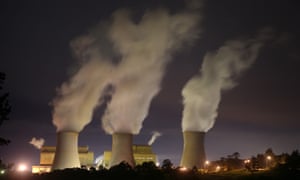
Yallourn Power Station in the Latrobe Valley, Victoria
The Yallourn power station in Victoria’s Latrobe Valley,
which along with Loy Yang A and Loy Yang B
power stations, produced 151 kilotonnes of sulphur
dioxide emissions in 2018 and covers a population
 of more than 470,000 people.
A new report by Greenpeace, published on Monday, used satellite data published by Nasa to analyse the world’s worst sources of sulphur dioxide (SO2) pollution, an irritant gas known to affect human health and one of the main pollutants contributing to deaths from air pollution worldwide.
The greatest source of SO2 in the atmosphere is the burning of fossil fuels in power stations and other industrial facilities.

Read the story from The Guardian by Lisa Cox - “Australian power stations among world's worst for toxic air pollution.”

17 July, 2018

Energy plan keeps the coal fires burning as long as possible

Australian households must prepare for a mammoth overhaul of the nation’s electricity grid as investment surges into renewable energy, sparking a new call to keep coal-fired power stations running for decades to help with the transition.
Energy reliability will require that the life of coal-fired
 power stations be extended, according to the report.
The nation’s energy market operator has warned that Australians are exposed “more than ever” to the risks and costs of the disruption as it sets out a series of major projects needed to improve the capacity and reliability of the electricity grid.

With almost 80 per cent of new energy projects using wind and solar generation, the peak regulator has outlined a sweeping investment plan including new transmission lines, battery storage and expanded hydro-electric projects to cope with the change.


Read the story from The Age by  David Crowe - “Energy plan keeps the coal fires burning as long as possible.”

04 April, 2018

Coal-fired power stations caused surge in airborne mercury pollution, study finds

Airborne mercury pollution from coal-fired power stations in Victoria’s Latrobe valley increased 37% in just 12 months, according to an annual national survey of toxic emissions.
The mercury output from Loy Yang B coal-fired power station alone
 more than doubled to 831kg in 2016-2017, the national survey of
toxic emissions found.
The mercury output from Loy Yang B power station alone more than doubled to 831kg in 2016-2017, an increase of 123% over five years.

The brown coal burning power station produced more than 640 times the airborne mercury pollution of Eraring power station near Newcastle, New South Wales.

Eraring, Australia’s largest coal-fired power station, produces three times the energy of Loy Yang B power station but reported just 1.3kg of airborne mercury pollution in 2016-17, a reduction of 97% over the past five years.


Read Calla Wahlquist’s story from The Guardian - “Coal-fired power stations caused surge in airborne mercury pollution, study finds.”

01 April, 2018

Mining firm in talks with government over Clean Energy Finance Corporation oil field funding proposal.

Resources Minister Matt Canavan said carbon
capture and storage can cut emissions and
 retain access to coal-fired power.
The company behind an Australian-first plan to use pollution from power stations to extract oil says taxpayers should help fund the project, despite criticism that it uses an unproven and expensive technology.

The Turnbull government has been in talks with the proponent over the venture, and believes such technologies can lower carbon emissions while keeping coal-fired power stations running.


19 November, 2017

Latrobe Valley power plant plans locked up due to terrorism fears

Fears of a possible terror attack on Victoria's Latrobe Valley power stations have led the Andrews government to lock up a stash of public documents for the next decade.
The Yallourn power plant in Gippsland's
Latrobe Valley could be a target for terrorism.
The documents were withdrawn from public access within days of the state having learnt it faces a higher risk of blackouts this summer and an increased risk of energy shortfalls over the next decade.

The trove includes technical plans of the Yallourn brown coal power station, which, it is feared, could be used to strike at Victoria's power network.

Yallourn is the second largest power station in Victoria and provides about 22 percent of the state's power supply and 8 percent of demand in the national electricity market.

The ageing plant has replaced Hazelwood as the most emissions-intensive power station in Australia, but remains critical to Victoria's energy needs.


Read Adam Carey’s story in today’s Melbourne Age - “Latrobe Valley power plant plans locked up due to terrorism fears.”

16 August, 2017

Energy solutions but weak on climate – experts react to the Finkel Review

The keenly anticipated Finkel Review, commissioned in the wake of last year’s South Australian blackout, has made a range of recommendations aimed at delivering a reliable, secure and sustainable National Electricity Market.

Dr Alan Finkel. 
Among the proposals is a new Clean Energy Target to boost investment in low-carbon electricity generation, as well as moves to require high-emitting power stations to give three years’ notice before shutting down.

Below, our experts react to the measures.


07 June, 2017

Tony Abbott warns against low emissions target ahead of Finkel review

Tony Abbott has fired a public warning shot ahead of Friday’s release of the Finkel review, declaring it would be a “big mistake” for the government to adopt a low emissions target which knocked out new high-efficiency coal-fired power stations.

Tony Abbott: ‘Anything that makes it impossible for us
 to bank new, efficient coal-fired power
stations I think is a big mistake.’ 
The former prime minister used a radio interview on 2GB on Wednesday afternoon to add his dissenting voice to commentary already expressed by government conservatives in the wake of Donald Trump’s withdrawal from the Paris climate agreement.

Abbott said he was concerned about media reports that Australia’s chief scientist, Alan Finkel, would recommend a low emissions target to the prime minister and the premiers this Friday.

He said he was anxious, based on “well briefed” reports, that the Finkel review “gives us not 50%, but 70% renewables by 2030 – and coal, which is by far the cheapest form of baseload power … goes from currently about 65% to 20% of total energy generation.”


25 May, 2017

India cancels plans for huge coal power stations as solar energy prices hit record low

India has cancelled plans to build nearly 14 gigawatts of coal-fired power stations – about the same as the total amount in the UK – with the price for solar electricity “free falling” to levels once considered impossible.
A field of solar panels at Cochin International Airport in southern India.
Analyst Tim Buckley said the shift away from the dirtiest fossil fuel and towards solar in India would have “profound” implications on global energy markets.

According to his article on the Institute for Energy Economics and Financial Analysis’s website, 13.7GW of planned coal power projects have been cancelled so far this month – in a stark indication of the pace of change.

In January last year, Finnish company Fortum agreed to generate electricity in Rajasthan with a record low tariff, or guaranteed price, of 4.34 rupees per kilowatt-hour (about 5p).

Mr Buckley, director of energy finance studies at the IEEFA, said that at the time analysts said this price was so low would never be repeated.


14 March, 2017

The Six Pillars of South Australia’s $550 million energy security plan

The South Australian Government has today announced a $550 million package to address energy security issues within the state. 
The South Australian Government will invest in a
new publicly owned gas generator as part of
its $550 million energy security plan. 

The plan will provide support for the construction of new renewable energy power stations, battery storage facilities, a publicly owned gas generator, and provides the state energy minister greater control over the operation of power stations in times of emergencies.

The plan follows two significant events in the last six-months which left parts of the state, or at times the whole state, without electricity during extreme weather events.

In announcing the plan this morning, South Australian Premier Jay Weatherill cited the need to act on energy security, stating that the open energy market had failed to make the investments necessary to maintain energy security in the state.


Read the RenewReporter story by Michael Mazengarb - “The Six Pillars of South Australia’s $550 million energy security plan.”

13 March, 2017

Reality check, Malcolm: you've already lost the war on renewables

For three years in a row, there's been more
investment globally in renewables than
in fossil fuel power stations. 
The war on renewable energy is entering its final, desperate stages. It is inevitable that Australia and the world will soon be entirely powered by the wind, sun, waves and water. The only questions left are whether that will happen in time to prevent the worst impacts of global warming, if coal-mining communities will be supported through the transition, and exactly when the Coalition will crawl out of its ideological bunker and realise the battle is already over.

What makes me so sure that the game is up for fossil fuels? It's not the increasing shrillness of a national Treasurer fondling a lump of coal in our parliament, or the "truth overboard" attempts to blame renewable energy for everything from South Australian blackouts to arrested production at Alcoa's Portland aluminium smelter.


Read Mark Wakeham’s comment in The Sydney Morning Herald - “Reality check, Malcolm: you've already lost the war on renewables.”

28 February, 2017

Government green bank receives funding request for $1.2 billion coal-fired power plant

Victoria's Hazelwood coal plant
will shut in March.
The Turnbull government's push for taxpayers to finance new coal-fired power stations is facing its first test after an application for support was lodged with the national green bank.

Clean Energy Finance Corporation chief Oliver Yates told a Senate estimates hearing that the agency received an email on Friday from an unidentified company requesting a loan for a proposed $1.2 billion, 900 megawatt coal plant with carbon capture and storage.


Read Adam Morton’s story in today’s Melbourne Age - “Government green bank receives funding request for $1.2 billion coal-fired power plant.”