Showing posts with label Australian National University. Show all posts

07 January, 2020

Listen to your people Scott Morrison: the bushfires demand a climate policy reboot

Frank Jotzo, the director of the Centre for Climate and Energy Policy at Australian National University, has some constructive advice for Prime Minister Scott Morrison in a column today for the ABC: do not waste an opportunity to recalibrate his government’s approach on climate change.
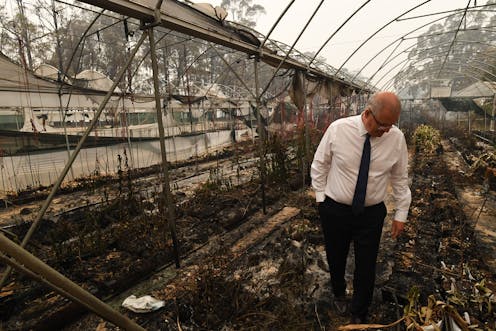
Image result for Listen to your people Scott Morrison: the bushfires demand a climate policy reboot
Scott Morrison’s response to the bushfires has been roundly
criticised as being too slow and out of touch.
Morrison should heed Jotzo’s suggestion that he and his cabinet need to “drop the old anti-climate change stance”. As Jotzo writes,
You’ve been politically locked into a no-action position, but the bushfires give you the reason to change […] You can make it your mission to protect the country from harm, an essential conservative cause.
Jotzo speaks with authority as one of the country’s foremost experts on climate reduction policies. He has a global reputation.

Read the story from The Conversation by an Adjunct Professor from the School of Communications at La Trobe University, Tony Walker -  “Listen to your people Scott Morrison: the bushfires demand a climate policy reboot."

13 February, 2019

Australia won’t meet the Paris targets despite what recent research claims.

The Australian National University has been making headlines for its analysis that, with the current rate of renewable energy growth, Australia will achieve its Paris agreement targets five years early – by 2025. Unfortunately, after a careful review, we find their analysis doesn’t stack up.
The government's policies are aimed at slowing renewable energy rollout.
The ANU briefing note has surprised, if not shocked, many in the expert and analytical community with detailed knowledge of Australia’s climate and energy policy.

Numerous international and national efforts to examine Australia’s climate and energy policy have all concluded that the government will not reach, on present policy settings, the 26-28% reduction from 2005 levels by 2030 it has put forward under the Paris agreement.

Read the story from The Guardian by Bill Hare - “Australia won’t meet the Paris targets despite what recent research claims.”

(Lead author of the ANU report, David Balkers, discusses his work on the "Climate Conversations" podcast - Robert McLean)

14 January, 2018

The global warming experiment we conduct at our peril

When the Australian Research Council awarded its funding plans in mid-2017, one recipient of the highly competitive seven-year grants was the Centre of Excellence for Climate Extremes.
The heat is on, and it is time to understand and
confront what extremes are going to look like. 
While building on the work of the previous Climate System Science centre, the new hub represents more than a name change.

The centre – grouping leading scientists from the Australian National University, Monash, Melbourne, and Tasmania universities, and based at the University of NSW – is the first in the world "with an unambiguous focus on the science behind climate extremes", according to its director, Professor Andy Pitman.

The Turnbull government and particularly Simon Birmingham, as the responsible minister, deserve credit for increasing the centre's capacity 10 percent over its predecessor – presumably against the views of a rump within the Coalition that denies climate change is a serious threat.


Read the Editorial from the Sydney Morning Herald - “The global warming experiment we conduct at our peril.”

23 May, 2017

Australian farmers are adapting to climate change

2016-17 has been a great year for Australian farmers, with record production, exports and profits. These records have been driven largely by good weather, in particular a wet winter in 2016, which led to exceptional yields for major crops.

Unfortunately, these good conditions go very much against the long-term trend. Recent CSIRO modelling suggests that changes in climate have reduced potential Australian wheat yields by around 27% since 1990.

While rising temperatures have caused global wheat yields to drop by around 5.5% between 1980 and 2008, the effects in Australia have been larger, as a result of major changes in rain patterns. Declines in winter rainfall in southern Australia have particularly hit major broadacre crops (like wheat, barley and canola) in the key southeastern and southwestern cropping zones. There is strong evidence that these changes are at least partly due to climate change.


Read the piece on The Conversation by a visiting fellow at the Australian National University, Neal Hughes - “Australian farmers are adapting to climate change.”

16 May, 2017

June discussion about the business benefits of climate change

The “Business Benefits of Climate Change” will be discussed at Wangaratta in June.

Professor Mark Howden from the Australian National University’s  (ANU) Climate Change Institute will set theme with a dinner lecture on the evening of Thursday, June 1.

That session, at Wangaratta’s Quality Hotel, starts at 6:30pm and continues until nine o’clock.

The following day, Friday, June 2, will begin at 8:30 am with a keynote address from the Australian Capital Territory’s Environment Commissioner, Dr Kate Auty.

That afternoon, continuing at the Wangaratta Performing Arts Centre, will be a consultation session conducted by the ANU.


The event is being staged by the Wangaratta Sustainability Network and tickets, which can be secured through EventBrite range from $50 for the Thursday evening session to free to the ANU session on Friday afternoon.

06 February, 2017

Donald Trump reminiscent of Stalin says chief scientist Alan Finkel as science 'literally under

Australia's Chief Scientist Alan Finkel has compared US President Donald Trump's move to censor environmental data with former Soviet dictator Josef Stalin's control of science in the USSR.
Data censorship criticised: Chief Scientist Alan
 Finkel has warned that Donald Trump is like
Stalin when it comes to science. 

Speaking at a Chief Scientists' roundtable discussion at the Australian National University on Monday, Dr Finkel made his comments saying he was "going off topic" as "science is literally under attack”.

Dr Finkel said: "The Trump administration has mandated that scientific data published by the EPA [Environmental Protection Agency] must undergo review by political appointees before they can be published.”

In the first week of his presidency Mr Trump's administration informed the EPA it could not send out press releases and no blog messages could be published. The EPA was also told "no new content can be placed on any website”.


Read Marcus Strom’s story in The Sydney Morning Herald - “Donald Trump reminiscent of Stalin says chief scientist Alan Finkel as science 'literally under.”

02 December, 2016

Discussing 'Potential Pathways to Decarbonisation'

Dr Sarah Bice.
“Potential Pathways to Decarbonisation” were discussed at a public session organized on November 10 by the Grattan Institute.

The panel for the Energy Futures Seminar featured Jeremy Bentham, who was the lead on Shell’s recently published plan to achieve net-zero emissions and transform four sectors of the energy system: power, industry, transport and buildings; Ross Garnaut, a Distinguished Professor of Economics at the Australian National University and a Vice-Chancellor's Fellow and Professorial Fellow of Economics at The University of Melbourne; Tony Wood, the Director of the Energy Program at the Grattan Institute; and Dr Sarah Bice from the University of Melbourne’s School of Government.

The global community has committed to deep decarbonisation by mid-century, yet, it is far from clear how we might get there, despite the progress made through last December’s Paris Agreement.

Listen to a recording of this event, including a Q&A with the audience.

08 November, 2016

'Quite sobering': Record hot 2015 could become 'new normal' by 2030, study finds

Dr Sophie Lewis - her research
is "quite sobering".
Record hot years such as last year's global scorcher will become the norm before 2030 unless greenhouse gas emissions are curbed, a new study by Australian researchers has found.

The scientists, led by Sophie Lewis from the Australian National University, used different emissions projections to determine when 2015's record global surface temperatures could be considered a "new normal".

Most of the climate models analysed that, within a decade, last year's emissions projections would be average or even cooler than average, Dr Lewis said.

"The studies are quite sobering and show us what will happen if we're not prepared to make the deep cuts to emissions," she said.

Read Peter Hannam’s story in today’s Melbourne Age - “'Quite sobering': Record hot 2015 could become 'new normal' by 2030, study finds.”

25 August, 2016

Turnbull told to match climate action with scientific facts

154 Australian experts have signed on open letter to Prime Minister Malcolm Turnbull demanding urgent action on climate change that matches the dire warnings coming from climate scientists.
James Whitmore has written
a book about climate change.

The letter, organised by Australian National University climatologist Andrew Glikson, calls on the federal government to make “meaningful reductions of Australia’s peak carbon emissions and coal exports, while there is still time”.

Signatories include leading climate and environmental scientists such as the Climate Council’s Tim Flannery, Will Steffen, and Lesley Hughes, as well as reef scientists Ove Hoegh-Guldberg and Charlie Veron.

They point out that July 2016 was the hottest month ever recorded, and followed a nine-month streak of record-breaking months. Average carbon dioxide concentrations in the atmosphere reached 400 parts per million (ppm) in 2015, and are rising at a rate of nearly 3 ppm each year.

Read the piece by the Editor of Environment and Energy at The Conversation, James Whitmore - “154 Australian scientists demand climate policy that matches the science.”

12 June, 2016

Humanity will never be able to defeat a threat it cannot perceive

Elizabeth Boulton.
In 2013, one of the world’s leading public relations experts, Bob Pickard, cried out to the climate world: “mobilise us!” In a frustrated op-ed, he listed 20 key problems with climate communication. One of them was “story fatigue”: bland stories with “highly repetitive and stale” themes.

Climate information is still often confusing, unengaging and absent from the wider public discourse. Linguistic analysis found that the most recent IPCC report was less readable than seminal papers by Einstein. Last year, in America, climate news media coverage rates dropped despite the historical Paris Climate Summit and Pope Francis’ climate Encyclical.

One key risk is complacency – a perception that the issue is now resolved. This is despite the risk increasing, as our response lags.

One study found that Australia had the highest percentage of climate sceptics in the world, (17% as compared to 12% in the USA). Analysis of global attitudes in 2015 found that, while across the world, 54% of people considered climate change a “very serious problem,” in Australia this figure was only 43%.

Read the piece on The Conversation by a PhD Candidate in cross-disciplinary approaches to climate and environmental risk at the Australian National University, Elizabeth Boulton -  “It’s time for a new age of Enlightenment: why climate change needs 60,000 artists to tell its story.”

22 January, 2016

'Hottest year' record continues to reverberate around the world


Mark Howden.
Janette Lindesay.
It’s official: 2015 was the hottest year on record. The US-based National Oceanic and Atmospheric Administration has confirmed overnight that 2015 saw the global average temperature climbing to 0.90°C above the 20th-century average of 13.9°C. The record has been confirmed by the UK Met Office.

It’s been only a year since the record was previously broken, but 2015 stands out as an extraordinarily hot year. 2014, the previous hottest year, was 0.74°C above the global average. December 2015 marks the first time in the NOAA record a global monthly temperature anomaly has exceeded 1°C - it reached 1.11°C.

Read the piece on The Conversation  by the Professor of Climatology at the Australian National University, Janette Lindesay, and a research scientist at the Agriculture Flagship of the CSIRO, Mark Howden - “It’s official: 2015 was the hottest year ever recorded.”

05 November, 2015

Remote places, but of critical importance to life on earth


T
he remote location of the Antarctic and Greenland polar ice sheets may leave us with the impression that developments in these regions have little effect on the climate and life in the temperate zones of the Earth, where most of us live.

We may therefore be forgiven for asking why should we care when these changes are projected to unfold over tens to hundreds of years.

However, the stability of the polar regions is critical for maintaining a planet with the conditions that allowed the emergence of humans, agriculture and civilisation, as well as many other species. The polar ice sheets serve as “thermostats” of global temperatures from which cold air and cold ocean currents emanate, moderating the effects of solar radiation. The ice sheets regulate sea levels, store volumes of ice whose melting would raise sea level by up to 61 metres.

Read the piece by Earth and paleo-climate scientist at the Australian National University, Andrew Glikson, published on The Conversation - “Melting Antarctic ice sheets and sea level rise: a warning from the future.”

15 October, 2015

Trees die, but we could be seeing the death of entire iconic landscape


T

rees die – that’s a fact of life. But is the death of an entire iconic landscape of Eucalyptus in the Cooma-Monaro region of New South Wales natural?

For over a decade, large stands of Eucalyptus viminalis, commonly known as Ribbon Gum or Manna Gum, have been gradually declining in health, and now stand like skeletons in huge tree graveyards.

In our recently published survey we found the affected area to cover almost 2,000 square km, about the size of the area burnt in the devastating Ash Wednesday bushfires in Victoria or more than the area covered by the 2003 Canberra fires.

Within this area, almost every Ribbon Gum is either dead or showing signs of severe stress and dieback, with thinning crowns full of dead branches. Other tree species seem to be surviving, but this smooth-barked gum with its characteristic ribbons of peeling park, once the dominant tree of the Monaro, now seems set to disappear from the landscape.

Read the story on The Conversation by Associate Professor Forest measurement and management, Australian National University, Cris Brack, and

PhD candidate, Australian National University, Catherine Ross - “Death of a landscape: why have thousands of trees dropped dead in New South Wales?”

21 July, 2015

We responded to the bleating and now we pay the price


D

uped by Tony Abbott’s bleating about “the great big new tax”, Australians are now paying the real price of abandoning the country’s carbon pricing structure.

Hugh Saddler writing on The Conversation has explored the “rebound effect” of Australia having opted to fall in line with Abbott plea to “scrap the tax”.

The Research Associate, Centre for Climate Economics and Policy at the Australian National University said, “..... achieving larger and faster emissions reductions will require a wide range of policies, all working in the same direction. A price on emissions, whether through an emissions trading scheme or a tax, will be a key component of such a suite, but only one component.”