Showing posts with label stability. Show all posts

19 November, 2019

Huge Tesla battery in South Australia primed for big upgrade

The largest lithium-ion battery in the world – Tesla's big battery in South Australia – will undergo a 50 per cent expansion in a move its owners hope will increase the stability of the grid and reduce power bills.
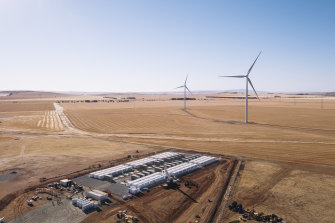
French energy giant Neoen has announced plans to expand the capacity of the huge Tesla battery installed at the Hornsdale Power Reserve in South Australia by 50 per cent.
French energy giant Neoen has announced plans to expand the capacity
 of the huge Tesla battery installed at the Hornsdale Power Reserve in
South Australia by 50 per cent.
Tech billionaire Elon Musk's Tesla built the huge battery in a remote area of South Australia in 2017. The battery system has the capacity of 100 megawatts and can store 129 megawatt-hours of energy from wind turbines nearby – enough to supply 30,000 homes for eight hours.
The battery system's capacity will now be increased to 150 megawatts under an expansion plan put forward by French energy giant Neoen, the owner of the site, with the support of Tesla and the state and federal governments.
Paired with the adjacent Hornsdale wind farm, Tesla's grid-scale battery, known as the Hornsdale Power Reserve, has helped reduce intermittency and manage increased demand during summer when the grid is under the most strain. In its first year of operation, it saved consumers more than $50 million, according to Neoen.

Read the story from The Sydney Morning Herald by Nick Toscano - “Huge Tesla battery in South Australia primed for big upgrade.”

25 October, 2017

Back to square one in energy policy: we now have a plan to produce a plan

A year and a day — that’s how long it took Frydenberg to kill off “Finkel”.
Prime minister Malcolm Turnbull (left) and federal environment
and energy minister John Frydenberg during a press conference
at parliament house in Canberra on 17 October 2017.
On 7 October 2016, just nine days after a series of tornados took out at least 22 transmission pylons in South Australia and set off a cascading series of events resulting in a state-wide blackout, federal environment and energy minister John Frydenberg commissioned chief scientist professor Alan Finkel to review the stability of our energy system. Finkel’s expert team met with regulators around the world, considered 390 submissions, held 120 meetings and commissioned modelling from multiple experts.

On 8 October this year, word trickled out that the clean energy target (CET), Finkel’s centrepiece, was dead.

A week later, Frydenberg announced the national energy guarantee (Neg). In just three weeks, with no public process, no modelling, no consultation with the Coag energy council, whose approval it requires, the newly formed Energy Security Board (ESB) had knocked together an alternative “conceptual framework”, described in an eight-page letter and a media release, that proposes to push responsibility for reliability and emissions reduction to electricity retailers.


Read the story by Simon Holmes à Court on The Guardian - “Back to square one in energy policy: we now have a plan to produce a plan.”

19 October, 2017

Malcolm Turnbull's energy policy offers hope via carbon price

Prime Minister Malcolm Turnbull's electricity and climate package is a welcome attempt to end a decade of policy mismanagement by providing the stability and certainty industry has been pleading for to underpin much-needed investment.
Let there be light: Prime Minister Malcolm Turnbull
discusses his climate and energy package.
The potentially crucial breakthrough is that the package appears to envisage a market-based price on carbon emissions, widely acknowledged as the most rational and cost-effective mechanism for the transition to renewable energy, the price of which is becoming compellingly competitive.

It is too early to assess whether the policy is the "game-changer" Mr Turnbull claims; it is yet to be fully detailed and depends on the support of the states, a number of which want a faster shift to renewables. Federal bipartisan support is also vital to the certainty and confidence required by investors.


Read today’s Editorial in today’s Melbourne Age - “Malcolm Turnbull's energy policy offers hope via carbon price.”