Showing posts with label severity. Show all posts

06 May, 2020

Logging likely had significant effect on summer fires: scientists

Logging native forests increases the severity and risk of bushfires and likely had a significant effect on Australia's unprecedented summer fires.
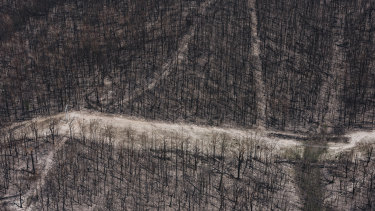
Burnt bushland on the NSW South Coast, which was heavily hit by bushfires.
New research from five scientists published in Nature Ecology & Evolution on Wednesday finds that public debates about the links between climate change and bushfires are warranted and should prompt action, but the contribution of logging to bushfires also needs greater scrutiny.
And, unlike much of the action needed to halt global warming, land management is within the control of Australians, write the scientists from the Australian National University, Macquarie University and the University of Queensland in their review of evidence.
Read the story from The Age by Miki Perkins - “Logging likely had significant effect on summer fires: scientists.”

27 March, 2018

Irreversible climate change due to carbon dioxide emissions

The severity of damaging human-induced climate change depends not only on the magnitude of the change but also on the potential for irreversibility. 
Susan Solomon.
This paper shows that the climate change that takes place due to increases in carbon dioxide concentration is largely irreversible for 1,000 years after emissions stop. Following cessation of emissions, removal of atmospheric carbon dioxide decreases radiative forcing, but is largely compensated by slower loss of heat to the ocean, so that atmospheric temperatures do not drop significantly for at least 1,000 years.
Read the 2009 paper by Susan Solomon - “Irreversible climate change due to carbon dioxide emissions.”

07 February, 2018

Climate action: the Foundation of Sustainable Development

The climate crisis is undoubtedly the single greatest threat to humanity. Despite the fierce debate in the United States surrounding the reality staring us square in the face, much of the rest of the world acknowledges the severity of this problem and the moral imperative to take urgent action. 


In its 2030 Agenda for Sustainable Development the United Nations included climate action as one of the 17 Sustainable Development Goals. Together, these goals outline a path by which the world can work together to strengthen universal peace and prosperity. When the UN pledged to take action on climate as part of the SDGs, it acknowledged an important – though often overlooked – fact: no issue we collectively face as humans exists separate and apart from the others. These challenges – from alleviating poverty to educating women and girls to addressing the climate crisis – intersect and are intimately connected to one another. A planet that is in a state of chaos and disruption offers a poor canvas for advancing development goals. 

Read the Impacter story by the CEO off the Climate Reality Project, Ken Berlin - “Climate action: the Foundation of Sustainable Development.”

01 November, 2017

Driest September on record through Murray-Darling Basin

The severity of drought in NSW has been backed up by Bureau of Meteorology data that shows that last month was the driest September in the Murray Darling Basin on record.
 Drought impacted crops are a common sight
 through the Murray-Darling Basin this year.
Many centres in the region recorded no rainfall for September at a time when falls are critical for crop development.

The data is compiled using an aggregation of rainfall data across the BOM’s network of weather stations and can be averaged out to a regional basis.

Worryingly, the record dry comes without a major climate driver pushing the weather towards drier conditions.


Read the farmonline story by Gregor Heard -  “Driest September on record through Murray-Darling Basin.”

26 August, 2017

Is Hurricane Harvey Related to Climate Change? Scientists Have a Better Answer

As Hurricane Harvey approaches Texas, an old argument has again resurfaced about whether climate change is to blame.
Hurricane Harvey brought some heavy
weather the coast of Texas.
In the past, scientists have had a rather unsatisfying answer for both environmentalists and skeptics, essentially saying that while climate change increases the frequency and severity of extreme weather, no individual event could be attributed to it.

But that may be changing.

Climate scientists now say that they can use models and historical data to evaluate with increased precision how global warming has affected the odds of a given individual weather event.

Known collectively as the World Weather Attribution group, a group of scientists formed in 2014 to conduct studies on the subject, developing a series of steps they have worked to perfect for case studies. The team begins every project with an announcement that it will undertake the project and a promise to publish the results, even if the impact of climate change on a particular event is shown to be negligible.


Read the Time magazine story by Justin Worland - “Is Hurricane Harvey Related to Climate Change? Scientists Have a Better Answer.”

03 May, 2017

Hydrological Drought Amplifies Wildfires in Borneo’s Humid Tropics

The area of wildfires in Borneo during drought years turns out to be ten times larger than during non-drought years, an international research team reports in Nature Climate Change of this week. The fires recurrently affecting Borneo’s humid tropical ecosystems have negative influence on the biodiversity and lead to large CO2 emissions, affecting atmospheric composition and regional climate processes. Future droughts in wet tropical regions will likely increase in frequency and severity, and consequently the fire risk, the team says.
The team also explored the link between hydrological drought and wildfire using the monthly fire area burnt from the spatially distributed Global Fire Emission Dataset from the period 1996-2015. They classified years in this period into drought and non-drought years. The analysis illustrates that wildfires occur annually, that is, also in non-drought years, but that amplification of wildfires occurs during drought years. In drought years, the maximum area burnt is almost a factor of ten larger than in non-drought years. Frequency of very large fire extents (>10,000 ha) is significantly higher in drought years.


Read the Science and Technology Research News story - “Hydrological Drought Amplifies Wildfires in Borneo’s Humid Tropics.”

09 January, 2016

Aerial pictures illustrate extent of Mississippi River flooding

New aerial photography by the National Oceanic and Atmospheric Administration released Monday are providing a glimpse of the extent and severity of last week's devastating flooding along hundreds of miles of the Mississippi River and its tributaries.

Along those rivers, thousands of Americans rang in the New Year with their homes and businesses underwater after three days of unusual winter rainstorms sent the rivers over their banks.

Read the Inside Climate News story - “New Aerial Photographs Show Midwest Flooding Devastation.”

30 January, 2014

Bureau helps us understand heatwaves


Help in understanding heatwaves comes from the Bureau of Meteorology with a new pilot heatwave forecast for Australia.

The Heatwave Forecast is a set of graphical maps of heatwaves, severe heatwaves and extreme heatwaves for the current day extending out for the next four days.

The pilot site explains what a heatwave is, what its severity is based on, its intensity and what a pilot heatwave forecast will look like.