Showing posts with label change. Show all posts

23 April, 2019

What Will Climate Change Do to Us?

One thing I’ve noticed over the years as I’ve written about climate change is that the actual predicted effects of a warmer world often aren’t well known. People understand that the planet is getting hotter, a change that is both easy to understand and directly familiar to almost everyone.

But the effects of the increased heat are much broader than simply higher temperatures. In an effort to delineate what scientists expect to see as the world warms, I spoke with Alex Halliday, director of the Earth Institute at Columbia University.
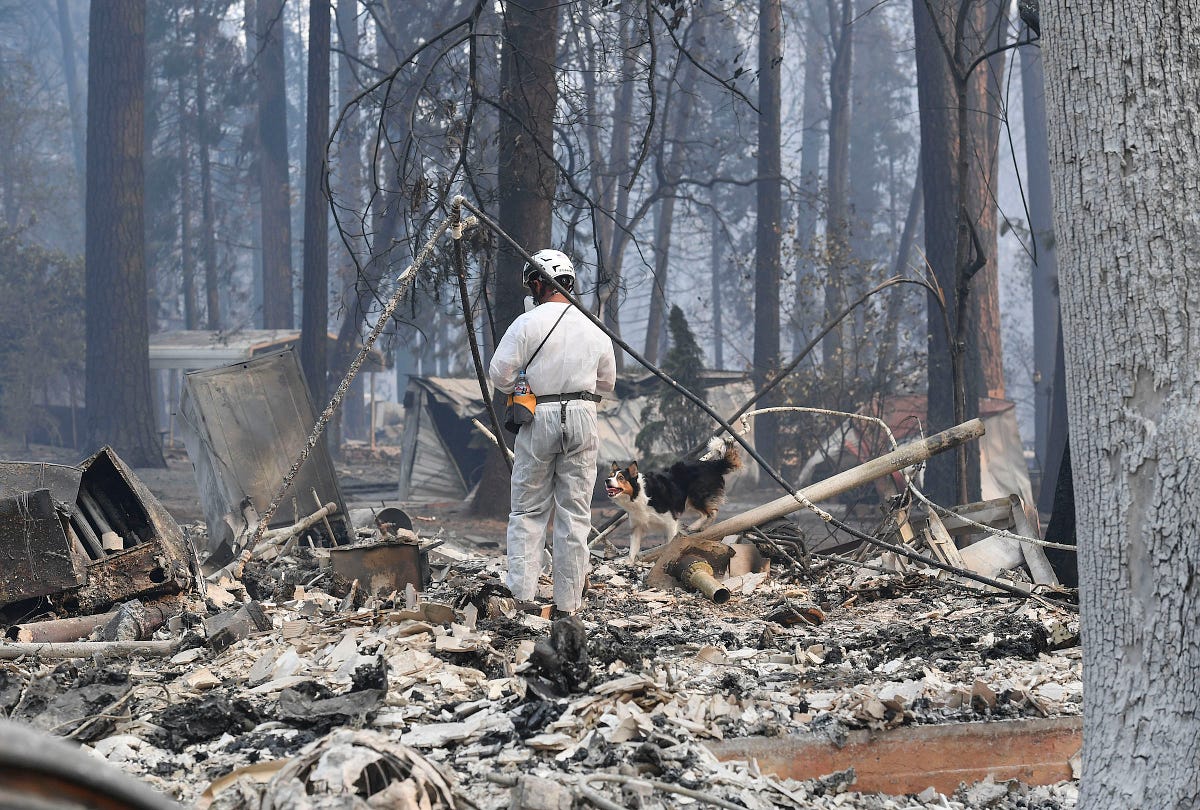
Mike Delannoy and Journey look for remains in Paradise,
Calif., on Nov. 15. Search teams combed through thousands
of fire-destroyed structures for signs of 130 people who
 were still missing after the Camp Fire. 

Here are the negative repercussions scientists expect to see in a warmer world.
  • Increased health risks
  • Drought
  • Wildfires
  • Shifts in growing areas for crops
  • Broader spread of some diseases
  • Big precipitation events with even more rain and snow
  • Warmer temperatures
  • Increased flooding
  • Rising sea levels
  • Warmer ocean water
  • Ice melts
  • Shifts in sea habitats
  • More-acidic oceans
  • Thawing permafrost, releasing more greenhouse gases

Read the story from The Washington Post introduced by Phillip Bump -  "What Will Climate Change Do to Us?

13 March, 2019

Climate Change Requires More Than Individual Solution

Change your lightbulbs. Buy a hybrid. Recycle.

These are just some of the actions we were told to take over the past couple of decades to do our part for the climate, especially after the release of Al Gore’s 2006 documentary An Inconvenient Truth. The dominant liberal narrative asserted that these small changes in individual consumption would be enough to avert climate catastrophe.


That was a lie.

It’s easy to see why this was the solution pushed by the liberal establishment. Since the 1970s, we’ve been inundated with messaging prioritizing individual action over that of governments and larger social systems. Eventually even centrist and center-left political parties like the US Democrats, UK Labour, and many more like them gave in.


Read the Radical Urbanist story by Paris Marx - “Climate Change Requires More Than Individual Solution.”

02 November, 2018

As fracking approaches, Northern Territory to pump up fines for breaching revised Water Act

The Northern Territory Government is getting ready to change its Water Act in what has been described as its most significant amendments since 1992.
The NT Government is proposing some major changes to its Water Act.
At the heart of the change is to make sure mining and petroleum companies are no longer exempt from water-use regulation.

With the NT's moratorium on fracking now lifted and gas companies expected to start the controversial practice next year, the NT's Department of Environment and Natural Resources is working on a series of reforms to update the Territory's laws around water.

NT Water Controller Jo Townsend said mining companies are required to obtain a water extraction licence in all states and territories in Australia, except the Northern Territory — an oversight that needed to be addressed.


04 July, 2018

Coal fades in developed world but is far from dead in Asia

In the energy business, perceptions of change often run ahead of reality. The 19th century is widely thought of as the Age of Coal. However, as environmental scientist Vaclav Smil points out, the dominant sources of total fuel use worldwide were wood, charcoal and straw.
Chinese city dwellers can live in the shadow of coal power plants
On that basis, it was the 20th century that was the true Age of Coal. The lesson, Mr Smil told a conference of energy experts and policymakers in 2013, is that “these energy transitions to higher quality fuels...take a very, very long time”.

The survival of the global coal industry into the 21st century proves his point.


Read the story from the Financial Times by Ed Crooks- “Coal fades in developed world but is far from dead in Asia.”

23 May, 2018

New York to end all coal-fired power by 2020

New York State has proposed strict new carbon dioxide standards which will lead to coal plants having to change the way they operate, or close down.
New York intends to end all coal-fired power by 2020.
New York’s Governor, Andrew Cuomo, made the announcement last week, calling coal “a relic of the past”.

The move forms part of Governor Cuomo’s target of reducing greenhouse gas emissions in the state by 40 percent by 2030. It also follows through on a pledge he made in 2016 to restrict coal use across the state.


Read the ClimateAction story - “New York to end all coal-fired power by 2020.”

09 April, 2018

Too wet? Too cold? Too hot? This is how weather affects the trips we make

What sorts of weather lead us to change our daily travel behaviour? How do we respond to scorching heatwaves, sapping humidity, snow and frost, strong winds, or torrential rain? International research shows weather is important in shaping our everyday movements.
Very wet weather is likely to persuade many regular
cyclists and walkers to travel instead by car if
 they can. This is Bondi Junction after a storm hit Sydney.
The research evidence suggests that bad weather can lead to planned journeys being rescheduled, rerouted or cancelled. The consequences of these shifts in daily travel choices can include increases in traffic congestion and accidents, travel delays, mental stress, environmental pollution and general travel dissatisfaction.

Because people who travel by bike or walking are most likely to change travel plans in bad weather, some cities are responding with innovations such as heated bicycle lanes and sheltered walkways.


27 March, 2018

Irreversible climate change due to carbon dioxide emissions

The severity of damaging human-induced climate change depends not only on the magnitude of the change but also on the potential for irreversibility. 
Susan Solomon.
This paper shows that the climate change that takes place due to increases in carbon dioxide concentration is largely irreversible for 1,000 years after emissions stop. Following cessation of emissions, removal of atmospheric carbon dioxide decreases radiative forcing, but is largely compensated by slower loss of heat to the ocean, so that atmospheric temperatures do not drop significantly for at least 1,000 years.
Read the 2009 paper by Susan Solomon - “Irreversible climate change due to carbon dioxide emissions.”

26 February, 2018

Forget about recycling, we need to start re-using

With China banning all types of recyclable containers, it’s time for us to take a new path in the use of containers. In fact the word recycle could be replaced with the word reuse and to take our possible change of thinking further, let’s add the word zero to waste so we always refer to zero waste when discussing unwanted product.
We need to re-use, nor just recycle.
I believe that most people would agree that they would prefer purchasing household products and take away food and drinks in reusable containers. So it is time to seriously introduce container deposit legislation, which has been ignored by successive Victorian governments for many years.

To pay people to collect reusable containers makes a lot of sense rather than paying councils for a Band-Aid recycling service.


Read the comment by Peter Cox in today’s Age - “Forget about recycling, we need to start re-using.

16 February, 2018

Elon Musk wants Australia to shake up its power grid

Elon Musk wants Australia to change its power grid to get ready for more big batteries.
Construction workers at the launch of Tesla's 100 megawatt
 lithium-ion battery at Jamestown, north of Adelaide.
Having deployed the world's largest battery in South Australia and shot a Tesla Roadster into space, the US billionaire's company now wants to change the face of Australia’s National Electricity Market.

Tesla has called for the nation's outdated electricity network to evolve and prepare for a transition to a new power system as part of the Australian Energy Market Commission’s review into the grid’s reliability.

In its submission, the electric car and solar battery maker outlined how when coal-fired power stations have failed – for example during Loy Yang power station generator's recent outages –  batteries were able to put power back into the grid and return it to normal operation in less than 200 milliseconds.


Read Cole Latimer’s story in The Age - “Elon Musk wants Australia to shake up its power grid.”

04 February, 2018

The Drum - our need to respond and change our behaviours.

Those of us interested in the implications and complications of climate change should find this Episode 5 of The Drum on ABC TV both informative and another illustration about why there is a particular urgency about our need to respond and change our behaviours.

Episode 5 of The Drum - well worth your time.
It features, along with others, the Professor of Public Ethics at Charles Sturt University, Clive Hamilton, who is renown for “telling it like it is” when talking about Earth’s disrupted climate system.

28 September, 2014

Professor explains our seemingly intractable desire to cosume


Professor Tim Kasser.
The seemingly intractable desire of most to consume is the root cause of climate change, worsened by the added complexity of resource depletion.

The latter is in fact a manifestation of that unbridled consumption, which is perverse desire to find happiness in surrounding ourselves with “stuff” simply intensifying our carbon-rich economies which worsen climate change.

Just recently it was the Professor of Psychology from Knox College at Galesburg, Illinois in the U.S., Tim Kasser, who set out to explain the root causes of consumerism during a free lecture at the University of Melbourne.

His address, “Consumerism, society and our ecological future: A psychological and empirical approach” was sponsored by the university’s Melbourne Sustainable Society Institute.

Prof Kasser set out to demystify consumerism, illustrating how we are all drawn into this almost magnetic need to shop, a point he illustrated with a quote from the New York Times just months after the destruction of the city’s World Trade Centre’s twin towers.

The newspaper, he was able to show, declared the terrorists should not be allowed to imagine achieved success in that they had frighten the nation to the extent that it was not going about it normal business and not shopping, or consuming.

He was able to show that people imagined that happiness was to be found in consuming, but in reality it has quite the reverse affect.

Prof Kasser explained that consumerism came with measurable ecological, social and personal costs; costs it seems that most people were happy to pay.

He discussed many things, among them the prime reasons why we become materialistic and that arose from having parents, friends or peers who were materialistic, watching more television or encountering more advertising, and living in a neo-liberalist capitalist nation.

A circular graphic of stochastic modelling prepared by Prof Kasser helped people understand how extrinsic values of consumerism helped promote undesirable traits popularity, image and financial success compared to the intrinsic values of community, affiliation and acceptance.

Those intrinsic values of community (‘I will help the world become a better place”), affiliation (“I will express my love for special people”) and self-acceptance (“I will follow my interests and curiosities wherever they take me”) contrast directly with the extrinsic values.

Prof Kasser said the ecological benefits of intrinsic values were more environmentally friendly behaviours; lower ecological footprint; and less consumption in the forest dilemma game.

He indicated it was important to eschew extrinsic values that promote consumerism and contribute little of value, while intrinsic values brought psychological benefits, among them more happiness, more life satisfaction, higher vitality, less depression, less anxiety and fewer physical problems.

The professor suggested some avenues for change, among them voluntary simplicity, improved environmental communications, a cut in our exposure to advertising, and a change from gross national product (GNP) to a National Indicator of Progress (NIP).

Prof Kasser concluded by noting that materialistic values undermine social ecological sustainability as well as personal and social wellbeing.


16 March, 2014

Understand the urgency of mitigating climate change


by Robert McLean

Prof Richard Somerville.
As kid it seemed that for something as peace on earth to be achieved could only result from a serious external threat to humanity.

That threat would be of such dimension that human survival would hinge, entirely, on the broad sweep of humanity bonding to use all its resources to see off the threat.

The imagined outcome was that good sense and logic would quickly and easily identify that as one, humanity would benefit massively and so a pattern of working together, and its importance, would become obvious.

That didn’t happen, thankfully, but something worse is happening – climate change is upon us, but humanity is so divided on the matter that unless there is an immediate sudden change of the international heart, we are in desperate trouble.

I urge you to spend about an hour watching and listening to world-renowned climate scientist and author of "The Forgiving Air: Understanding Environmental Change," Professor Emeritus Richard Somerville, discusses the scientific case for urgent action to limit climate change.

The Youtube segmentTheScientific Case for Urgent Action to Limit Climate Change” emphasises the need for all of us who care about our climate and the future of our children and grandchildren to act now.

02 March, 2013

Gathering Beneath the Wisteria is good for our health


Those of us who gather each month Beneath the Wisteria in Shepparton are playing our part in the broader betterment of humanity’s health.

The implications of that are explained in an account about health and how the taking of action about climate change is implicated is spelt out in a report, “Our Uncashed Dividend”.

The report, subtitled: “The health benefits of climate action”, is the work of The Climate and Health Alliance and the Climate Institute.

Early in the introduction the report says: “Climate change is already contributing to increasing public health problems: injuries and deaths associated with more extreme weather events such as fires, storms and droughts; worsening of chronic illnesses; the spread of infectious diseases; deteriorating water and food quality and availability; declining air quality; and the displacement of populations—all will impact on human health and well-being”.

Conversations about mitigating climate change frequently, rather always, become distracted and derailed by concerns about economic implications, but many of the present carbon abatement proposals have been costed and shown to be economically advantageous, and good for our health.

The final paragraph of the report’s conclusion says: “Finally, given both the tremendous health risks of a more hostile Australian climate and the potential benefits of action, a national health and climate change plan is needed. Such a plan could help communities, businesses and government better prepare for climate change, take advantage of the opportunities provided by low-carbon initiatives, and take actions that cut emissions and promote better human health”.

11 June, 2012

New book helps us understand how to achieve sustainability


The Melbourne Sustainable Society
Institute will soon release a
new book discussing a
sustainable society and how we
achieve it.
Supporters of Beneath the Wisteria might be interested in a new book coming soon from the Melbourne Sustainable Society Institute.

The book, 2020 Vision for a Sustainable Society”, will be launched on 14 June, and will be available online shortly afterwards through the institute’s website at.

A compilation of 26 chapters, the book is written by experts; among whom are distinguished professors, established non-fiction authors and even a Nobel Prize winner.

Each chapter identifies something that needs to change and selects one key action that is necessary in the next decade.

These actions are mostly set within the context of Australia and the Asia-Pacific, although they do have global relevance.

They are aimed at communities and government rather than individuals / households and the final chapter compiles these priority actions into a ‘to do’ list: key actions to be taken before 2020 to create a sustainable society.