Showing posts with label problems. Show all posts

29 December, 2019

The Commons review – eerily plausible and uncomfortably timely climate crisis drama

Stan’s eight-part Australian drama The Commons is based in “the not-so-distant future” – a familiar turn of phrase to describe story worlds similar to our own in many respects but strikingly different in others. It is set in a climate crisis-devastated Sydney, where the air is a sickly shade of orange and extreme weather conditions pose all sorts of problems – making the show’s arrival uncomfortably well-timed, perhaps, given the 2019 bushfires and increased discourse about the relationship between extreme weather and global heating.

People queue in a dusty, polluted hangar
A still from the first season of The Commons, an
eight-part Australian climate crisis drama from Stan.
The first episode opens with a dream sequence in which a heavily pregnant protagonist, Eadie (Joanne Froggatt from Downton Abbey), runs desperately through an empty hospital and into a beautiful garden. There her water breaks, bats fall from the sky and her pregnant belly suddenly disappears; she clutches the ground and howls in pain.

Read the story from The Guardian by Luke Buckmaster - “The Commons review – eerily plausible and uncomfortably timely climate crisis drama.” 

13 November, 2019

Climate change makes bushfires worse. Denying the truth doesn't change the facts.

It’s not just climate protesters who powerful voices are trying to silence in Australia, it’s anyone who wants to talk about the bigger-picture causes to the problems Australia is facing.
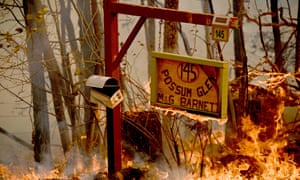
A bushfire burns outside a property near Taree
‘If we can’t talk about the underlying reasons why
bushfires are becoming more frequent, we can’t possibly
 talk about how to manage either the fires Australia is
experiencing today or the far worse ones we will experience
 in the decades to come.’
In modern Australia it has become “inappropriate” to talk about why our rivers are running out of water, why our aged care centres are running out of food and nappies, and why our fire brigades are running out of firetrucks. But it’s impossible to solve problems when you can’t talk about the underlying causes.
When people crash their car going around a tight bend we can sympathise with their families while discussing whether speed, fatigue, alcohol or poor road design were to blame. It’s not impossible to be sensitive to victims and serious about the cause at the same time.

Read the opinion piece from The Guardian by Richard Denniss - “Climate change makes bushfires worse. Denying the truth doesn't change the facts.” 

27 January, 2019

India calls for cautionary approach to link climate change.

UNITED NATIONS: India has called for adopting a cautionary approach on linking climate change to security and giving the UN Security Council the right to take action to address it, saying overly militarised solutions to problems which require non-military responses bring the "wrong actors" to the table. 

Rising sea levels are threatening coastal
towns and cities across the globe
A "mere decision of the Council" to takeover enforcement of climate change action would disrupt the 2105 Paris Agreement and multilateral efforts to find solutions, India's permanent representative Syed Akbaruddin told the Security Council on Friday. 

He was speaking at the UN Security Council's open debate on 'Addressing the impacts of climate-related disasters on international peace and security' 

"Climate Change is an unprecedented challenge to global civilisation," he said. 


Read the story from The Economic Times - “India calls for cautionary approach to link climate change.”

27 April, 2018

Climate Change Is Making Deadly Air Pollution Worse in Cities Across the U.S.

Environmentalists worry that climate change could cause problems with rising sea levels and crop failures in the coming decades, but one group of researchers has found it’s already causing health problems now.
Climate change is worsening air pollution in U.S. cities.
Temperature increases linked to climate change are worsening air pollution in communities across the country right now contributing to a range of health problems from asthma to premature death, according to a new report from the American Lung Association.

The total number of Americans exposed to unhealthy air rose to nearly 134 million, according to the group’s 2018 State of the Air report. That represents a spike from 125 million in the previous year.


Read the story by Justin Worland from Time Magazine - “Climate Change Is Making Deadly Air Pollution Worse in Cities Across the U.S..”

11 December, 2017

The Real Politics of the Planetary Crisis

(This is part three of a work in progress. The series begins with The Last Decade and You, and continues with On Climate, Speed is Everything.

In the last two pieces, I pointed out how getting on the right emissions reduction curve for this era means taking bold action, now. We must peak global emissions by 2020. Then we must cut them in half by 2030 — and then cut them in half again by 2040, and then again, by 2050 — while restoring the natural world and spreading sustainable prosperity. 

Because the planetary crisis is steepening — the longer we wait, the harder it becomes to solve the problems we face — failing to get on the right curve will mean that we end up, very quickly, on an even steeper curve. Wait too long and the curves we face become essentially impossible to meet.


We can fail catastrophically on climate. We’ll know that failure when we have delayed action so long that we find ourselves confronting an insurmountable emissions reduction challenge coupled with rising and untenable losses — a crisis where all humanity’s choices are bad ones. We will have then reached a point where a even drastic program of global carbon austerity — even when combined with our wildest gambles on trying to pull CO2 out of the air and engineer the planet’s temperature — will simply not be enough to avoid tragic, essentially permanent losses for all humanity.


Read the story by Alex Steffen - “The Real Politics of the Planetary Crisis.”

26 November, 2017

Disasters and mental health in rural and remote areas

Mental health problems cause profound suffering and are worthy of attention for that reason alone. But despite policy and service reform, such problems remain as common, expensive and disabling as they were a decade ago.
Vulnerable people and places are worst affected by weather-related
disasters, especially those most reliant on the land.
 
Bad mental health erodes financial and personal resources, and undermines resilience and adaptive capacity in affected families, workplaces and communities. So it’s vital to foresee threats that might compromise mental health.

Climate change is one such threat. Our world faces potentially catastrophic warming and we have limited capacity to adapt to rapid or extreme climatic changes. As the world’s most variable climate, our continent is the canary in the mine. We have a need and an obligation to invest in understanding and responding effectively to this threat.


Read the piece on The Conversation by the Professor of Psychiatric Epidemiology and Associate Dean Research, University of Canberra, Helen Louise Berry - “Disasters and mental health in rural and remote areas.”

26 September, 2017

Everyone has a different excuse for the electricity stuff-up

The electricity market is such a mare's nest of stuff-ups and problems it's impossible to see the deeply divided Turnbull government making much progress in fixing it.

The gas industry has built massive export facilities in north Queensland. 
The goals of halting runaway power prices and reducing the risk of summer blackouts wouldn't be quite so daunting, for instance, were it not for the third goal of "sustainability" – the euphemism you use when you can't say "climate change”.

It's tempting to focus on the first two and forget the third, but even that wouldn't work because the inescapable reality of climate change means that, until the Turnbull government ends the "policy uncertainty" about its treatment of fossil fuels relative to renewables, it's unlikely to get sufficient investment in new production capacity to keep prices controlled.

Even if Turnbull were to patch together some weakened version of an (already toned down) clean energy target, that wouldn't do the trick if it failed to win the endorsement of the alternative government.


Read the story by Ross Gittins on The Sydney Morning Herald - “Everyone has a different excuse for the electricity stuff-up.”

12 August, 2017

Humanity needs science to survive and thrive.

“Bad times have a scientific value. These are occasions a good learner would not miss.” -Ralph Waldo Emerson

Hi there, world. It’s been a long time since you’ve had a heart-to-heart with science, but there’s no better opportunity than right now. There are a whole slew of problems facing our nation and the world today, and I’m afraid you’re going to need it for all of them if you want to get through them successfully. The world is a large, complex system, with many different competing interests all vying for your attention as to which one is most important. No one is here to decide that for you, contrary to what you might’ve heard. Instead, science is here to contribute something that every perspective should agree on: the best suite of facts, laws, models, theories, conclusions and inferences that the whole of humanity has been able to collect and construct. That’s what science is. It’s what science was made to do. And it’s why humanity is the success that it is today.

Read the story by Ethan Siegel - “Humanity needs science to survive and thrive.”