Showing posts with label economics. Show all posts

10 July, 2019

The Problem With Putting a Price on the End of the World

On a Saturday afternoon in early December, inside a soaring auditorium on the campus of Stockholm University, William Nordhaus gave the crowning lecture of his half-century career as an economist. The occasion was his acceptance of the Nobel Prize in economics, which Nordhaus, a trim, soft-spoken Yale professor, had been jointly awarded. The title of the lecture was “Climate Change: The Ultimate Challenge for Economics.”

As a young professor on a sabbatical in Vienna in the mid-1970s, Nordhaus happened to share an office with an environmental researcher, who helped spark his interest in the emerging issue. While there, Nordhaus came up with the target, now famous, of holding global warming to two degrees Celsius above preindustrial levels. He chose the target, as he recently explained to me, because he believed that the earth has experienced similar fluctuations before and that humans had tolerated them.

The Nobel was a tribute to the originality and influence of his work developing economic models that help people think about how to slow climate change. It also seemed to be a cri de coeur from the Swedish academics who choose the economics laureates: Climate change is a threat like no other. Fatal heat waves, droughts, wildfires and severe hurricanes are all becoming more common, and they are almost certain to accelerate. Avoiding horrific damage, as a United Nations panel of scientists recently concluded, will require changes in human behavior that have “no documented historic precedent.”


Read the story from The New York Times Magazine by David Leonhardt - “The Problem With Putting a Price on the End of the World.”

25 February, 2019

And the Nobel Prize for Climate Change Goes To…

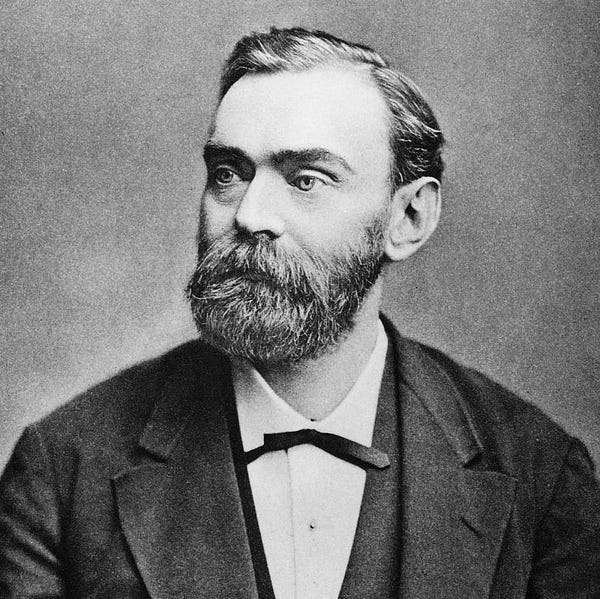
Alfred Nobel.
When Swedish chemist and inventor of dynamite Alfred Nobel died in 1896, he left his considerable fortune to fund annual prizes given to individuals who had conferred “the greatest benefits” to humanity during the previous year. But his vision only included five fields deemed worthy of recognition at the time: chemistry, physics, physiology or medicine, literature, and peace. Later, Sweden’s central bank also created a sixth prize in economics in his memory.

Nobel wasn’t prescient. He couldn’t have foreseen the that climate change would become the defining crisis of future generations, one that would call on the courage, insight and ingenuity of our most brilliant scientists, inventors, advocates and political leaders. Helene and Raoul Costa, a French couple now living in Seattle, want to recognize achievements in climate change — and they think Alfred Nobel would have approved.

Read the Nexus Media story by Marlene Cimons - “And the Nobel Prize for Climate Change Goes To…”

19 May, 2018

Sarah Myhre: Scientist/feminist/activist, all in one

At the American Geophysical Union fall meeting in New Orleans last December, Sarah Myhre, PhD, joined with other scientists on a panel presenting and fielding questions on the science, economics, and politics of climate solutions.
Sarah Myhre, a veritable force of nature in addressing
 climate and other issues she is passionate about.
Myhre (pronounced my-ree) delivered a message that may have been startling to some in the audience – that climate change cannot fully be addressed without also grappling with the misogyny and social injustice that have perpetuated the problem for decades. Myhre characteristically delivered her talk with a sense of urgency, confidence, and polish.

After the presentations, an audience member directed a comment to panelist Stefan Rahmstorf, PhD, of the Potsdam Institute. Rahmstorf had illustrated just how quickly the world will need to stop burning fossil fuels if warming is to be kept to no more than 2 degrees C, about 3.6 degrees F.


Read the Yale Climate Connections story Karin Kirk - “Sarah Myhre: Scientist/feminist/activist, all in one.”

11 April, 2018

Frydenberg takes the low road: It’s a weak NEG or nothing

The Coalition government is ramping up the pressure on the Labor states, seeking to paint the National Energy Guarantee as the middle path and the one and only policy option, despite its desperate attempts to shift the discussion to meet the demands of its own right wing.
Energy minister Josh Frydenberg - "Nice
words, but the cynicism is breathtaking".
Energy minister Josh Frydenberg used a National Press Club appearance on Wednesday to try and force the states to agree on the as yet ill-defined NEG, arguing that economics and engineering should triumph over ideology, and there was a need for a market based solution.

Nice words, but the cynicism is breathtaking.

Ideology? This, from a man who has spent much of the past 18 months demonising renewables, arguing in the face of all evidence to the contrary from the CSIRO and the network owners that high levels of renewables is reckless.


Read the story Giles Parkinson story from RenewEconomy - “Frydenberg takes the low road: It’s a weak NEG or nothing.”

14 July, 2017

Everywhere Man Josh Frydenberg: The minister who could make or break the Turnbull government

Josh Frydenberg has always been a man in a hurry.

The scene when Josh Frydenberg's press
conference in South Australia was crashed
by state Premier Jay Weatherill.
By 35, he had achieved honours degrees in law and economics, studied at Oxford and Harvard, advised Alexander Downer and John Howard, and been head of global banking at Deutsche Bank. Determined to enter Parliament, he tried to blast long-time member Petro Georgiou out of Kooyong - a prestigious Melbourne seat that had been held by Liberal Party founder Robert Menzies. He lost. But by the next election in 2010 the seat was his.

A prodigious networker and media performer, Frydenberg was touted as a potential future leader as soon as he arrived in Canberra. No job, it seemed, would be enough to contain his enthusiasm and ambition. Then Malcolm Turnbull found it. 


Read Matthew Knott’s story in today’s Melbourne Age - “Everywhere Man Josh Frydenberg: The minister who could make or break the Turnbull government.”

23 May, 2017

Reading classic novels in an era of climate change.

Philip Steer.
There is a strange and troubled kind of intimacy between our own moment of climate change and 19th century Britain. It was there that a global, fossil fuel economy first took shape, through its coal-powered factories, railways, and steamships, which drove the emergence of modern consumer capitalism.

What might we now find if we look again at the literature of the 19th century? Although Victorian writers lacked our understanding of a warming planet, we can learn from their deep awareness of the rapid and far-reaching ways that their society was changing. In their hands, the novel became a powerful tool for thinking about the interconnections between individuals, society, economics, and the natural world.


Read the thoughts The Conversation of a Senior Lecturer in English at Massey University, Philip Steer - “Reading classic novels in an era of climate change.”

19 February, 2017

Australia positioned to be renewable energy superpower

Illustration: Glen Le Lievre.
The old joke says the questions in economics exams don't change from year to year, but the answers do. Welcome to the economics of energy and climate change, which has changed a lot without many people noticing - including Malcolm Turnbull and his climate-change denying mates.

They've missed that the economics has shifted decisively in favour of renewable energy, as Professor Ross Garnaut , of the University of Melbourne, pointed out at an energy summit in Adelaide last October.


Read Ross Gittins’ story in The Sydney Morning Herald - “Australia positioned to be renewable energy superpower.”

12 June, 2016

Economics defeats science in climate change conversation

Immediately the climate change conversation became a matter of economics it was lost.

The economically loaded dice.
The climate change doubters, denialists, and their contemporaries celebrated once they were able to shift the discussion from the realities of science to the quirkiness and whimsicality of economics.

The financialization of the world is complete and world leaders driven by a populous unable to see beyond or through this shroud of secrecy that favours just a few, a frighteningly small percentage of the world’s population, make decisions rooted in economics, rather than good sense.

What’s best for people is a concept that under the sleight of hand control by the demagogues of the world has collapsed to slide to near the bottom of the hierarchy of importance, while what’s best economically now sits unchallenged at the top.

Climate change can only be resolved if the public is again allowed, or given, its pre-eminent importance and the people of the world set free of the economic chains that presently restrict their behaviour.

Individualism, globalism, the desire to have more, and the urgency to accumulate riches whatever the cost, exemplified by a distorted capitalism, has bequeathed the world climate change and although we live in a world with many cultures, races, territories, passions, views and ideas that can divide us, we are, whatever people think or believe, one people with just one planet and the resolution of climate change, or at least learning to live what we have done, rests with us acting at one.

The dilemma that has produced climate change, the financialization of a scientific conversation, is being repeated on Britain contemplates it future in the European Union.

What’s best for the people of Britain is now being judged almost entirely in raw economic terms, rather than what is best for them; what will enable them to build the resilience to be a socially richer country; a country able to address and deal with the challenges evolving from our disrupted climate system.

Dealing with climate change is not economic, it is a social issue as is the matter of whether or not Britain leaves or stay in the European Union.

19 January, 2016

Renewable energy massive boost to global GDP

The Renewable Energy Benefits: Measuring the Economics report found that doubling the global share of renewable energy by 2030 would lead to a 1.1% increase in global GDP.

That equates to $1.87 trillion AUD – more than the combined economies of Chile, South Africa and Switzerland!

The report also found that doubling the share of renewables (e.g. wind and solar) would create 24 millions jobs globally, as well as increasing global welfare by 3.6%.

07 November, 2015

New paper points out the costs of climate change


C
limate change may have many economic impacts, including loss of crops, changes in water supply, increased incidence of natural disaster, and spikes in health care costs related to infectious diseases and temperature-related illnesses. However, hard evidence about the effects of climate change on economic activity has been inconsistent.

A new paper published in Nature takes on the ambitious task of connecting micro- and macro-level estimates of climate costs. The study finds that climate change can be expected to reshape the global economy by reducing average global incomes roughly 23 percent by the year 2100. This study is important because it solves a problem that has existed in prior models of climate change effects on economics: discrepancies between macro- and micro-level observations. This study presents the first evidence that economic activity in all regions is coupled in some way to global climate. The study also sets up a new empirical paradigm for modelling economic loss in response to climate change.

23 January, 2015

Profit, in the modern sense, and the sustenance of human life are incompatible


Profit and a regard for sustaining earth’s suitability for humans are incompatibly, particularly if profit is considered in contemporary terms.

Reporting on Davos 2015, The Guardian says: “It’s not possible to listen to petroleum industry executives defending their reckless extraction of oil without feeling that we are living in an age of madness.”

A private conversation under the Chatham House rules, one of the world’s most senior industry leaders, who is considered to be at the more moderate end of the spectrum, insisted that we are going to burn all the world’s hydrocarbons despite the consequences.

Former U.S. vice-president and committed climate change activist, Al Gore, has accused the world’s oil companies of using the atmosphere as an open sewer.

Lord Stern, who wrote the landmark 2006 Stern review of the economics of climate change, says it is no surprise oil executives are seeking to defend their corner, who, like Gore, said basic arithmetic tells us that it is impossible to burn all the world’s hydrocarbons without devastating consequences.

He points out that the earth has not seen a 3C rise for 3m years, he pointed out, and it has been tens of millions of year since there has been a 4C rise.

05 June, 2014

PM chastised for 'backward' thinking


Australia’s Prime Minister simply doesn’t understand.

A story in today’s Melbourne Age headed: “Climate change ‘off’ G20 agenda” tells us that Tony Abbott has suggested that any discussion about climate change does not fit the meetings economic focus.

Greens Leader has chastised the PM for his backward thinking in not understanding the connection between climate change and economics.

15 February, 2014

Most Americans want action on climate change, whatever the cost


Efforts to ease worsening global warming causes usually fall at the “economics” hurdle.

However, in America at least, that appears to be changing.

A story on Environment 360 headed: “Despite costs, most Americans want action on climate change, report finds” tells us that more than 80 per cent of Americans want something done to ease global warming.

Interestingly, and importantly, those same people are saying they want something done irrespective of the cost.