Showing posts with label Climate Council. Show all posts

25 February, 2020

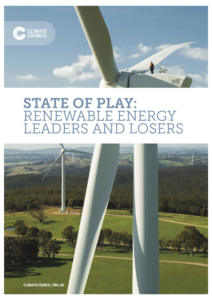
State of play: renewable energy leaders and losers


Image result for State of Play: Renewable Energy Leaders and Losers

States and territories are leading the transition to renewable energy in Australia, as the Federal Government is not only failing to lead but getting in the way of progress. 

Every year the Climate Council tracks the relative progress of Australian states and territories based on their performance across a range of renewable energy metrics: share of electricity from renewable energy; proportion of households with rooftop solar; large-scale wind and solar capacity per capita; and targets or policies in place to support the transition. 

The Climate Council outlines the progress made by each state and territory government over the last twelve months in the race to a renewable future. 

This report is the Climate Council’s fifth scorecard evaluating state and territory progress on renewable energy. This report follows on from previous state and territory renewable energy updates in 2014, 2016, 2017, and 2018


13 January, 2020

Fact check: The PM’s interview with Insiders’ host, David Speers

On Sunday, January 12 Prime Minister Scott Morrison did an interview with the host of Insiders, David Speers about the bushfire crisis and climate change. The Climate Council’s research team has fact-checked this interview.


Read the story from The Climate Council - “Fact check: The PM’s interview with Insiders’ host, David Speers.”


09 March, 2019

Australia’s 'angriest summer': 200 records broken and fruit cooking on trees

Australia's record-breaking summer was so hot fruit cooked on trees, the Climate Council says.
A spot fire on the Bunyip side of the Princes Highway in Victoria.
A new report released by the council on Thursday found that the recent summer season was the hottest on record for the Australian continent. In total, 206 records were broken in just 90 days. 

One of these was in Port Augusta, South Australia, which reached a massive 49.5 degrees Celsius in January - the highest temperature ever recorded in the country.

Meanwhile, every state experienced serious bush fires and Townsville broke its 10-day accumulated rainfall total.


19 November, 2018

Australia’s emissions rising as world 'flat-lines' - Climate Council report

The latest round of United Nations climate talks are taking place in the German city of Bonn this week and next.
The Climate Council says no new fossil fuel power plants should be opened.
The meeting is expected to help set the 'rulebook' that will underpin the Paris climate accord.

The 2015 agreement was seen as a breakthrough in global climate action with nations agreeing to work together to avoid dangerous climate change and limit future warming to 'well below two degrees’.

This morning, the independent non-profit organisation, the Climate Council, is releasing a report which says that to help meet that goal no new coal or gas resources should be developed in Australia.

The report points to government data showing that Australia's emissions have been rising the past two years, while global emissions are ‘flat-lining'.


Listen to the Radio National interview with Professor Will Steffen - “Australia’s emissions rising as world 'flat-lines' - Climate Council report.”

20 April, 2018

Clean & Reliable Power: Roadmap to a Renewable Future

The Climate Council has released a roadmap outlining how Australia can cut its rising greenhouse gas pollution levels, while continuing the transition to clean, affordable and reliable renewable energy and storage technology.

The ‘Clean & Reliable Power: Roadmap To A Renewable Future’ report features 12 key policy principles for any national energy and climate policy framework, including calls for the rollout of a minimum 50-70% renewable energy target across Australia by 2030.

The ‘Roadmap To A Renewable Future’ framework recommends Australia continues to transition away from its ageing, polluting and inefficient coal and gas fleet and encourage investment in a new clean power supply. The report calls for pollution targets which can be ratcheted up along with transparent tracking and reporting of carbon pollution levels.


Read the Climate Council story by Andrew Stock - “Clean & Reliable Power: Roadmap to a Renewable Future.”

10 October, 2017

Abbott Out of Step With Reality

Abbott’s speech last night confirms he’s even more out of touch than we thought with the reality of climate change and its worsening impacts on Australians.
Climate Council CEO, Amanda McKenzie -
"Abbott even more out of touch than we thought".
The speech to the climate denying group, The Global Warming Policy Foundation included a range of ludicrous statements, denying that record-breaking temperature rises are taking place.

“Tony Abbott’s comments are out of step with the reality that Australians are experiencing, with extreme hot days having doubled in the past 50 years.” said Amanda McKenzie, Climate Council CEO.

Read the Climate Council story - “Abbott Out of Step With Reality.”

31 August, 2017

States leave federal government in the shade when it comes to renewables: report

NSW has the most large-scale renewable energy projects under way in Australia, and lifted its share of clean energy markedly in the past year, as states and territories take the lead in decarbonising the electricity sector, a report by the Climate Council has found.

The states are leading the way on
renewables, a new report finds. 
A jump in hydropower helped raise renewable energy share in NSW by 5 percentage points last year to 17 per cent. That was marginally above the national share of 16 per cent, and the second-biggest increase after South Australia.

The Climate Council, though, rated by the most populous state behind all but Western Australia and the Northern Territory. While NSW has a net-zero economy-wide emissions target for 2050, it has not set a goal for renewables.

By contrast, Victoria gained credit for its efforts to legislate this year a 25 per cent renewable energy share by 2020 and 40 per cent by 2025. Last year, the state's share was 12 per cent, up one percentage point from 2015.


Read Peter Hannam’s in today’s Melbourne Age - “States leave federal government in the shade when it comes to renewables: report.”

20 June, 2017

Are heatwaves ‘worsening’ and have ‘hot days’ doubled in Australia in the last 50 years?

The release of the Finkel report has refocused national attention on climate change, and how we know it’s happening.
What exactly does research say on heatwaves and hot days?
On a Q&A episode following the report’s release, Climate Council CEO Amanda McKenzie said we’ve seen:
… worsening heatwaves, hot days doubling in Australia in the last 50 years.

Her comment provides the perfect opportunity to revisit exactly what the research says on heatwaves and hot days as Australia’s climate warms.


Read the piece on The Conversation by a Climate Extremes Research Fellow from the University of Melbourne, Andrew King - “Are heatwaves ‘worsening’ and have ‘hot days’ doubled in Australia in the last 50 years?”

13 June, 2017

Unpacking the Finkel Review

On Friday, Australia’s Chief Scientist, Dr Alan Finkel, released the findings of a review into the future of the National Electricity Market.

The Finkel Review was tasked with developing a “blueprint” for the national electricity market (NEM) that:
◦ delivers on Australia’s emissions reduction commitments
◦ provides affordable electricity, and
◦ ensures a high level of security and reliability.

It's a hefty 212 page document so we've put together an explainer to help explain the content.


Read the story by the Climate Council - “Unpacking the Finkel Review.”

24 February, 2017

‘Going gangbusters': Solar surge has only just begun and batteries' charge close behind

Solar energy's surge is only just getting started in Australia as utilities join the rush to a source of power that is now far cheaper than new coal plants, a report by the Climate Council finds.


The report also comes as the world's biggest supplier of batteries, Warren Buffett-backed China's BYD, marks out Australia as its second market to target consumers anxious to shield themselves from rising electricity prices.


Read Peter Hannam story in today’s Melbourne Age - “‘Going gangbusters': Solar surge has only just begun and batteries' charge close behind.”

15 June, 2016

Jobs and growth to be found in renewable energy infrastructure

Building 50% renewables by 2030 would create more than 28,000 jobs nationally, new research by Ernst & Young (EY) and the Climate Council has found.

"The Renewable Energy: Future Jobs and Growth" report finds that 50% renewable electricity by 2030 will create almost 50% more employment than our business as usual trajectory (34% renewables by 2030).

This report compares two scenarios for the national energy sector – business as usual renewable energy growth (34% renewable electricity in 2030) and 50% of electricity derived from renewable sources in Australia by 2030. Both scenarios show increased uptake of renewable electricity will create employment nation-wide.

-      50% Renewable Electricity (50RE) scenario in 2030 will lead to over 28,000 new jobs, nearly 50% more employment than a business as usual (BAU) scenario.

-      Jobs are created in the construction, operation and maintenance of renewable energy installations, as well as in related industries.

-      Across the period 2014- 2030, over 80% of full-time employment created by 50RE is additional to the economy.

-      Job losses in coal fired electricity generation are more than compensated for by increased employment in the renewable energy sector. However, the transition for employees in the fossil fuel sector must be planned well.

The net effect on jobs of 50RE is positive across Australia and each individual state: every state will experience net job growth.

-      New South Wales (NSW) and Queensland will have the largest net growth in jobs, around 11,000 and 6,000 respectively.

-      South Australia and NSW will experience the largest per capita jobs growth.

-      Victoria will see a net gain of around 4,000 jobs by 2030.

Unlike other industry transitions such as in automotive manufacturing and steel smelting, which have seen many jobs move offshore, a transition to 50RE will create jobs in Australia.

-      A large proportion of new jobs gained in the electricity supply sector by 2030 will stem from construction and installation activities related to renewable energy infrastructure. Many of these jobs will be additional to the economy, though location and skills may differ from those currently in demand.

-      Most states will see half of all new jobs created in rooftop solar photovoltaics (PV): rooftop solar PV jobs are generally accessible, being located in areas where people already live and work.

17 May, 2016

Reef preservation should dominate election campaign: Tim Flannery

Tim Flannery - Great Barrier Reef should
be at the heart of the election campaign.
Tim Flannery says preserving the Great Barrier Reef from coral bleaching linked to climate change should be a central issue in the federal election campaign.Flannery, a scientist and member of the Climate Council, said the lack of attention paid to climate change so far in the eight-week campaign was “staggering”.

“This needs to be the reef election,” he told Guardian Australia. “This is the last moment I think that we can realistically expect that we can enact some policies … to close down coal-fired power stations and save the reef.

“Other issues are still going to be there in another four years. This one won’t.”

A study in April found that almost 93% of the Great Barrier Reef had been affected by global bleaching, part of a global coral bleaching event that scientists say was caused partly by El Niño and partly by background global warming.

24 April, 2016

Scientists pay, literally, for Great Barrier Reef crisis publicity


‘Climate Council pays for full-page advert as expert says the Courier Mail, Queensland’s biggest newspaper, is not covering coral bleaching properly’

The advertisement as paid for
 by the Climate Council
Scientists say they are fed up with Queensland’s biggest newspaper not covering the worst bleaching event to hit the Great Barrier Reef, so have taken out a full page ad to get the message out.

The ad comes as a survey revealed 93% of the Great Barrier Reef was affected by the bleaching. That finding motivated the Queensland government to call on the federal government to convene an urgent meeting of the nation’s environment ministers to talk about measures to address climate change in light of bleaching.

Organised by the Climate Council, the full page ad in the Courier Mail on Thursday contains an open letter signed by 56 scientists.

“One of the reasons we placed the ad in the Courier Mail was that we’ve seen very little coverage of the coral bleaching event in that paper and in fact there was a front-page story that said the coral bleaching event had been wildly exaggerated,” said Ove Hoegh-Guldberg, director of the Global Change Institute at the University of Queensland and one of the signatories of the letter.

The letter explains that it is the worst bleaching event in its history, and that it is being driven by climate change.

30 March, 2016

Heat records tumble in Perth, Sydney, Tocumwal and Echuca - Climate Council calls for action

Records tumble and Climate
Council calls for action.
Record hot spells in Australia this month blurred the line between summer and autumn in another sign of rapidly advancing global warming, a Climate Council report says.

The first four days of March saw maximum temperatures in much of the country 4C above average – and 8C to 12C above average in most of south-eastern Australia – the report said.

Despite summer being over, the New South Wales/Victorian border towns of Echuca and Tocumwal suffered the longest, hottest spell in their recorded history, with eight consecutive days of 38C or above.

It follows a summer that delivered Perth more 40C days than ever before and 39 consecutive days over 26C for Sydney, a record that more than doubled the previous high.

28 February, 2016

Winston has muscled its way into the record books

Cyclone Winston, a category-5 storm with wind gusts reaching 300km/h, struck Fiji last weekend leaving 44 people dead, 45,000 people displaced, 350,000 directly impacted and $650 million worth of damage.

According to Weather Underground, Winston is among the strongest tropical cyclones to make landfall in world recorded history, and the strongest recorded in the Southern Hemisphere.

21 January, 2016

Hottest year on record (again)!


Last year was the hottest on record by a jaw-dropping margin, our new report has revealed.

Key findings:

1: 2015 was the hottest year on record globally. Climate change was a major factor in driving the record-breaking heat in 2015 worldwide;

2: Climate change is a major factor in extreme heat and fire in Australia; and

3: Temperature records are being smashed across many regions of the world, largely through the influence of climate change.

Read the Climate Council story - “The Hottest Year On Record (Again).”

19 January, 2016

Renewable energy massive boost to global GDP

The Renewable Energy Benefits: Measuring the Economics report found that doubling the global share of renewable energy by 2030 would lead to a 1.1% increase in global GDP.

That equates to $1.87 trillion AUD – more than the combined economies of Chile, South Africa and Switzerland!

The report also found that doubling the share of renewables (e.g. wind and solar) would create 24 millions jobs globally, as well as increasing global welfare by 3.6%.

07 December, 2015

Extra innovation is surplus to needs as we already have the climate tools/ideas


AUSTRALIA already has the tools it needs to solve the climate crisis and innovation can accelerate the transition, the Climate Council said today.

Welcoming the release of the government’s innovation statement, the Climate Council’s Professor Will Steffen said science was core to building a modern, vibrant and enterprising society.

Read the Climate Council’s story - “Innovation no excuse for delay on climate action.”

(Plans announced today by Australia’s PM to spend nearly $1.1 billion in the next four years to promote business-based research, development and innovation is to be applauded, but condemned as it is a populist way of appearing to be “doing something” while side-stepping the main game of actually doing something to combat climate change.

The innovation we need exists, it simply needs government support and encouragement to see it employed on a broad scale.

Interestingly, Malcolm Turnbull has specified “business-based research” when even a cursory of glance illustrates that most innovations that have changed the face of society have had their beginnings in the public sector. The “business-based” phrase simply panders to the rump of the Liberal Party – Robert McLean.)

03 December, 2015

Climate Council's reflections of what is happening in Paris


T
Professor Lesley Hughes
of the Climate Council
and the CEO,
Amanda McKenzie, in  Paris.
hey’re doing what the Climate Council does best - keeping Australians informed! You might have already seen them on Sunrise, the Today Show, ABC News 24, SBS or the Guardian.


In addition to talking to journalists and finding great stories of progress from all over the world to inspire us, they’re also connecting with organisations and individuals around the world to create partnerships for the future

In the first update from the ground, Climate Council CEO Amanda McKenzie talks about why Climate Council is different to other climate talks and the big issues during the first two days of the conference - “Reflections on two days at the Paris climate talks.”

02 December, 2015

Reasons of hope for climate success in Paris


G
lobal leaders are in Paris this week to nut out the next phase in global agreements to tackle climate change.

It will be one of the biggest diplomatic events of the decade. Among the 45,000 people turning up are about 150 world leaders including Obama and Chinese President Xi Jinping.

In the past these talks have been criticized for being a lot of talk and not a lot of action. But this year it is different.

Read the Climate Council story - “5 Reasons for Hope in Paris.”