Showing posts with label Perth. Show all posts

11 April, 2020

Perth records hottest April day ever as Easter beach crowds observe coronavirus measures

Perth has sweltered through its warmest April day on record, with police continuing to warn beachgoers about the importance of social distancing amid another eight WA cases of coronavirus.
Three police officers walk along Cottesloe Beach in uniform with beachgoers nearby on the sand.
Police patrolled Cottesloe Beach on Easter Saturday
to enforce physical distancing measures.
The temperature in the city reached 39.5 degrees Celsius just before 2:00pm, breaking the previous record of 37.6C set on April 9, 1910.
Bureau of Meteorology (BOM) duty forecaster Max Strack said warmer weather in the state's north-western Gascoyne region had been pushed south by a trough off the west coast.
Read the ABC News story by Garrett Mundy and James Carmody - “Perth records hottest April day ever as Easter beach crowds observe coronavirus measures.”

20 November, 2019

Battlelines drawn over Australia's hydrogen 'fork in the road’

A potential stoush is brewing over the future source of energy to power Australia's prospective hydrogen exports, with several states lining up to support renewables over coal at this Friday's energy ministers summit in Perth.
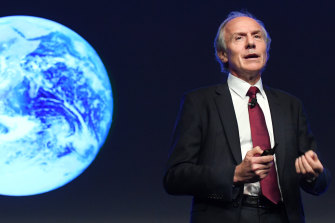
Chief Scientist Alan Finkel will kick off this Friday's COAG energy council meeting in Perth with a discussion about hydrogen.
Chief Scientist Alan Finkel will kick off this Friday's COAG
 energy council meeting in Perth with a discussion about hydrogen.
Chief Scientist Alan Finkel will kick off the COAG energy council meeting - the only such gathering in 2019 - with a presentation on Australia's National Hydrogen Strategy, according to a copy of the agenda obtained by The Sydney Morning Herald and The Age.


Read the stray from The Sydney Morning Herald by Peter Hannam and Mike Foley - “Battlelines drawn over Australia's hydrogen 'fork in the road’.”

17 November, 2019

Perth endures hottest November day since records began as Western Australia sizzles in the heat

The outline of the sun shimmers in a heat haze
The temperature reached 40.4 degrees in Perth today.
The temperature hit 40.4 degrees on Saturday — the hottest November day since records began in 1897.
It was also the fourth consecutive day over 35 degrees which is only the second time it has happened in November. The last time was in 1933.
Bureau of Meteorology WA duty forecaster Darryl Vink said Perth broke the record in style.
"Basically there's a high in the bight, a very broad surface trough down the west coast, [and] a hot air mass over the state," he said.
"And the north-easterly winds have brought down that hot air over the west coast.
"It's the hottest November day since records began in 1897, and it's also the hottest spring day since 1897."

17 June, 2018

How hot is your neighbourhood? Areas of Perth feel the heat as tree canopies dwindle

The average ground temperatures of different areas of Perth can vary by as much as 9 degrees Celsius, and tree canopy levels have a big influence on how hot your suburb feels.
Cottesloe is known for its tall Norfolk pines but
 its total tree canopy is just 15 per cent.
But local councils warn an increasing pressure to comply with strict infill development targets is putting canopy levels at risk, and potentially turning up the heat as a consequence.

If you live in Perth's western suburbs or the Hills, chances are the temperature is a few degrees lower than in built-up areas, where the traditional Aussie backyard is disappearing to make way for infill.


Read the story by Irena Ceranic from ABC News - “How hot is your neighbourhood? Areas of Perth feel the heat as tree canopies dwindle.”

22 April, 2017

March for Science participants hoping to send strong message to political leaders

Thousands of people have rallied across Australia as part of a global movement calling on political leaders to focus more on science.

Marching for science in Sydney.

Crowds gathered in cities and towns including Sydney, Melbourne, Hobart, Perth, Brisbane and Townsville as part of the inaugural March for Science, which is taking place in 500 locations worldwide.
The movement was started by scientists sceptical of the agenda of US President Donald Trump, but Stuart Khan, one of the organisers of the Sydney march, said it quickly went global.

He said marchers were calling on politicians to take note that the public wanted policy based on fact.


06 February, 2017

Three ingredients for running a successful environmental campaign

Clearing machinery arrives on site under
heavy police protection, January 2017.
Here in Perth, a battle is raging over a 5km stretch of road known as Roe 8

Work on the project, part of the proposed Perth Freight Link, began late in 2016 and as legal avenues to halt construction were exhausted, opponents resorted to non-violent direct action. Some protest “mass actions” have attracted more than 1,000 people from all walks of life and by the end of January, as bulldozers tore through the Coolbellup bushland under costly police protection, well over 100 had been arrested.

Proponents say the road is necessary to improve the safety and efficiency of freight traffic to and from the Port of Fremantle. Opponents point to freight alternatives that will avoid Roe 8’s destruction of Aboriginal heritage, endangered banksia woodland, and important wetlands
Critics have also decried the government’s lack of transparency and prudence in decision-making, and highlighted serious shortcomings in environmental policies and laws.

The state’s Labor opposition has promised to scrap the project if it wins government at the state election on March 11, yet to the shock and dismay of many, bulldozing continues.


Read the story on The Conversation by an Associate Professor of History at the  University of Western Australia,  Andrea Gaynor -  “Three ingredients for running a successful environmental campaign.”

30 March, 2016

Heat records tumble in Perth, Sydney, Tocumwal and Echuca - Climate Council calls for action

Records tumble and Climate
Council calls for action.
Record hot spells in Australia this month blurred the line between summer and autumn in another sign of rapidly advancing global warming, a Climate Council report says.

The first four days of March saw maximum temperatures in much of the country 4C above average – and 8C to 12C above average in most of south-eastern Australia – the report said.

Despite summer being over, the New South Wales/Victorian border towns of Echuca and Tocumwal suffered the longest, hottest spell in their recorded history, with eight consecutive days of 38C or above.

It follows a summer that delivered Perth more 40C days than ever before and 39 consecutive days over 26C for Sydney, a record that more than doubled the previous high.

24 February, 2016

CSIRO priorities 'all wrong' - Sarah Gill

As I'm writing this, the mercury is heading towards 40 degrees outside. Again, I've only just recovered from the recent four-day swelter-thon that broke the 50-year record for Perth. It's all very well if you want to cook Heston Blumenthal's slow-roast chicken in your car, but not if you'd prefer not to broil yourself or your offspring at the 3pm school pick-up.

by Sarah Gill

Just weeks ago, Perth broke the benchmark for the number of summer days over 40 degrees, so this spike takes us sailing into uncharted territory: a phenomenon repeated across the continent as records fall like dominoes, starting with the summer's widespread record temperatures across the south-east and Victoria's highest-ever minimum temperature, clocked in December 2015.

The recent bushfire in the south-west of Western Australia – a monster blaze that created its own weather pattern and raged for 17 days, claiming two lives and razing the town of Yarloop is just one chapter in this year's devastating bushfire saga, which included the devastation around Victoria's Great Ocean Road in December.

Read Sarah Gill’s opinion piece in today’s Melbourne Age - “CSIRO cuts: getting our priorities all wrong.”

(Work done by the CSIRO is about saving lives and yet our Federal Government keeps a tight grip on the organization’s purse strings, so much so that the body has elected, with the government’s knowledge, to change its emphasis on what is does in terms of researching, documenting and responding to climate change.

In a contradictory sense, it was also announced that while doing less about addressing climate change, our government will spend $2 trillion on defence over the next two decades; defence, when taken back to its first principles is about killing people.

More than half of that $2 trillion should be spent on helping Australia, and Australians, prepare for the significant changes unfolding, quickly, because of climate change. That is, of course, if the Turnbull-led Coalition Government really cares about saving lives – Robert McLean.)

10 February, 2016

Perth records 4th consecutive day in excess of 40 degrees Celsius

Perth has recorded its fourth consecutive day of temperatures above 40 degrees Celsius, equalling a record that has stood for more than 80 years, as a heatwave continues to grip the city.

The temperature peaked at 40.3C in Perth at 11:30am on Wednesday.

The last time the city recorded four consecutive days above 40C was in 1933

07 February, 2016

Perth in day one of scorching five-day heatwave

Perth is heading for a scorching 40 degrees Celsius on day one of a heatwave that is expected to last for at least five days.

The temperature is forecast to climb to 42C on Monday and Tuesday, a slightly cooler 41C on Wednesday and 39C on Thursday.

Bureau of Meteorology (BoM) duty forecaster Steve McInerney said the hot spell was being caused by a strong high pressure system.


(Those still living with what once was and who confuse 100 degrees Fahrenheit with 40 degrees Celsius, need to update their thinking for 40°C is actually 104°F – a marked difference and most certainly when you get to upper end of the temperature scale, and so what is occurring in Perth can easily bring consequences that will see people die – Robert McLean).

07 October, 2015

Perth - it's an isolated city and now becoming one of the driest


P

erth, the capital of Western Australia, is not only one of the most isolated cities in the world, it is also becoming one of the driest in Australia.

Perth - a city of lush lawns and
 eye-catching flower beds faces
 dire climate change projections.
Since the gold rush of the 1890s, impressive engineering schemes have transported enough water to make Perth a city of lush lawns and eye-catching flowerbeds, to the surprise of some visitors.

But a drop in average annual rainfall in recent years, along with some truly dire climate change projections, have required government and business to focus on water security. Australia’s Climate Council estimates that water flow from rainfall into Perth’s dams has slumped by 80% since the 1970s, with precipitation in the south-west corner of Australia forecast to drop by up to 40% by the end of the century.

25 March, 2015

Australia moves slowly towards solar power as WA tackles "basket case"


A

ustralia is “solar-rich” and although we are decades late, the country is now moving closer to solar power.

Writing on Reneweconomy, Giles Parkinson said that West Australian energy minister Mike Nahan had conceded the state’s electricity market faces radical change, with rooftop solar to become ubiquitous on homes and businesses within a matter of years.

“In questions following an eagerly awaited speech in Perth on Tuesday, outlining the first of his government’s major energy market reforms, Nahan said solar, battery storage and off-grid installations would have a big impact on the market,” he writes.

Repairing the WA energy “basket case” is discussed in the story: “WA to go solar – may be the only way out of energy mess”.

10 July, 2014

Coal miner blocks carbon tax repeal


Clive Palmer.
The coal miner walks into the Senate and blocks the repeal of the carbon tax.

Sounds like a joke and it probably will be if we are ever allowed access to the intrigue surrounding Clive Palmer and the Palmer United Party senators.

The Senate today blocked the repeal of Australia’s carbon tax in a 35 to 37 vote.

It was only earlier this morning that Australia’s PM, Tony Abbott, in a Perth press conference was almost celebrating the demise of the carbon tax legislation.

He was wrong as noted in this report from the Australian Financial Review headed: “Clive Palmer blocks carbon tax repeal”.

For the moment, thanks Clive, but let’s withhold the real back-slapping until next week when the government will rush the repeal legislation back to the Senate.

17 April, 2014

Prof Stanley adds her voice to the climate change conversation


Neither you nor I, and most certainly not former Australian of the Year, Professor Fiona Stanley, need any further convincing about the slow motion train wreck that is climate change.

Just today on a Radio National interview, Prof Stanley talked more about climate science denial following a withering attack earlier in the week about how science, and its findings, are being disregarded.

She has told an audience of doctors and medical students in Perth that the looming health impacts of climate change were “scary” and were being politically ignored.

Prof Stanley said the medical profession had failed to sell the health co-benefits of individual and community action on climate change.

Listen to what Prof Stanley had to say here on "Health impacts of climate change being politically ignored”.

12 January, 2014

Global Warming 'signs-up' in Perth as another heat record tumbles

Perth breaks minimum temperature record.
 
Hottest minimum temperature in Perth last night …. 29.7 degrees
Breaks previous record by 0.4 degrees!
Hot nights are a signature of global warming.
 

20 July, 2013

Gray seeks national discussion about nuclear power


The climate change conversation is complex in the extreme, but is little more than a friendly neighbourhood chat compared to the emotion-charged discussion about nuclear power.

Federal Resources Minister,
 Gary Gray, he wants a
national discussion about
nuclear power.
Discussion devoid of logic and driven by argument pining for fact herds reason into a cul-de-sac leaving the nuclear power advocates on an isthmus that a flood a disapproval is about to cut loose from the mainland.

Traditional power sources, primarily coal, are clearly responsible for many thousands of deaths, maybe even millions, while deaths nuclear power faults on a comparative basis, relatively few.

The discovery of coal and the subsequent realization that it’s energy could be accessed by humans and used for many purposes freeing them from a paradigm in which the prime sources of energy were sun, wind, water, human and animal to open a new vista in which fossil-fuel energy freed them from their daily drudgeries and without those natural limitations, humans flourished.

As with everything, however, there are unintended consequences and so after more than two centuries of gouging on reserves nature had put aside, the party, to use Richard Heinberg’s words, is over for we have damaged the climate (at least in human terms) to such an extent, that the only exist open to us is a return to sun, wind, water, human and animal power.

There is, however, still another fossil energy that humanity has until now only, in the greater scheme of things, really simply fiddled with. That is a suggestion that the French would unquestionably take umbrage with for some seventy per cent of their power come from this source.

Uranium, an energy-rich fossil fuel, allows for nuclear power and being effectively free of carbon-dioxide emissions, it stands as a genuine alternative to meet the world’s energy needs and when considered in isolation it would be a major step in mitigating global warming.

Federal Government Resources Minister, Gary Gray, wants Australian’s to objectively and honestly discuss and although he didn’t say so much, such a discussion would only produce an effective result if each of us were able to enter it in a non-ideological manner.

Mr Gray talked about the need for a national discussion about nuclear power at the recent Australian Uranium and Rare Earths conference in Perth.

The ABC report on the matter in a story headed: “Federal Resources Minister Gary Gray wants nuclear Australia debate”.


12 March, 2012

McKellar's droughts and floods have a new meaning


Dorothea McKellar
The Australia Dorothea McKellar understood when she wrote “My Country” has, in a contemporary sense, taken on a new meaning.

It was in the second stanza that the late poet (1855-1968) said:

I love a sunburnt country,
A land of sweeping plains,
Of ragged mountain ranges,
Of droughts and flooding rains.


Much of Australia, in particular the eastern-states and within them the south-east corner, has just emerged from a decade-long drought to be confronted by, first in Queensland and then in Victoria and New South Wales, the “flooding rains”.

So droughts and flooding rains it is.

Just today the ABC reports that “
Perth swelters through record heatwaves”.