Showing posts with label warming world. Show all posts

12 November, 2019

’Old hat': Is there a link between climate change and bushfires?

As Sydney braces for its first-ever day of catastrophic fire danger, it's worth recapping what scientists think about the links between bushfire risks and a warming world.
Is there a link between climate change and more severe and frequent bushfires?

Read the story from The Age by Peter Hannam - ”’Old hat': Is there a link between climate change and bushfires?

27 September, 2019

Premier says kids' climate emergency fears are 'entirely healthy’

Young people's concerns about a warming world and a strong focus on their future are an ‘‘entirely healthy thing’’, Premier Daniel Andrews says.
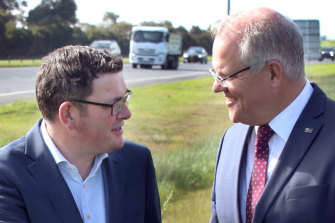
Daniel Andrews and Scott Morrison are in agreement on some things.
The Premier's stance puts him at odds with Prime Minister Scott Morrison who, in response to this week's impassioned speech by teenage Swedish activist Greta Thunberg, said the climate debate was subjecting children to ‘‘needless anxiety’’.

Read the story from The Age by Charlotte Grieve - “Premier says kids' climate emergency fears are 'entirely healthy’."

15 December, 2018

How Climate Change Is Challenging American Health Care

Climate change can seem almost too big to fathom. Reports such as the recent National Climate Assessment and the United Nations Intergovernmental Panel on Climate Change’s recent release have made waves by portraying the dire threats of a warming world, making the case that the fundamental fabric of humanity will be degraded without immediate action. But the scenarios—the biblical floods and droughts, the mass migrations of dispossessed people, the creeping seas and the retreating glaciers—have a way of short-circuiting the brain. It’s almost easier to despair or to will oneself into ignorance than to begin to grapple with the future. What are human lives when measured against the coming tempest?
Gina McCarthy, a former administrator of the
Environmental Protection Agency, says climate change
 can reverse major public-health gains.

Read the story from The Atlantic by Van R. Newkirk II - “How Climate Change Is Challenging American Health Care.”

30 August, 2017

Exxon deliberately misled public on climate science, say researchers

ExxonMobil has knowingly misled the public for decades about the danger climate change poses to a warming world and the oil giant’s long-term viability, according to a peer-reviewed study.
 An activist protests outside Exxon Mobil’s
annual shareholder meeting in Dallas in 2016.
An analysis of nearly 200 documents spanning decades found that four-fifths of scientific studies and internal memos acknowledged global warming was real and caused by humans.


(Listening to a panel discussion last night at the RMIT University about climate change and the law, it became obvious that it was rather difficult to prosecute someone, or a corporation, for the outcome of a damaged climate, but it was viable to initiate legal action on the basis that an organization had failed to acknowledge a difficulty, had not been honest in its dealings with shareholders or the public, and so had failed in its fiduciary responsibilities - Robert McLean)

25 May, 2017

Exploring the psychology and politics of a warming world

The Great Barrier Reef is dying. 
Extreme weather is becoming all too familiar. And the Coalition government is divided and paralysed.

In this vivid, urgent essay, Anna Krien explores the psychology and politics of a warming world. She visits frontlines in Australia's climate wars - the Great Barrier Reef, South Australia, the Coalition party room. 

She looks at the global state of play. Talking to coal workers and scientists, lobbyists and activists, she considers where climate change is taking us, and assesses where effective action is to be found.

Hear Anna talk about her essay in Melbourne on Monday, June 19, at 6:30 pm in conversation with  Chloe Hooper at the Church of All Nations at 180 Palmerston Street, Carlton. Tickets are $25, includes a copy of the essay.


Tickets can be secured through Readings.

22 February, 2017

CSIRO says Australia can get 100 per cent renewable energy

No technical impediment to Australia
reaching 100 per cent renewables.
The Australian government’s chief scientific body says there is no apparent technical impediment to reaching 100 per cent renewables for the national electricity grid, and levels of up to 30 per cent renewable energy should be considered as just “trivial” in current energy systems.

The CSIRO estimate was made in the Senate select committee into the “Resilience of electricity infrastructure in a warming world,” which is providing some fascinating insight that we will be reporting on (because mainstream media won’t).

Of course, the whole proposition of the committee was considered absurd by One Nation Senator and climate conspiracy theorist Malcolm Roberts, who repeatedly insisted that global warming was not happening and constantly badgered the energy experts on this point.

But what did emerge was a general consensus that the electricity grid was in the midst of a rapid and massive transformation, and a change of rules and regulations could likely accelerate that transformation and make it cheaper.

And amid the toxic political debate about the level of renewable energy, specifically wind and solar, that can be accommodated into the system, CSIRO energy division’s principal research scientist Paul Graham said there were no barriers to 100 per cent renewable energy, and lower levels could be easily absorbed.


Read the RenewEconomy by Giles Parkinson - “CSIRO says Australia can get 100 per cent renewable energy.”

20 November, 2016

Climate Change's Most Vulnerable Nations Vow to Run Entirely on Renewable Energy

Zahra Hirji from Inside Climate News.
MARRAKECH, Morocco—As talks on implementing last year's landmark climate treaty closed in Marrakech, a group of 47 developing countries that are highly vulnerable to the climate crisis announced their intention to run on 100 percent renewable energy "as rapidly as possible."

They said this ambition is crucial to their survival in a warming world, as well as an example to other, more prosperous nations.

"We aim to survive and thrive," wrote the member countries of the Climate Vulnerable Forum (CVF) in a two-page decision adopted Friday at the climate talks. They also reaffirmed their commitment to keeping warming below 1.5 degrees Celsius above pre-industrial temperatures, the most ambitious climate target of the Paris agreement.

This climate action pledge was welcomed by climate officials and experts as one of the more aggressive to come out of the 22nd session of the Conference of the Parties to the United Nations Framework Convention on Climate Change (COP 22). The UNFCCC is the umbrella treaty that led to the Paris Agreement last year.

Read Zahra Hirji’s story on Inside Climate News - “Climate Change's Most Vulnerable Nations Vow to Run Entirely on Renewable Energy.”

11 March, 2016

Women can be the 'change-makers' in the race against climate change

Women are frequently portrayed as being vulnerable to climate impacts.
As rainfall become less reliable and more
erratic, women face longer walks
to collect the vital resource.


This much is true, especially so in developing countries where they are responsible for running households, collecting water and feeding their families.

But there’s another critical side too. Women are leading actors in enabling change, in educating communities to become more resilient and influencing regional, national and international leaders.

To mark International Women’s Day 2016 we picked out nine views explaining why women are critical to global efforts to address and prepare for a warming world.

Read the Climate Home story - “Why women are key to tackling climate change.”

29 January, 2016

Zika virus outbreak underlines concerns about warming world

A warming world and an increase
 in mosquito-borne infections
 are comfortable bedfellows.
The recent outbreak of the mosquito-borne Zika virus in South America serves as a stark reminder of the health risks linked to a warming world, health experts say.

The virus, linked to brain damage in thousands of babies in Brazil, has already been discovered in Australian travellers returning from South America, and was detected in six Australians last year.

Zika is spread by the Aedes aegypti mosquito, which also spreads the dengue and chikungunya viruses. The Zika virus generally only causes symptoms in one in five people.

Read Lucy Cormack’s story in today’s Melbourne Age - “Climate change could worsen diseases like Zika virus, experts say.”

23 July, 2015

A warming world could worsen human diseases


A

s the world warms, animals and plants will shift their ranges to keep pace with their favoured climate. While the changing distributions of species can tell us how climate change is affecting the natural world, it may also have a direct impact on us.

One good example is the disease carried by insects.

Those small, familiar flies called mosquitoes are responsible for much human suffering around the globe because of their ability to transmit diseases.

12 July, 2015

David Suzuki’s thoughts on our warming world


D

avid Suzuki’s thoughts on our warming world –

David Suzuki.
My hometown, Vancouver, is in a rainforest, so we celebrate sunny days. People I talk to are enjoying the recent warm, dry weather, but they invariably add, “This isn’t normal”—especially with all the smoke from nearby forest fires.

With no mountain snowpack and almost no spring rain, rivers, creeks and reservoirs are at levels typically not seen until fall. Parks are brown. Blueberries, strawberries and other crops have arrived weeks earlier than usual. Wildfires are burning here and throughout Western Canada. Meanwhile, normally dry Kamloops has had record flooding, as has Toronto. Manitoba has been hit with several tornadoes and golf-ball-sized hail.

Unusual weather is everywhere. California is in its fourth year of severe drought. Temperatures in Spain, Portugal, India and Pakistan have reached record levels, sparking wildfires and causing thousands of deaths and heat-related ailments. Heavy rains, flooding and an unusually high number of tornadoes have caused extensive damage and loss of life in Texas, Oklahoma and Mexico.

The likely causes are complex: a stuck jet stream, the Pacific El Niño, natural variation and climate change. Even though it’s difficult to link all events directly to global warming, climate scientists have warned for years that we can expect these kinds of extremes to continue and worsen as the world warms. Some hypothesize that the strange behaviours of this year’s jet stream and El Niño are related to climate change, with shrinking Arctic sea ice affecting the former.

Read the EcoWatch story - “David Suzuki: The Realities of a Warming World”.