Showing posts with label coral reefs. Show all posts

29 December, 2018

The Coming Climate Change War

Current global warming is real, it is man-made, and its consequences will be profoundly negative over time. The significant loss of polar ice, damage to the coral reefs, increased flooding along coastlines and other waterways, more frequent heatwaves, and an increased risk of forest fires are among the most likely consequences as the earth continues to warm.

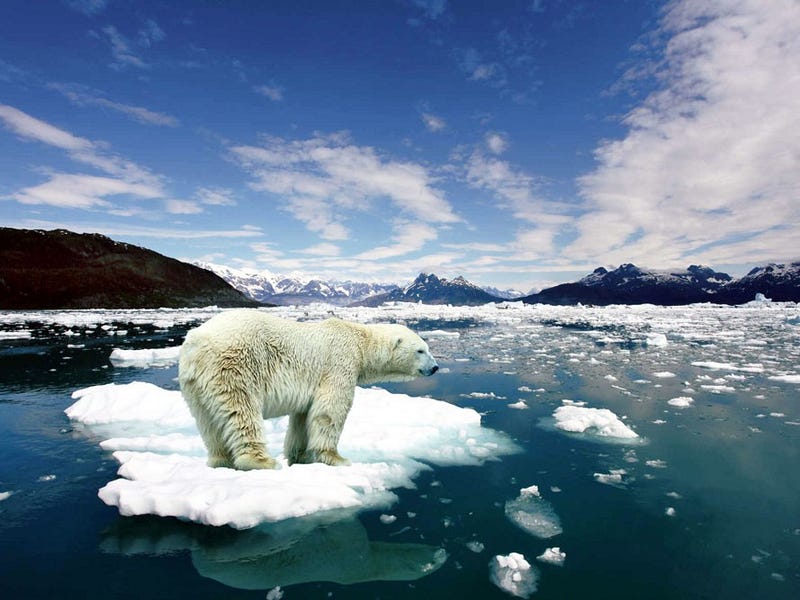
A lone polar bear on a shrinking island
of ice- a symbol of climate change.
Theory and empirical data support these predictions, unequivocally.
That reality, however, is being cynically weaponized by an unqualified chattering class that seeks partisan advantage, even at the risk of war.
Reactions to the latest Intergovernmental Panel on Climate Change (IPCC) report on climate change exemplify this problem…

Read the Medium story by Kent Kroeger - “The Coming Climate Change War.”

13 April, 2018

Heat waves over the ocean have ballooned and are wreaking havoc on marine life

Heat waves over the world’s oceans are becoming longer and more frequent, damaging coral reefs and creating chaos for aquatic species. A study published Tuesday in the journal Nature Communications found a 54 percent increase in the number of days in which heat waves have cooked the oceans since 1925.
(Institute of Atmospheric Physics)
The rise in these marine heat waves has occurred while ever more heat is stored in the ocean because of accumulating greenhouse gases in the atmosphere. The ocean heat content in 2017 was the highest in recorded history, noted Kevin Trenberth, a climate scientist at the National Center for Atmospheric Research. Trenberth said in an email that ocean heat waves will necessarily increase given the building stockpile of heat, which has been measured from the surface down to more than a mile deep (2,000 meters).

Read Jason Samenow’s story from The Washington Post - “Heat waves over the ocean have ballooned and are wreaking havoc on marine life.”

23 February, 2018

Our acid oceans will dissolve coral reef sands within decades

Carbonate sands on coral reefs will start dissolving within about 30 years, on average, as oceans become more acidic, new research published today in Science shows.

Carbonate sands, which accumulate over thousands of years from the breakdown of coral and other reef organisms, are the building material for the frameworks of coral reefs and shallow reef environments like lagoons, reef flats and coral sand cays.

But these sands are sensitive to the chemical make-up of sea water. As oceans absorb carbon dioxide, they acidify – and at a certain point, carbonate sands simply start to dissolve.

The world’s oceans have absorbed around one-third of human-emitted carbon dioxide.


Read the piece on The Conversation by the Professor of Biogeochemistry from the Director of the Centre for Coastal Biogeochemistry at Southern Cross University, Bradley Eyre - “Our acid oceans will dissolve coral reef sands within decades.”

12 December, 2017

Great Barrier Reef will be dead by 2100, says David Attenborough's Blue Planet II

London: Coral reefs – including Australia's Great Barrier Reef – will be dead by 2100 due to human "maltreatment of the oceans", David Attenborough's Blue Planet II has declared.

Sir David Attenborough - he says the Great Barrier Reef
will be dead by 2100 due to our maltreatment of the oceans.
 
Attenborough's follow-up documentary series, which took four years to film and produce, finished airing in Britain on Sunday night (local time). It ended with his grim warning about the state of our oceans, which Attenborough said were "under threat now as never before.”

He said climate change, plastic pollution and over-fishing were all contributing to the demise of coral reefs.

Blue Planet II has been Britain's most-watched show of 2017, with 14 million tuning into the first episode of the wildlife series. Nine will air the seven-part series on free-to-air television in Australia in 2018.


Read Latika Bourke’s story in today’s Melbourne Age - “Great Barrier Reef will be dead by 2100, says David Attenborough's Blue Planet II.”

10 December, 2017

‘Super corals' may offer ailing Great Barrier Reef some 'breathing space'

For Charlie Veron, the veteran marine biologist, new evidence of the prospect of "super corals" offers the prospect of more time for the world's coral reefs hard-hit by climate change.

Sea mission: (from left) John Rumney, Managing Director
of GBR Legacy, Dr Charlie Veron with new coral species,
and Dr Dean Miller, Director of Science and Media GBR Legacy. 
Dr Veron, who earned the moniker of the "godfather of coral" for naming about one-fifth of the world's corals, has just returned from a mission funded by donations to locate corals unusually resilient to the past two summers of severe bleaching on the Great Barrier Reef.

"There were endless hectares of what used to be luxurious corals, which are now totally dead," Dr Veron said in Port Douglas at the end of a three-week expedition by the Great Barrier Reef Legacy.

However, in some outer reefs off far north Queensland, corals were found by the scientists to have fared relatively well, offering signs that critical biodiversity had survived.


Read Peter Hannam’s story in today’s Melbourne Age - “‘Super corals' may offer ailing Great Barrier Reef some 'breathing space'."

25 July, 2017

Extreme El Nino events to double in number even with 1.5-degree warming: study

Extreme El Nino events will more than double in frequency, even with the most ambitious goals to curtail global warming, exposing large regions to severe droughts and placing coral reefs in peril, a team of scientists including Australians say.


In 2015, almost 200 nations signed the Paris Climate accord, agreeing to curb greenhouse gas emissions to prevent global temperatures warming more than 1.5-2 degrees compared with pre-industrial times. National pledges so far point to warming of closer to 3 degrees.


Read Peter Hannam’s story in today’s Melbourne Age - “Extreme El Nino events to double in number even with 1.5-degree warming: study.”

15 July, 2017

Live near the beach? Coral reef expert Charlie Veron has some advice for you

Charlie Veron, the world's foremost expert on coral reefs, lives on a shady bend of Sachs Creek, half an hour's drive out of Townsville, in a concrete block house with three dogs, eight geese, two pet rats, seven cockatoos, a baby red fruit bat, scores of tropical fish, a green tree frog (in the bathroom), bush turkeys, the occasional echidna and what appears to be several million wallabies just about everywhere you look. Other animals include one son, two daughters and an adult female named Mary Stafford-Smith.

Charlie Veron, the “Godfather of Coral”, says Australia’s
 politicians are “idiots” for doing nothing about climate change. 
"The house is a bit of a menagerie," says Stafford-Smith, who also happens to be Veron's wife. "There are dingoes in the valley, too. Once we found a pup under a bush in the garden and looked after it.”


Read Tim Elliott’s story in today’s Melbourne Age - “Live near the beach? Coral reef expert Charlie Veron has some advice for you.”

17 September, 2016

Monbiot muses about our 'disposable planet'


(In this piece by Guardian columnist, George Monbiot, muses about what he describes as our “Disposable Planet” zeroing in our consumerism that allows even those offended by some aspects of our behaviour to remain remote and seeming detached from the acts that are wrenching our earth apart, and little by little, destroying it, and by implication, leaving our home in ruins – to turn to a popular axiom, “We are shitting in our own nest” and yet seem untroubled that we are allowing someone else to do what in effect is our ”dirty work” – Robert McLean)

George Monbiot.
The world’s largest land animal, the biggest fish, the bird with the greatest wingspan, the largest primate: all are sliding towards extinction at astounding speed. If we will not protect such magnificent species, what are we prepared to do?

In just seven years, 30% of Africa’s savannah elephants have been wiped out. The other African sub-species, the forest elephant, has crashed by more than 60% since 2002. Perhaps this month’s resolution to ban domestic sales of elephant tusks will make a difference, but governments have done so little to restrain the international trade that illegal ivory and other wildlife parts are still sold on the surface web, rather than the dark web.

Last month the whale shark was classified as endangered. Some are still hunted deliberately for their meat and fins, and it seems that the revolting practice of live finning – slicing them off then dumping the shark overboard to die slowly – continues. Most are killed as bycatch in nets used to catch other species, especially tuna. Some fishing boats use whale sharks as markers (tuna tend to congregate beneath large objects), and deliberately cast their nets around them.

Their decline – whale shark numbers have halved or worse in 75 years – reflects the global loss of ocean life. Since 1996, the fish catch has fallen by one million tonnes a year, as stocks are exhausted. Sieving the seas for what remains, fishing fleets will trigger the collapse of entire ecosystems.

Fishing also accounts for what has happened to the bird with the largest wingspan, the wandering albatross, whose population has fallen by around 30% in 11 years. Again, the tuna fishery is the principal threat, in this case through the use of baited longlines. The albatrosses dive for the bait, get hooked and drown. Another cause is their junk food diet: the plastic they eat then feed to their chicks through regurgitation. The photographs were taken by Chris Jordan on Midway atoll, of the albatross corpses rotting away to reveal the rubbish they contain, are a synopsis of our treatment of the living world. However far we travel, our impacts precede us.

A week ago the status of the eastern gorilla, the world’s largest primate, was changed from endangered to critically endangered: it has declined by 70% in 20 years. Its habitat, in central Africa, has been ripped apart by logging, mining, and farming, and the gorillas are hunted for meat. As they share 98% of our DNA, this is not far from cannibalism. All the great apes are now either endangered or critically endangered, in the case of orang utans largely as a result of producing palm oil. What does it say about us, that we are prepared to drive our closest relatives towards extinction?

The great acceleration towards a bare grey world is also reflected in this week’s State of Nature report, which shows that more than 10% of the remaining species in the UK are now threatened with extinction. Last week we learnt that one-tenth of the world’s wild places, forests, savannahs and other lands in which human impacts are not obvious, have been lost – dewilded – over the past 25 years. The trajectory suggests that there could be almost nowhere left by the end of the century.

These should be among the central issues of our age. Yet we treat these losses as sad but peripheral, though we commission them through the things we buy. Elephants, rhinos, lions, polar bears, the great sharks, turtles, condors, whales, rainforests, wetlands, coral reefs: they are all the bycatch of consumerism. We assert both the right to consume – whatever we want, however, we want – and the right to forget the consequences.

Flying to Bratislava or Bermuda for a stag weekend, shopping trips to New York, driving our gas guzzlers 300 metres to school, buying jetskis, leaf blowers and patio heaters, furnishing our homes with rare wood, eating tuna, prawns and salmon without a thought of how they were produced: these ephemeral satisfactions, to judge by the reactions when you question them, occupy a sacred and inviolable space. The wonders of the living world, by contrast, are dispensable.

Recipes for tuna salad abound, but none
explain the implications of the dish.
People who would never dream of killing an albatross or a whale shark are prepared to let others do so on their behalf so that they may eat whatever fish they fancy. People who could not bring themselves to gut a chicken are happy to commission the disposal of entire ecosystems. The act of not seeing is sanctioned and normalised, while attempts to explain the consequences are treated as abnormal and impertinent. On the Guardian’s website, you can read about the global collapse of tuna populations, then, in a recipe published the following day, learn how to prepare a tuna salad, without a word about the implications.

Such cultural norms, positioning us as consumers first and moral beings either second or not at all, grant the disposal of the living planet its social licence. They allow us to compartmentalise, to be conscious of the issues when there is little that we can do about them, and to forget them at the moment when we have the capacity to act (or to refrain from acting). This is the safe space we establish for consumerism.

The costs cannot be computed in financial terms. There is no price that can capture the awe aroused by a whale shark, the deep being of an elephant herd, the way in which your heart soars with the albatross as it mounts a column of air; the gorilla’s fathomless gaze. The albatross hangs around our necks with a weight that defies calculation.

Is this how we choose to be remembered? We were here; it is true that we existed: you can see it in the pulse of extinction. Are we to use our gift of life to snuff out other lifeforms? What will you leave behind, except your contribution to the Pacific garbage patch?

I believe we can do better, that we can position ourselves as just one participant in a world of wonders, blessed and cursed with higher consciousness, but using that capacity to embed ourselves within its limits.

We cannot wait for governments or schools or the media to deliver a new environmental ethics. Join the groups trying to defend the living planet, learn about the consequences of what you do, demand, from friends, from parents, from yourself, a better way of engaging with the world. By living lightly we enrich our lives.

10 September, 2016

Oceans Reaching Limit of Soaking up Global Warming

A new IUCN report, entitled “Explaining ocean warming: causes, scale, effects and consequences”, sets out the most recent and comprehensive review to date on this topic and shows a complex story of change in the ocean.

This change is underway, often already locked in for many decades to come, and has already begun to impact people’s lives. 

This is no longer a single story of ocean warming challenges to coral reefs, but a rapidly growing list of alarming changes across species at ecosystem scales, and across geographies spanning the entire world.

It is pervasive change, driven by ocean warming and other stressors already operating in ways we are only beginning to understand, where essential gaps in marine data, systems and capabilities are leaving the world poorly prepared to cope in the future.

Read the UN Climate Change Newsroom story - “Oceans Reaching Limit of Soaking up Global Warming.”