Showing posts with label coal. Show all posts

10 February, 2020

New report shows world is awash with fossil fuels. It's time to cut off supply

A new United Nations report shows the world's major fossil fuel producing countries, including Australia, plan to dig up far more coal, oil and gas than can be burned if the world is to prevent serious harm from climate change.
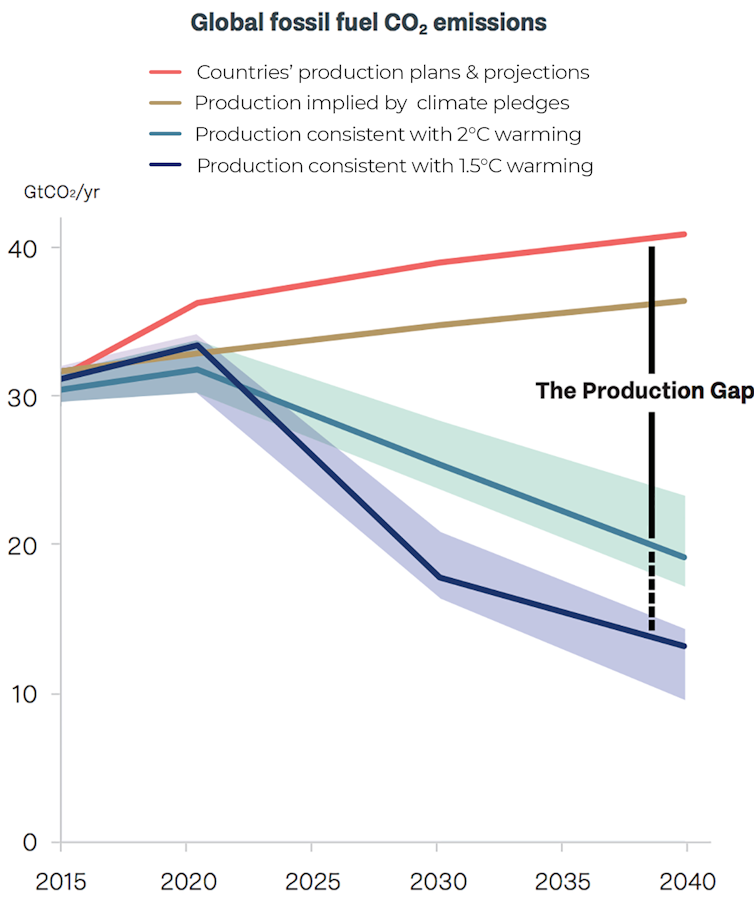
The report found fossil fuel production in 2030 is on track to be 50% more than is consistent with the 2℃ warming limit agreed under the Paris climate agreement. Production is set to be 120% more than is consistent with holding warming to 1.5℃ – the ambitious end of the Paris goals. 
Australia is strongly implicated in these findings. In the same decade we are supposed to be cutting emissions under the Paris goals, our coal production is set to increase by 34%. This trend is undercutting our success in renewables deployment and mitigation elsewhere.

Read the story from The Conversation by Peter Christoff - “New report shows world is awash with fossil fuels. It's time to cut off supply.”

16 January, 2020

Why Australia will keep right on damaging the climate by selling coal

Australia’s remarkable prosperity rests on a balancing act. It mines coal, natural gas and iron ore from a vulnerable landscape. It takes ever more money from China while allied with the U.S. military.
scott morrison coal
In 2017, then-Treasurer Scott Morrison brought a lump of
coal to parliament and urged the nation not to be so afraid. 
With devastating wildfires ripping through its countryside, that balance may become increasingly difficult to maintain.
Australia’s leaders face growing pressure to address climate change, as scientists blame the country’s increasingly hot and dry conditions for the disastrous blazes. That would mean reckoning with Australia’s dependence on providing China and other countries with coal.
The fossil fuel, used to fire many of the world’s power plants and steel mills, is one of Australia’s biggest exports. Coal is also one of the biggest sources of climate change gases, and produces most of Australia’s own electricity.


15 August, 2019

Australia removes climate 'crisis' from Pacific islands draft declaration

Scott Morrison at the Pacific Islands Forum in Funafuti, Tuvalu
Scott Morrison at the Pacific Islands
Forum in Funafuti, Tuvalu. Australia
 has been working to soften language
 on coal and the climate emergency
in its draft declaration.
Australia has succeeded in removing all but one reference to coal on the draft communique of the Pacific Islands Forum, and is expected to be able to get that removed on Thursday as Pacific leaders including Scott Morrison meet to debate the text.

Sources familiar with the negotiations on the communique, which is used for regional policy making, told Guardian Australia that Australia has been working hard during negotiations to soften the language on climate change and has succeeded in many mentions.


Read the story from The Guardian by Kate Lyons - “Australia removes climate 'crisis' from Pacific islands draft declaration.”

15 May, 2019

How to transition from coal: 4 lessons for Australia from around the world

With 12 coal power stations in Australia closed since 2013, a full transition out of coal is coming.
A Hazelwood power station employee hangs his hat
on the fence after it closed after 52 years of operation.
Around the world, governments and stakeholders are considering how to implement a “just transition” from coal to clean energy – a transition that’s fair for local workers and communities in coal regions.

Some coal-producing nations, such as Germany and Spain, are delivering major just transition packages. Other nations are less successfully trying to navigate social conflicts around the transition, such as Poland and South Africa.


08 March, 2019

‘National disgrace': Glencore coal campaign revelations prompt calls for reform

Revelations that Glencore used a secret multi-million dollar project to bolster support for coal have outraged environmentalists and transparency advocates, who are calling for democratic reform to bring such campaigns out of the shadows.
 Former prime minister Kevin Rudd described
Glencore’s Project Caesar as a ‘national disgrace’. 
Glencore used one of the world’s best political operatives, the C|T Group, to run a vast, secret communications campaign aimed at shifting public and government attitudes towards coal.

The campaign, named Project Caesar, used an annual budget of between £4m and £7m to spread sophisticated pro-coal, anti-renewables messaging across social media, using slick video, memes and graphics through supposedly grassroots Facebook groups.


Read the story from The Guardian by Christopher Nauas - “‘National disgrace': Glencore coal campaign revelations prompt calls for reform.”

01 January, 2019

In 2018 the Australian government chased its energy tail. Here's a more hopeful story

While the government continued to trash Australia’s international reputation by reaffirming allegiance to coal on the global stage, lying about progress on our climate commitments and dismissing the findings of the landmark IPCC report, the transformation in our electricity sector tells a different and hopeful story.
‘Almost everyone in the energy sector now accepts that
renewables are cheaper than building new coal capacity’
 
Attacks by the former prime minister Tony Abbott and his environment minister Greg Hunt on the renewable energy target, and the investment strike that followed, are a fading memory. Momentum is now unstoppable.

In the three years from 2018 Australia will install a little over 12 gigawatts of renewables, as much as was installed in the 30 years after the country’s first windfarm opened at Salmon Beach in Western Australia in 1987.


Read the opinion piece from The Guardian by Simon Holmes à Court - “In 2018 the Australian government chased its energy tail. Here's a more hopeful story.”

27 December, 2018

The World Needs to Quit Coal. Why Is It So Hard?

HANOI, Vietnam — Coal, the fuel that powered the industrial age, has led the planet to the brink of catastrophic climate change.
An open pit mine in Burdwan, West Bengal, India.
Coal is the single largest source of electricity worldwide.
Scientists have repeatedly warned of its looming dangers, most recently on Friday, when a major scientific report issued by 13 United States government agencies warned that the damage from climate change could knock as much as 10 percent off the size of the American economy by century’s end if significant steps aren’t taken to rein in warming.

An October report from the United Nations’ scientific panel on global warming found that avoiding the worst devastation would require a radical transformation of the world economy in just a few years.

Central to that transformation: Getting out of coal, and fast.


Read the story from The New York Times by Somini Sengupta - “The World Needs to Quit Coal. Why Is It So Hard?”

21 December, 2018

Climate change and the risk to civilisation: the doctors' prescription.

The 2018 State of the Climate report, released yesterday, again highlights the risk to human wellbeing from our love affair with fossil fuels. Coal, oil and gas have underpinned the incredible advances in affluence, population size, and health since development of the steam engine. But fossil fuel use has an optimum dose, which is now well past.
An evacuation during the November bushfires,
 near Mount Larcom, Queensland.
CREDIT:
We are metaphorically drowning in carbon dioxide, the invisible, odourless waste product of burning fossil fuel. As the report notes, this is increasing heatwaves, acidifying the oceans and raising the sea level. It is also lowering the micronutrient concentrations of food.


Read the story from The Age by Colin Butler - “Climate change and the risk to civilisation: the doctors' prescription.”

13 July, 2018

ACCC rejects coal-fired power support claims

Competition chief Rod Sims has dismissed suggestions a landmark energy report he issued on Wednesday backed government support for coal, as Coalition figures used the claim to push public subsidies for a new coal-fired power plant to solve Australia's energy crisis.
ACCC chairman Rod Sims.
Nationals MPs latched onto a key recommendation that new “firm” generation capacity be underwritten by the government to support new entrants by giving them a long-term guarantee that Canberra would buy electricity to help them secure finance.

"It is technology neutral and if you are interested in affordability best to stay that way," Mr Sims said. "It's not targeted at baseload power and it's not targeted at coal.”


Read the story from The Age by Eryk Bagshaw - “ACCC rejects coal-fired power support claims.”

04 April, 2018

Tony Abbott-led push on energy policy struggles to find serious numbers to threaten PM

Prime Minister Malcolm Turnbull is spurning a backbench push to ramp up support for coal as critics including Tony Abbott work to force a shift in direction on energy policy but struggle to secure widespread support.
Take my advice, mate: Malcolm Turnbull and local
 Norm Clarke at a community lunch in Brisbane.
The government is confident of sealing an agreement with the states within weeks on its National Energy Guarantee, clearing a key hurdle for national rules that require energy retailers to improve reliability and reduce emissions.

Mr Turnbull’s allies on Tuesday blamed a backbench “ginger group” for trying to undermine the Prime Minister ahead of any agreement, and the government's expected loss of its 30th Newspoll survey next week.

The rebel MPs claim 20 signatures or more for a statement that backs the use of coal for electricity generation and calls for an end to renewable energy subsidies, reviving demands they made in the Coalition party room last year.


03 April, 2018

Which generates more greenhouse gases, transportation or buildings?

It all comes back to buildings.

A few months ago I wrote that transportation is now the biggest source of US CO2 emissions, noting that the switch from coal to natural gas for power generation had caused emissions from power generation to decrease while cars kept turning into trucks and emitting more. More recently, the Rhodium Group released final US emissions numbers for 2017, including other sectors, like industry and buildings.


Architect Gregory Duncan saw this graph and suggested that architects and others in the industry should not get complacent just because the yellow line was so low, way lower than power or transportation.


Read the Treehugger story by Lloyd Alter - “Which generates more greenhouse gases, transportation or buildings?”

26 January, 2018

Insurance companies have a role to play in equipping us for challenges of climate change

Lloyd's of London will no longer allow their trading platform to be used for investing in coal, because this fuel is the main driver of climate change. Given the global insurance industry has been harking on for decades about the increasing risks of extreme weather to property, one would have thought they might have arrived at that conclusion a little sooner.
A resident in the flooded streets of Rockhampton
during the aftermath of Cyclone Debbie in April 2017.
During their 25 years of inaction on this front, the insurance industry, through investments and cover, has facilitated massive coal use around the world, locking emissions and unavoidable warming into the atmosphere. As a result, we now have a large number of property owners around Australia who are going to feel the heat of surging insurance prices to cover worsening weather extremes. The industry has an obligation to respond.


Read Karl Mallon’s comment in today’s Melbourne Age - “Insurance companies have a role to play in equipping us for challenges of climate change.”

14 January, 2018

How Much Does Climate Change Cost? Try $1.5 Trillion (and Counting)

The Trump administration, and its allies in Congress, are fighting a losing war. They continue to press forward for the development of oil, gas, and coal when the rest of the world understands the implication of that folly. Global warming is the most pressing issue for our time. Period.
The thing is governments really have two choices when it comes to managing the impact on its people from global warming: spend money on trying to reduce the problem or spend money on cleaning up the catastrophes.
Firefighters clear debris from a mudslide in Los Angeles,
California on January 9, 2018. The deadly rain storm claimed
 the lives of 13 people in Santa Barbara County. Flash
flooding also occurred in the recently burned areas
of Ventura and Los Angeles counties.
The Trump administration is on the hook for the catastrophe. A report released Monday by The National Centers for Environmental Information pegged the total cost this year at $1.5 trillion, including estimates for Hurricanes Harvey, Irma, and Maria. (And that doesn’t even begin to count the human toll, lost lives, lost jobs, lost opportunity.)

I witnessed firsthand the impact of Hurricane Maria on the island of Dominica last month. We keep hearing stories about the power grid being down (similar to Puerto Rico) and you think, Why? It’s been months. Why aren’t the lights on? Then you see nearly every electrical pole on the island sideways. The entire grid needs to be rebuilt (or better, rethought) and that’s decades of infrastructure. So the figure of $1.5 trillion is far short of what will be needed. Nearly every electrical line, every other house, the damage was so widespread it’s impossible to overstate. And that’s just one island. Multiple the effect across the region. The planet.


Read Mark Trahant’s story on Yes! Magazine - “How Much Does Climate Change Cost? Try $1.5 Trillion (and Counting).”

08 January, 2018

Winds of change: Britain now generates twice as much electricity from wind as coal

Just six years ago, more than 40% of Britain’s electricity was generated by burning coal. Today, that figure is just 7%. Yet if the story of 2016 was the dramatic demise of coal and its replacement by natural gas, then 2017 was most definitely about the growth of wind power.

Wind provided 15% of electricity in Britain last year (Northern Ireland shares an electricity system with the Republic and is calculated separately), up from 10% in 2016. This increase, a result of both more wind farms coming online and a windier year, helped further reduce coal use and also put a stop to the rise in natural gas generation.


Read the story by a Teaching and Research Fellow from the Chemical and Biological Engineering at the  University of Sheffield, Grant Wilson, on The Conversation - “Winds of change: Britain now generates twice as much electricity from wind as coal.”

27 December, 2017

New study reaches a stunning conclusion about the cost of solar and wind energy

In one of the fastest and most astonishing turnarounds in the history of energy, building and running new renewable energy is now cheaper than just running existing coal and nuclear plants in many areas.
Stunning report - wind and solar now cheaper
than existing coal and nuclear plants.
A widely-used yearly benchmarking study — the Levelized Cost of Energy Analysis (LCOE) from the financial firm Lazard Ltd. — reached this stunning conclusion: In many regions “the full-lifecycle costs of building and operating renewables-based projects have dropped below the operating costs alone of conventional generation technologies such as coal or nuclear.”

Read Joe Romm’s on ThinkProgress  story  - “New study reaches a stunning conclusion about the cost of solar and wind energy.”

22 December, 2017

A lump of coal - metaphor for a wretched year for Malcolm Turnbull

The moment that summed up the political year 2017 for me came in the first sitting week when treasurer Scott Morrison marched into parliament brandishing a lump of coal.
‘The marriage equality vote was a step forward for the nation, but the process was expensive and needlessly divisive, the May federal budget was rightly portrayed as Labor-lite, while a bank royal commission has been imposed on a reluctant government’
 ‘The marriage equality vote was a step forward for the nation,
but the process was expensive and needlessly divisive, the
May federal budget was rightly portrayed as Labor-lite, while
 a bank royal commission has been imposed on a reluctant government’
“This is coal – don’t be afraid, don’t be scared”, the treasurer cried out maniacally, before passing it along his front bench where Barnaby Joyce proceeded to fondle it like Gollum his precious ring.
The coal stunt was a none-too-subtle attempt to shift the focus of energy policy away from the imperative of transitioning to a renewable future by opening a new wave of investment in fossil fuels.

The premeditated stunt locked the Coalition in behind a coal lobby that had been running a coordinated campaign to besmirch renewables since an extreme weather event had led to blackouts in South Australia in late 2016.

The lump of coal act was also the final surrender by a prime minister who had built a public persona around his determination to take meaningful action on climate change.


Read the opinion piece by Peter Lewis on The Guardian - “A lump of coal - metaphor for a wretched year for Malcolm Turnbull.”

19 November, 2017

Coal trumps Trump as climate talks villain

Bonn: The villain of this year's UN climate talks hasn't been Donald Trump, as many expected, instead coal took centre stage.

A replica of the Statue of Liberty by Danish artist Jens
Galschiot emits smoke in a park outside the 23rd
 UN Conference of the Parties (COP) in Bonn, Germany, on Friday.
The fortnight-long conference in Bonn was expected to be dominated by the US President's withdrawal from the Paris climate accord, but talks focused instead on weaning the world's dependence on coal.

The conference culminated in 20 countries - including New Zealand, the UK and Canada - creating a new Powering Past Coal alliance, which promises to build no more coal power plants and phase out traditional ones by 2030.

They hope to have 50 members by next year's COP, to be held in December in coal-hungry Poland.


Read the story from Bonn by Katina Curtis in today’s Melbourne Age - “Coal trumps Trump as climate talks villain.”

17 November, 2017

Powering Past Coal Alliance: 20 countries sign up to phase out coal power by 2030

Twenty countries including Britain, Canada and New Zealand have joined an international alliance to phase out coal from power generation before 2030.

The Hazelwood power station in Victoria's La Trobe Valley.
The Powering Past Coal Alliance was unveiled at the COP23 climate talks in Bonn, Germany, which were working out the technical details of the 2015 Paris Agreement.

"I think we can safely say that the response has been overwhelming," Canadian Environment Minister Catherine McKenna said.

The alliance, which isn't legally binding, was launched days after a pro-coal presentation by the Trump administration jarred with many ministers who wanted the talks to focus on cleaner energy sources.


05 November, 2017

To Close Climate Goals Gap: Drop Coal, Ramp Up Renewables — Fast, UN Says

Countries will have to phase out coal and invest in renewable energy even faster than previously expected to keep global warming below perilous levels and fend off the most dangerous impacts of climate change, according to a United Nations report released just before the next round of international climate talks.
The world can meet more ambitious emissions targets with a major scaling
back of coal and ramping up of renewable energy, a new UNEP report says. 
The United Nations Environment Program on Tuesday released its annual report on the "emissions gap"—the distance between countries' pledged commitments for meeting the targets of the 2015 Paris climate agreement and the pathways that scientists estimate could actually achieve those targets.

The report, prepared by dozens of scientists and incorporating the latest scientific findings, includes new information to help negotiators zero in on more ambitious commitments that might achieve the Paris Agreement's most stringent target: keeping the rise in temperatures to 1.5 degrees Celsius since the start of the industrial era.


Read Georgina Gustin’s story on Inside Climate News - “To Close Climate Goals Gap: Drop Coal, Ramp Up Renewables — Fast, UN Says.”

21 October, 2017

South Australia goes all out on renewables despite federal focus on coal

October 13, 2017 — The Australian federal government’s love affair with coal has reached new levels in recent years, with federal ministers bringing chunks of the mineral into parliament and donning high-visibility mining vests as pro-coal publicity stunts. Yet against this backdrop, one Australian state has managed to break global records in the renewable energy space.

Recently, South Australia’s state government has announced not one but two record-breaking renewable energy projects: the world’s largest solar thermal power plant and the world’s largest lithium ion battery installation. Together, these projects will help the state surge well ahead of its already ambitious renewable energy targets while delivering a clear challenge to its coal-obsessed federal counterpart.


Read the ENSIA story by Bianca Nogrady - “South Australia goes all out on renewables despite federal focus on coal.”