Showing posts with label history. Show all posts

11 January, 2020

Terror, hope, anger, kindness: the complexity of life as we face the new normal

When we come to write the history of climate politics in Australia, it’s possible New Year’s Eve 2019 will be seen as the moment everything changed. That was the day the nation – and indeed the world – watched in horror and despair as the people of Mallacoota fled to the beach to escape the wall of flame bearing down on their town.
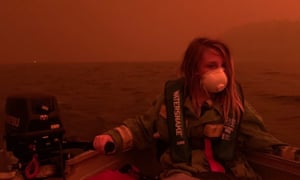
A photo by Mallacoota mother Allison Marion
The photo taken by Mallacoota resident Allison Marion showing
 her 11-year-old son, Finn, seated in the stern of a dinghy.
They weren’t the only ones fleeing the fire that day. In towns from the Blue Mountains to the outskirts of Melbourne, communities were facing catastrophe. But there was something about the images from Mallacoota, the crowds of people and animals huddled on the sand in the eerie red light that somehow brought not just the scale but the uncanniness of the crisis home. “When Brueghel meets the Anthropocene,” a friend of mine tweeted about similar scenes in Malua Bay. More like Bosch, others replied.

Read the story from The Guardian by James Bradley - “Terror, hope, anger, kindness: the complexity of life as we face the new normal.” 

21 December, 2019

2019 has been a year of climate disaster. Yet still our leaders procrastinate

2019 may go down in history as Year Zero of the climate apocalypse. The tsunami of extreme events has been so relentless that each is quickly forgotten in favour of its successor.
Bushfire Bargo
‘Despite all the scientific evidence, all the destruction,
all the suffering, all the apocalyptic predictions, and
all the strikes and marches, nothing happens.’
So before the year ends we should pause, remember just how extraordinary it was, and reflect on what this might mean for our future.
The year started with a record-breaking heatwave in southern Australia with temperatures in the mid-40s, in some areas for 40 days in a row. Then followed the immolation of vast areas of moist Tasmanian forests, forests that date back to the last ice age. Approximately 3% of the state burned as a long-term trend of less rainfall and more evaporation was capped off by the driest January on record. On the mainland, who could forget those horrifying images of the Menindee fish kills?

Read the story from The Guardian by Geoff Goldrick - “2019 has been a year of climate disaster. Yet still our leaders procrastinate.” 

16 January, 2019

Making the heat trend in Australia’s capital cities for 2018 and future projections

The Is it hot right now? website provides a daily view on daily average temperatures for Australian capital cities, comparing the average temperature to its history for that day, to see where it sits in the distribution of temperatures typical for the time of year. 

The site was developed by climate researchers Mathew Lipson, Steefan Contractor and James Goldie. The data comes from the Bureau of Meteorology's ACORN-SAT.

Mat Lipson provided the Yearly average temperature charts and the 2018 heat maps for each city. The trend in rising temperatures is clearly visible in each. I have added details for each city of future projections done by CSIRO in 2015.


28 October, 2018

China and Russia are eyeing up Antarctica — and experts say Australia should be more concerned

Australia is spending $2 billion on a new Antarctic icebreaker — the biggest single investment in the history of our Antarctic program.
The RSV Nuyina floating in the dry dock in the
Romanian shipyards where it is being built.
The state of the art RSV Nuyina — which was floated last month — will primarily support Australia's scientific research team in Antarctica, but it also has another purpose: shoring up our territorial claim to 42 per cent of the icy continent, where countries including China and Russia have been ramping up their presence.

But why does Australia need to lay claim to so much of Antarctica? What has gotten other countries so interested in the region? And why does it even matter?


22 May, 2018

WIN - 'a book that should be read by every Australian'

Nobel Laureate Peter Doherty has heaped praise on “Sunburnt Country: the history and future of climate change in Australia” by Joelle Gergis.
Win a signed copy of a
"Sunburnt Country".

He said “It’s a book that should be read by every Australian”.

And now Beneath the Wisteria followers have a chance win one of two copies the new book personally signed by Joelle.

The book, Sunburnt Country, it says on the back cover, highlights the impact of a warming plant on Australian lifestyles and ecosystems, and the power we all have to shape future life on earth.

Further, it says, “Sunburnt Country pieces together Australia’s climate history for the first time. It uncovers a continent long vulnerable to climate extremes and variability. It gives an unparalleled perspective of how human activities have altered patterns that have been with us for millions of years, and what climate change looks like in our own backyard.”

One Shepparton reader has said the book is written in plain language and so is accessible and understandable to even those with the most basic grasp of climate science.

Author Joelle Gergis (holding book) is pictured
 with her mentor, Professor David Karoly,  the
 Executive Publisher at MUP,  Sally Heath ( left
and the Dean of Science at UOM,
 Professor Karen Day
Tim Flannery has said that a Sunburnt Country is “A marvellous investigation of Australia’s climate and how we are affecting it.”

Those eager to be in the draw to win one of the two books need simply send their details (name and email address) to Robert McLean before midnight on June 15. Winners will be contacted for details for the mailing out the books.

Dr Gergis is an award winning climate scientist and writer the University of Melbourne.


The two books have been made available by the publishers, Melbourne University Press.

13 April, 2018

Earth’s temperature history is good news for finding alien life

An analysis of temperature during early Earth’s history supports more moderate average temperatures throughout the billions of years when life slowly emerged on Earth.


Theories about the early days of our planet’s history vary wildly. Some studies have painted the picture of a snowball Earth, when much of its surface was frozen. Other theories have included periods that would be inhospitably hot for most current lifeforms to survive. The new research suggests a milder youth for our planet.

“Ideas about the early Earth’s environment are all over the place, from a very hot world, to one locked in a permanent ice age, from a world with acidic oceans to one with seawater so alkaline it would sting your eyes,” says David Catling, a professor of earth and space sciences at the University of Washington.


Read the Futurity story by Hannah Hickey from the University of Washington - “Earth’s temperature history is good news for finding alien life.”

30 March, 2018

‘We’re Talking Very Big Bucks’: New Bill Could Put Oil Companies on the Hook for Climate Change Costs

Oil companies have become some of the wealthiest organizations in history by producing a product that we now know is endangering the future of humanity.
Many of these companies have known about the effects of carbon dioxide for decades, yet while they adapted their own businesses to survive climate change, they actively undermined efforts to understand it.

Should Canadians be able to sue oil companies for that?

“They are in a position to pay for this damage; they have the responsibility to pay for this damage,” Peter Tabuns, the NDP’s climate change critic in the Ontario legislature, told DeSmog Canada. “We’re talking very big bucks.”

23 February, 2018

East Coast Shatters Temperature Records, Offering Preview to a Warming World

There are records—like Wednesday being the earliest 80-degree day in Washington, D.C., history—and then there are the eye-popping effects of those records, like seeing people wearing T-shirts on the streets of Portland, Maine, in February.
Thermometers registered record highs across the eastern
U.S. in mid-February. The map shows temperatures in
 degrees Fahrenheit on Feb. 21, 2018, at 1 p.m. EST.
However you measure it, Feb. 20-21, 2018, were days for the books—days when the records fell as quickly as the thermometer rose, days that gave a glimpse into the wacky weather that the new era of climate change brings.

"What we have is a large-scale pattern that wouldn't be too uncommon in the spring," said meteorologist Patrick Burke of the National Weather Service. "But it's a little bit unusual to see it set up this way in February—and set up with such persistence.”


Read the Inside Climate News story by Sabrina Shankman - “East Coast Shatters Temperature Records, Offering Preview to a Warming World.”

27 December, 2017

New study reaches a stunning conclusion about the cost of solar and wind energy

In one of the fastest and most astonishing turnarounds in the history of energy, building and running new renewable energy is now cheaper than just running existing coal and nuclear plants in many areas.
Stunning report - wind and solar now cheaper
than existing coal and nuclear plants.
A widely-used yearly benchmarking study — the Levelized Cost of Energy Analysis (LCOE) from the financial firm Lazard Ltd. — reached this stunning conclusion: In many regions “the full-lifecycle costs of building and operating renewables-based projects have dropped below the operating costs alone of conventional generation technologies such as coal or nuclear.”

Read Joe Romm’s on ThinkProgress  story  - “New study reaches a stunning conclusion about the cost of solar and wind energy.”

03 September, 2017

Largest fire in Los Angeles' history burns on city's outskirts, homes evacuated

The city of Los Angeles is under siege from a bushfire which the city's mayor has described as the largest in its history.
A crew with Cal Fire battles a brushfire on
the hillside in Burbank, California, on Saturday. 
The fire, which is burning in the La Tuna area in the north-east of the city, has consumed about 2000 hectares of brush in the San Fernando Valley's Verdugo Mountains.

Only 10 per cent of the fire is contained, officials say.

Around 700 homes have been evacuated, roughly 550 of them from the Burbank and Glendale areas, which are adjacent to the fire.


Read Michael Idato’s story in today’s Melbourne Age - “Largest fire in Los Angeles' history burns on city's outskirts, homes evacuated.”

18 May, 2017

Writing the WA wheatbelt, a place of radical environmental change

What can creative literature tell us about radical environmental change? Most people accept that literature can be closely connected to places. Whether it is Dickens’s London or Hardy’s Wessex, we also accept that imaginative works deliver something about the nature of place that does not necessarily come to us by any other means.

How then does this work in Australia? I have spent the past decade writing a literary history of the Western Australian wheatbelt and have sought in various ways to answer this question.
It is a regional literary history that nevertheless encompasses some of the nation’s finest writers — Albert Facey, Dorothy Hewett, Peter Cowan, Jack Davis, Randolph Stow, Elizabeth Jolley, Tom Flood, John Kinsella. Facey’s A Fortunate Life  (1981) is a landmark in Australian autobiography; Hewett, Cowan and Stow helped define literary modernism in Australia; Jack Davis was a leading figure in the Aboriginal literary renaissance; and Jolley’s The Well (1986) and Flood’s Oceana Fine (1990) both won the Miles Franklin literary award.

What unites these works? Is it simply a quirk of fate that a sparsely populated hinterland in Australia’s most isolated state produces a body of literature that rivals in many ways the literary outputs of the great Australian metropolitan centres in Melbourne and Sydney?


Read the piece by an Associate Professor of  English and Cultural Studies at the University of Western Australia, Tony Hughes-D'Aeth, on The Conversation - “Writing the WA wheatbelt, a place of radical environmental change.”

22 September, 2014

Noam speaks/writes, we should stop and listen


Noam Chomsky is one of our great thinkers and when he talks, or writes, we should all step back from the rush that is life and consider.
Noam Chomsky - we should reflect.

Writing in In These Times, the American linguist, philosopher, cognitive scientist, logician, political commentator and activist, has discussed the likely end of the era of civilization.

He writes foreshadowing a new report from the Intergovernmental Panel on Climate Change (IPCC) in a story headed: “The End of History?”

Chomsky say: “The era of civilization coincides closely with the geological epoch of the Holocene, beginning over 11,000 years ago. The previous Pleistocene epoch lasted 2.5 million years.

“Scientists now suggest that a new epoch began about 250 years ago, the Anthropocene, the period when human activity has had a dramatic impact on the physical world. The rate of change of geological epochs is hard to ignore”.

He said: “One index of human impact is the extinction of species, now estimated to be at about the same rate as it was 65 million years ago when an asteroid hit the Earth.

“That is the presumed cause for the ending of the age of the dinosaurs, which opened the way for small mammals to proliferate, and ultimately modern humans. Today, it is humans who are the asteroid, condemning much of life to extinction”.

26 October, 2013

History illustrates our knowledge is not new


Climate change might seem quite new, but history illustrates that we knew what was happening, and what was likely to happen, as long ago as 1824.

It was in that year that French physicist Joseph Fourier described the Earth's natural "greenhouse effect".

He wrote then: "The temperature [of the Earth] can be augmented by the interposition of the atmosphere, because heat in the state of light finds less resistance in penetrating the air, than in re-passing into the air when converted into non-luminous heat."

More detail about the history of climate change can be found on this BBC Science and Environment reported head: “A brief history of climate change”.

09 March, 2013

Earth on track to be 'hottest in human history'


Earth is on track to becoming the hottest it has been at any time in the past 11.3 millennia, a period spanning the history of human civilisation, a new study says.

An ABC news story: “Earth ontrack to be hottest in human history: study” tells how fossil samples and other data collected from 73 sites around the world, have allowed scientists to reconstruct the history of the planet's temperature from the end of the last Ice Age around 11,000 years ago to the present.

“They have determined the past 10 years have been hotter than 80 per cent of the past 11,300 years,” the ABC reports.