Showing posts with label producing. Show all posts

13 December, 2019

Grattan on Friday: Climate winds blowing on Morrison from Liberal party’s left

Scott Morrison is picking up that Australia’s devastating, prolonged fires are producing a soured, anti-government mood among many in the community.
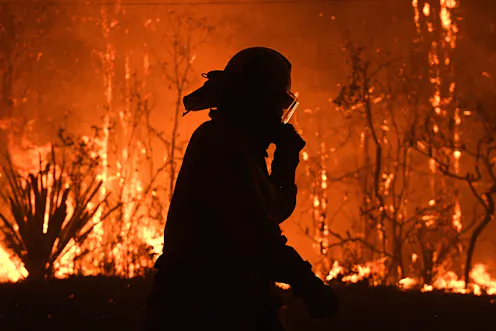
Image result for Grattan on Friday: Climate winds blowing on Morrison from Liberal party’s lef
Morrison has refused to meet calls for a national
summit or a COAG meeting on the fire effort.
It may not be entirely rational for people to turn on politicians in such situations. The actual fighting of the fires, driven primarily at state and local levels, appears to have been efficient.
But the government has invited anger in terms of the broad debate by being so inactive and partisan about climate change over years.
Morrison is struggling to navigate his way through these fraught days before Christmas. He’s stressing unity - “I want to reassure Australians, that the country is working together … to deal with the firefighting challenge”. He’s refusing to meet calls for a national summit or a COAG meeting on the fire effort, but he’s highlighting the federal government’s co-ordinating activities.

Read the story from The Conversation by a Professorial Fellow from the University of Canberra, Michelle Grattan -  “Grattan on Friday: Climate winds blowing on Morrison from Liberal party’s left.”

30 March, 2018

‘We’re Talking Very Big Bucks’: New Bill Could Put Oil Companies on the Hook for Climate Change Costs

Oil companies have become some of the wealthiest organizations in history by producing a product that we now know is endangering the future of humanity.
Many of these companies have known about the effects of carbon dioxide for decades, yet while they adapted their own businesses to survive climate change, they actively undermined efforts to understand it.

Should Canadians be able to sue oil companies for that?

“They are in a position to pay for this damage; they have the responsibility to pay for this damage,” Peter Tabuns, the NDP’s climate change critic in the Ontario legislature, told DeSmog Canada. “We’re talking very big bucks.”

06 January, 2018

The 150-Mile Wardrobe: A Solution for One of the World’s Most Polluting Industries

Between pesticides, chemical dyes, and plastic, producing a typical sweater eats an enormous amount of natural and industrial resources. Apparel is one of the world’s most polluting industries, and the U.S. sends up to 75 percent of its cotton abroad—only to ship it back as cheap T-shirts.
Fibershed founder Rebecca Burgess, Mike Lewis of Growing Warriors in Kentucky,
 and Arnie Valdez of Rezolana Institute in Colorado collaborate on hemp processing. 
The Northern California Fibershed was designed to circumvent all that.

About 104 farmers, ranchers, weavers, spinners, and designers across 19 counties make up a garment-producing system where every producer uses materials sourced within a 150-mile radius: A shop in Oakland buys marigolds from a farm in Chico to dye yarn shorn from sheep in Sonoma and weaves it into sweaters sold in San Francisco.

The concept started in 2010 when textile artist and sustainability advocate Rebecca Burgess challenged herself for one year to wear only clothes produced near her community.


Read the Yes! Magazine story by Araz Hachadourian - “The 150-Mile Wardrobe: A Solution for One of the World’s Most Polluting Industries.”

21 December, 2017

The 150-Mile Wardrobe: A Solution for One of the World’s Most Polluting Industries

Between pesticides, chemical dyes, and plastic, producing a typical sweater eats an enormous amount of natural and industrial resources. Apparel is one of the world’s most polluting industries, and the U.S. sends up to 75 percent of its cotton abroad—only to ship it back as cheap T-shirts.
Fibershed founder Rebecca Burgess, Mike Lewis of Growing
Warriors in Kentucky, and Arnie Valdez of Rezolana Institute
 in Colorado collaborate on hemp processing.
The Northern California Fibershed was designed to circumvent all that.

About 104 farmers, ranchers, weavers, spinners, and designers across 19 counties make up a garment-producing system where every producer uses materials sourced within a 150-mile radius: A shop in Oakland buys marigolds from a farm in Chico to dye yarn shorn from sheep in Sonoma and weaves it into sweaters sold in San Francisco.

The concept started in 2010 when textile artist and sustainability advocate Rebecca Burgess challenged herself for one year to wear only clothes produced near her community.


Read the Yes! Magazine story by Araz Hachadourian - “The 150-Mile Wardrobe: A Solution for One of the World’s Most Polluting Industries.”

The holes in Santa’s stocking: Mapping food loss from the farm and beyond

Imagine, just imagine, you withdraw $1000 from the ATM for Christmas and they slide out as they do, on their tiny conveyor belts, but some of them are crumpled a bit, so you don’t take those ones, and when you’re walking home you cross the road too fast and a few loose ones flick up and get lost to the wind, and you get home and lay the money out to count it and the kids push some notes to the side because they smell funny so you throw those out too, and then you count how much you’ve got left and you’re pleased because you’ve got $400 and that seems fine because you always end up with $400.
Christmas is a time for plenty and celebrating all we
have. Without food loss, we’d have even more to celebrate! 
We’ve used ‘money’ as an analogy for food here—food, the stuff we pour 2/3rds of our water into producing, the stuff we clear land to make farms for, the stuff that keeps us alive.

Dr Pablo Juliano, one of our principle researchers heading up a project to map food loss, says food losses between the paddock and retailer worldwide might be as high as 60 per cent. This of course depends on the country and many other factors, but is a shameful waste regardless. Like the above analogy, food waste occurs at a number of ‘places’ along the supply chain: at the source (farm), at the stores, and, you’ll know all about this one, in the home.


30 August, 2017

Kenya imposes world's toughest law against plastic bags

Nairobi: Kenyans producing, selling or even using plastic bags will risk imprisonment of up to four years or fines of US$40,000 from Monday, as the world's toughest law aimed at reducing plastic pollution came into effect.

Men and women scavenge for recyclable materials
amidst mountains of garbage and plastic bag
 at the dump in the Dandora slum of Nairobi, Kenya.
The East African nation joins more than 40 other countries that have banned, partly banned or taxed single use plastic bags, including China, France, Rwanda, and Italy.

Many bags drift into the ocean, strangling turtles, suffocating seabirds and filling the stomachs of dolphins and whales with waste until they die of starvation.

"If we continue like this, by 2050, we will have more plastic in the ocean than fish," said Habib El-Habr, an expert on marine litter working with the UN Environment Programme in Kenya.


Read the story in today’s Melbourne Age - “Kenya imposes world's toughest law against plastic bags.”