Showing posts with label plastic bags. Show all posts

20 June, 2019

Plastic bag ban looms as Victoria acts to match big stores, other states

Single-use plastic bags will be banned in all shops and supermarkets across Victoria from November this year to stop millions of them flowing into the streets and natural environment.
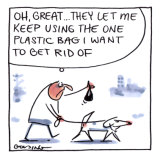
Illustration: Matt Golding
The ban will extend to all lightweight, single-use bags including those made from degradable, biodegradable and compostable plastics.
But plastic bin liners, small clear plastic bags used for fresh fruit and vegetables and animal waste bags will still be allowed.
Legislation will be introduced in the Victorian Parliament on Wednesday banning supermarkets, clothing stores, fast food outlets and service stations from distributing the bags.

Read the story from The Age by Benjamin Preiss and Michael Flower - “Plastic bag ban looms as Victoria acts to match big stores, other states.”

25 April, 2019

Councils to review collecting plastic bags in recycling bins

The future of a popular recycling service that allows half a million Victorians to put plastic bags in their kerbside recycling bins is in doubt following the crisis precipitated by China’s crackdown on waste imports.
Four Victorian councils are reviewing a service that
allows residents to put plastic bags in recycling bins.
Flexible plastics recycling was introduced with great fanfare in 2016 and 2017 by four pioneering Victorian councils – Nillumbik, Cardinia, Hobsons Bay and Boroondara – which said the “exciting change takes us one step closer to eliminating waste sent to landfill”.


Read the story from The Age by Jewel Topsfield - “Councils to review collecting plastic bags in recycling bins.”

06 June, 2018

Shepparton's Fairleys SUPA IGA step up plastic bag ban

Shepparton’s Fairleys SUPA IGA will join supermarket giants Woolworths and Coles in phasing out single-use plastic bags by July 1.

Operations manager Dominic D’Agostino said the supermarket was running down its excess stock while waiting for new reusable bags to be completed by a third-party manufacturer.
Shepparton's Fairleys SUPA IGA step up to plastic
bag ban and Woolworths say plastic straws will be
going as well.
‘‘It was our intention to roll it out sooner but we’re sitting on excessive stock and are waiting to get the reusable bags,’’ he said.

‘‘We will also have reusable plastic bags.’’

He said there would soon be a range of calico, hessian and woven bags for sale ranging from $1 to $4.

Last year Woolworths and Coles announced they would phase out the plastic bags by July 1, with Woolworths recently bringing the date forward to June 20.

Ahead of World Environment Day yesterday, Woolworths also announced plans to phase out plastic straws as well as reduce its plastic packaging on fruits and vegetables.

‘‘While we’ve made progress in reducing the amount of plastic in our stores, supported recycling labelling initiatives, and made improvements in energy efficiency, sustainable sourcing and reducing food waste, we know that more needs to be done to meet our customers’ expectations,’’ Woolworths group chief executive Brad Banducci said.

Coles committed to halving food waste in its supermarkets by 2020 by donating unsold edible food to people in need and diverting food waste to animal feed, clean energy, fertiliser and compost.

‘‘Over the coming months, Coles will release a range of initiatives and commitments to drive more sustainable operations, to reduce our impact on the planet and to help our customers and team members lead healthy lives,’’ its website read.

While Fairleys IGA has no immediate plans in place to phase out products such a plastic straws, Mr D’Agostino said they had always maintained a low level of plastic packaging for fresh produce items.

‘‘We look at ourselves as being a fruit shop on steroids,’’ he said.

‘‘There’ll always be a prepackaged market when it comes to bags of potatoes, etc. That’s just the reality.’’

He said they would also offer their home delivery clients the option to have their groceries packed into boxes.

‘‘There’s a lot of clients who can’t grab their own reusable bag so we can pack it into boxes if they so desire.’’This story is from the Shepparton News - “Plastic bags be gone”.

04 March, 2018

Taiwan Announces Ban on All Plastic Bags, Straws, and Utensils

All single-use plastic must be phased out by 2030.


Ordering take-out, picking up groceries, buying a soft drink — these are all activities that will change over the next decade in Taiwan when the island nation imposes a blanket ban on single-use plastic bags, straws, and cups, according to the Hong Kong Free Press.

It will be one of the farthest-reaching bans on plastic in the world, and it demonstrates the momentum of the anti-plastic movement as the scale of environmental harm caused by the substance is fully realized.

"We aim to implement a blanket ban by 2030 to significantly reduce plastic waste that pollutes the ocean and also gets into the food chain to affect human health," said Lai Ying-yaun, a Taiwanese Environmental Protection Agency official, in a statement.


Read the Global Citizen story by Joe McCarthy - “Taiwan Announces Ban on All Plastic Bags, Straws, and Utensils.”

18 October, 2017

Lightweight plastic bags to be banned in Victoria

Single-use lightweight plastic bags will soon be banned across Victoria.

Premier Daniel Andrews has committed
to banning lightweight plastic bags.
The Andrews government has committed to outlawing plastic bags following the lead of supermarket giants Coles and Woolworths who announced their own bans earlier this year. 

The latest announcement comes after intense lobbying from environment groups who had been pressuring the Andrews government to adopt similar bans already introduced by other states.

The bans mean consumers will most likely need to bring their own shopping bags or buy other bags from retailers.


Read the story by Benjamin Preiss in today’s Melbourne Age - “Lightweight plastic bags to be banned in Victoria.”

30 August, 2017

Kenya imposes world's toughest law against plastic bags

Nairobi: Kenyans producing, selling or even using plastic bags will risk imprisonment of up to four years or fines of US$40,000 from Monday, as the world's toughest law aimed at reducing plastic pollution came into effect.

Men and women scavenge for recyclable materials
amidst mountains of garbage and plastic bag
 at the dump in the Dandora slum of Nairobi, Kenya.
The East African nation joins more than 40 other countries that have banned, partly banned or taxed single use plastic bags, including China, France, Rwanda, and Italy.

Many bags drift into the ocean, strangling turtles, suffocating seabirds and filling the stomachs of dolphins and whales with waste until they die of starvation.

"If we continue like this, by 2050, we will have more plastic in the ocean than fish," said Habib El-Habr, an expert on marine litter working with the UN Environment Programme in Kenya.


Read the story in today’s Melbourne Age - “Kenya imposes world's toughest law against plastic bags.”

04 August, 2017

We Should Never Have Called It Earth

Kate Marvel.
We should never have called it Earth. Three quarters of the planet’s surface is saltwater, and most of it does not lap at tranquil beaches for our amusement. The ocean is deep; things are lost at sea. Sometimes we throw them there: messages in bottles, the bodies of mutinous sailors, plastic bags of plastic debris. Our sewage.

Sometimes the things we lose slip unnoticed down the sides of passing ships. We expect never to see lost objects again, but every so often they are carried by shifting currents and swirling eddies to wash ashore on distant beaches. We are reminded that things, once submerged, have a habit of returning.

I am not afraid of the ocean, although I should be. On hot summer weekends I take my son to the beach. He toddles toward the water, laughs at the lazy waves splashing his fat baby legs. I follow behind, turn him back when the water reaches his naked belly. He is too young to know the sea gets deeper, that eventually it rises above your head and you must swim so as not to drown. I am prepared for nightmares as he grows and learns about the vastness of the ocean and the monsters real and imagined that swim there. He will soon know that evil things lurk in the deep.


Read the essay by Kate Marvel -  “We Should Never Have Called It Earth.”

15 July, 2017

Woolworths announces all stores will ban single-use plastic bags within 12 months.

Single-use plastic bags will be a thing of the past at the checkouts of Woolworths and Coles in the next 12 months.

Woolworths Group chief executive Brad Banducci, right, and Woolworths Stores director Michael James with the company's ...
Woolworths Group chief executive Brad Banducci, right, and Woolworths
 Stores director Michael James with the company's new range of bags.
In a shock announcement on Friday afternoon, Woolworths revealed it would shortly begin phasing out the bags in supermarkets, Big W and BWS stores, with a total ban in place by June 30 next year.


29 March, 2017

Change is in the bag, but Australia's lawmakers lag on plastic bans

The environmental and economic case against single-use plastic bags is so compelling that it beggars belief Australia's lawmakers continue to fail to react adequately.

These bags pollute land and sea, waste scarce resources, contaminate the food chain and choke and poison many creatures. Plastic bags are used for a matter of minutes, but can linger as pollution and landfill for many years.

More and more countries are eradicating the problem, primarily through levies or outright bans.

But Australia – one of the wealthiest nations and therefore one with a population less sensitive to waste and the cost of dealing with garbage – is yet to come up with a national strategy.


Read the Editorial in today’s Melbourne Age - “Change is in the bag, but Australia's lawmakers lag on plastic bans.”

15 December, 2013

Paying lip service to dangerous mantras


Prof Corinne Le Quere.
The idea that “every little bit helps” is a dangerous mantra when it comes to climate change abatement.

Those “every little bit” comments are, according to a story published in The Guardian, really just paying lip service to avoiding catastrophic climate change.

A major two-day London conference at the Royal Society headquarters this week it became clear that “every little bit helps” is a dangerously misleading mantra when it comes to mitigating climate change.

The organizers, Professors Kevin Anderson and Corinne Le Quere of the Tyndall Centre – posed contributors a brutally simple question: what would need to happen if we were to do more than simply pay lip service to the idea of avoiding dangerous climate change?

The Guardian in its story headed: “’Every little helps’ is a dangerous mantra for climate change” said the answers to the question about avoiding dangerous climate change were radical, but none mentioned re-using plastic bags.

The clear message from the conference, it was reported, was unrestrained capitalism was incompatible with decarbonisation: the sums simply don’t add up.