Showing posts with label civilization. Show all posts

30 December, 2018

Climate Change and the Savage Human Future

Long after the last print copy of the King James Bible has disintegrated and the Venus de Milo has gone to powder, the glory of our civilization will survive in misshapen, neon-flecked rocks called plastiglomerate: compounds of sand, shells and molten plastic, forged when discarded wrappers and bottle caps burn in beach campfires. Additional clues about the way we lived will be found in the ubiquity of cesium-137, the synthetic isotope produced by every nuclear detonation, and in the glacial ice (should any glaciers remain) that will register a spike of atmospheric carbon dioxide beginning in the Industrial Revolution. Future anthropologists might not be able to learn everything there is to know about our culture from these geological markers, but they will be a good start.
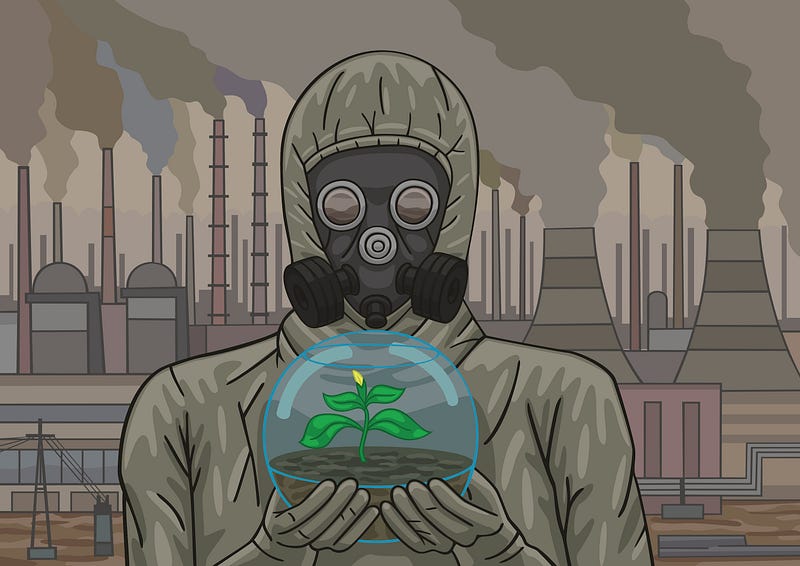
Image: strelss/iStock/Getty Images Plus
In the beginning, humans tended to view nature as a mortal enemy with wariness, dread and aggression. The closer we were to the other animals, the more threatened we were by their proximity geographical and behavioral. “Wilderness”: from the Old English -ness + wild + deor, “the place of wild beasts.” In the Old and New Testaments, “the wilderness” is a godless, hostile domain, the anti-Eden; Samuel Johnson defined it as “a tract of solitude and savageness”; William Bradford, a founder of Plymouth Colony, reacted to the untrammeled New World with horror, calling it “hideous & desolate … full of wild beasts & wild men.”


Read The New York Times Magazine story by Nathaniel Rich - “Climate Change and the Savage Human Future.”

22 April, 2016

Humes helps us understand the complexities and cost of food miles

The subtitle of Humes’ new book Door to Door is The magnificent, maddening, mysterious world of transportation. It was previously mentioned on TreeHugger in the context of a short excerpt about the role of the car, but that is only one very small part of the world of transportation. It is a complex world that even our grandparents would barely recognize; Humes notes in the introduction:

We live like no other civilization in history, embedding ever greater amounts of miles within our goods and lives as a means of making everyday products and services seemingly more efficient and affordable. In the past, distance meant the opposite: added cost, added risk, added uncertainty. It’s as if we are defying gravity. The logistics involved in just one day of global goods movement dwarfs the Normandy invasion and the Apollo moon missions combined.

Not only is it complex now, it is going to be changing even more rapidly in the future as self-driving vehicles change our cars and 3D printing changes our distribution. He ends the introduction with the warning “Buckle up” but could have added Bette Davis’s follow-up “It’s going to be a bumpy ride.”

Read the Treehugger story - “Door to Door by Edward Humes: we deliver a book review.”

18 March, 2014

Solve climate change and avoid catastrophic collapse


The resolutions of factors responsible for climate change are the key also to rescuing humanity from reaching a rather catastrophic conclusion.

NASA has funded a study that
suggests humanity is headed
toward the collapse of
industrial civilization.
We simply need to use less and therefore consume less energy and within that use fewer of the earth’s irreplaceable resources.

Sounds simple enough, but it is not.

Market driven consumer economy that pervades the world has a momentum, and a grip on the human psyche that is taking us irresistibly toward collapse.

The inequality of wealth distribution worsens every day and further weakens the understanding the elite have of the fragility of humanity.

The idea of the collapse of global industrial civilization within the coming decades is discussed in a story published by The Guardian headed: “NASA-funded study: industrial civilization headed for ’irreversible collapse’?”.

The story says: “The NASA-funded HANDY model offers a highly credible wake-up call to governments, corporations and business - and consumers - to recognize that 'business as usual' cannot be sustained, and that policy and structural changes are required immediately”.

Beneath the Wisteria convener, Robert McLean, believes are only hope of avoiding catastrophic climate change and the collapse the Guardian story discusses is to be found in structural and systemic changes to how we presently live.

“We need to immediately implement understood renewable energy technologies to power the human society; change our voracious appetite for energy and resource-rich consumer goods; understand that contentment arises from contemplation rather than the brutality of action aimed only at acquisition of goods; and in everything we do work toward making this a more equitable society,” Robert said.

He said that if we were able to mitigate causes of climate change, we might have some hope of avoiding the irreversible collapse of the modern civilized industrial civilization.

22 December, 2013

Climate change and the conundrums of life


Life often throws up irresolvable conundrums.

Philosopher John Armstrong.
The latest arose when reading the “Ministerial Foreword” of the Emissions Reduction Fund green paper put out by our Federal Government on which public comment has been invited.

Nothing is more critical than preparing Australians to deal with the unfolding dilemma of climate change and so the content and intent of the Green Paper makes it the most important document in our country’s history.

Written with a sense of intergenerational responsibility, the Green Paper, which has at its heart the Coalition’s Direct Action Plan for the control of domestic carbon dioxide emissions, could make Australia a leader in climate change mitigation. It won’t though.

The final paragraph his Ministerial Forward, Australia’s Minister for the Environment, Greg Hunt, wrote: “Our goal is to conserve our natural environment while ensuring strong economic growth”.

Mr Hunt is celebrated in many quarters as a remarkably intelligent, quick thinking fellow, making it curious that he fails to understand that such an observation is contradictory.

Strong economic growth and preservation of the natural environment are diametrically opposed.

The first is about the creation of high entropy goods resulting in obscene waste that is offensive, and ultimately destructive, to the latter, the natural environment.

The irony of the document arrives in the “Executive Summary” where is says: “The Australian Government acknowledges the science of climate change and supports national and global efforts to reduce greenhouse gas emissions”. It clearly doesn’t.

That is a cleverly worded statement as acknowledgement of and resultant action because of that recognition are decidedly different things and nothing our relatively new Tony Abbott-led Government has done yet suggests it actually understands the seriousness of the science.

Australia is considered a mature civilization and in claiming such a lofty position, the responsible men ought to take the time to read the thoughts of Melbourne-based philosopher, John Armstrong, who wrote, “In Search of Civilization: Remaking a tarnished idea”.

He said: “Civilization is seen as a rigorous artifice, designed to save us from ourselves. Life is regarded as a mess that needs to be cleaned up.

“We need to subordinate our wayward desires to law or rationality or justice; ideas that carry a prohibition, that deny our wishes,” he wrote.

So here we face another conundrum – are we or are we not civilized? Should we opt for the latter then there is nothing else we can do but demand that our Federal Government act in a way that illustrates deep concern for those yet unborn and so without a vote or influence.

A target of five per cent drop in carbon emissions by 2020 is pitifully inadequate and if the world is to have any understandable chance of avoiding catastrophic change we need 80 per cent this decade.
- Robert McLean.

09 March, 2013

Earth on track to be 'hottest in human history'


Earth is on track to becoming the hottest it has been at any time in the past 11.3 millennia, a period spanning the history of human civilisation, a new study says.

An ABC news story: “Earth ontrack to be hottest in human history: study” tells how fossil samples and other data collected from 73 sites around the world, have allowed scientists to reconstruct the history of the planet's temperature from the end of the last Ice Age around 11,000 years ago to the present.

“They have determined the past 10 years have been hotter than 80 per cent of the past 11,300 years,” the ABC reports.