Showing posts with label our planet. Show all posts

03 October, 2019

If warming exceeds 2°C, Antarctica’s melting ice sheets could raise seas 20 metres in coming centuries

We know that our planet has experienced warmer periods in the past, during the Pliocene geological epoch around three million years ago. 
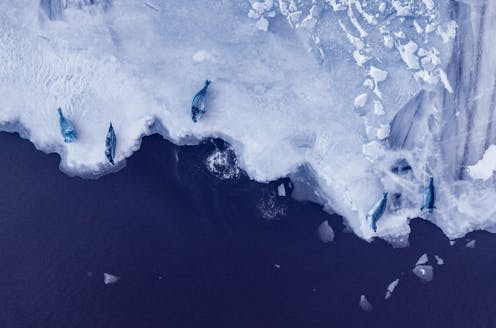
Image result for If warming exceeds 2°C, Antarctica’s melting ice sheets could raise seas 20 metres in coming centurie
During the Pliocene, up to one third of Antarctica’s
ice sheet melted, causing sea-level rise of 20 metres.
Our research, published today, shows that up to one third of Antarctica’s ice sheet melted during this period, causing sea levels to rise by as much as 20 metres above present levels in coming centuries. 
We were able to measure past changes in sea level by drilling cores at a site in New Zealand, known as the Whanganui Basin, which contains shallow marine sediments of arguably the highest resolution in the world.
Using a new method we developed to predict the water level from the size of sand particle moved by waves, we constructed a record of global sea-level change with significantly more precision than previously possible. 

03 July, 2019

Australia’s politicians will not be alive when climate impacts accelerate

If a plastics factory dumps toxic sludge into a river, we see, in days, the consequences. If a coal-fired power station in New South Wales dumps carbon emissions into the atmosphere, the impacts diffuse into a stupidly big sheet of roiling fluid film covering our planet, and the consequences manifest among a trillion hyperactive climate variables.
Our present politicians will be dead and gone
when climate change really begins to bite.
As you peer further into the future, the impacts of climate change get worse, and consequently, easier to detect on a personal, lived scale. They get so bad that I feel silly talking literally about them:

“In a six-degree-warmer world, the Earth’s ecosystem will boil with so many natural disasters that we will just start calling them “weather”: a constant swarm of out-of-control typhoons and tornadoes and floods and droughts, the planet assaulted regularly with climate events that not so long ago destroyed whole civilisations”


19 April, 2019

Climate Change: The Facts review – our greatest threat, laid bare

Once, a night in with David Attenborough promised the TV equivalent of a warm blanket. It was a chance to watch spectacular creatures revelling in the beauty of their natural habitats, as the man with a voice as soothing as ice-cream described what we could see, from the violent to the serene. Those days are gone. Attenborough’s recent move to Netflix, for Our Planet, was deceptive: a seemingly gorgeous nature documentary that doubled up as animal kingdom snuff movies in which the beauty of those natural habitats was revealed as a crumbling paradise, ruined by people and particularly by greed. One of the main points of praise for Our Planet, which was well received, suggested that Attenborough was no longer tiptoeing around the issue of climate change, the implication being that he had done so before.
Maybe the message will filter through …
David Attenborough in Climate Change – The Facts.
You sense that Our Planet was unfortunately timed for the BBC. In Climate Change: The Facts, the gloves are now not so much off as thrown to the floor in a certain rage. It’s right there in the title, bold and stark. This hour-long documentary, part of the Our Planet Matters season, is wide-ranging yet concise, easy to understand, not blighted by the ego of, say, An Inconvenient Truth, and it is designed to do for climate change denial what 2017’s Blue Planet did for single-use plastic.


Read the story from The Guardian by Rebecca Nicholson - “Climate Change: The Facts review – our greatest threat, laid bare.”

06 October, 2018

'Rise and Resist' - considering high fashion and global carbon emissions

The face of pollution is not limited to dirty fossil fuels or raw sewage in our waterways. 
University of Melbourne’s Sustainable Society Institute,
 deputy director, Dr Sangetha Chandrashekeran (right)
 talks with author and sustainability editor at large for Vogue
 magazine, Clare Press.
The fast fashion we buy each season is creating a negative impact on our planet– The clothing production and selling process is often convoluted; the process entails textile manufactures, various suppliers, raw materials, quality checks, global and domestic shipping, retail, and the inevitable discarding of the item. 

Calculating the overall footprint of this industry is a feat of its own; a comprehensive analysis would take into account not only the clothing production process, but also the farming, harvesting, extraction, and manufacturing needed to create the materials.When examining the lifecycle of clothing there is a shocking amount of emissions and waste from both the production and disposal stage. 

It would be a monumental task to calculate the overall emissions of any single product. However, there are clear steps that industry players can make to reduce this footprint. Items that are made from reused or recyclable material all make a difference in creating a circular economy.

One who has thought a lot about fashion and its contribution to the world’s carbon dioxide problem is the sustainability Editor-at-large for Vogue magazine, Clare Press, who has written about that in her heart book, “Rise and Resist: How to change the world”.


Clare talked with the deputy director of the University of Melbourne’s Sustainable Society Institute, deputy director, Dr Sangetha Chandrashekeran, about her book and then answered questions from the more than 100 people in the audience at the university’s School of Design.