Showing posts with label worldwide. Show all posts

30 December, 2018

Cities don’t cause global warming but must adapt to it

Humans have been urbanizing in earnest since the beginning of the Industrial Revolution. Worldwide, 55% of humans live in urban areas, and the ratio is much higher in the Americas. This trend is only accelerating, with automation of agriculture and resource extraction reducing rural labor needs, while the information and service economies of cities continue to increase labor needs.
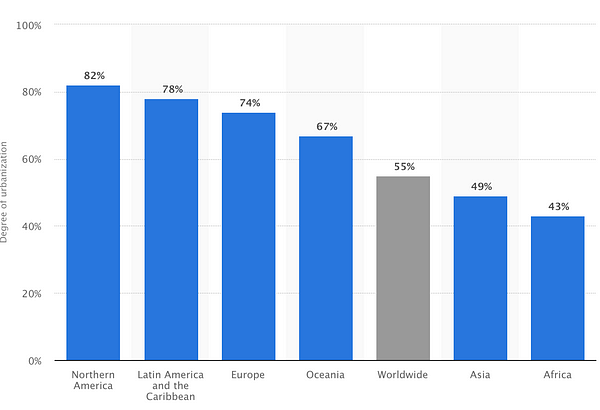
Degree of urbanization (percentage of urban
 population in total population) by continent in 2018 
Statista
As an example, the Appalachias of 1910 had close to 800,000 people employed in the coal industry, and that number is around 60,000 today. By comparison, New York City had under 5 million residents in 1910 vs 8.6 million today.
Global warming caused by humans since the beginning of the Industrial Revolution has a correlation with urbanization. Automation allowed and required the work force to leave rural areas and congregate in much more efficient cities which produced much more value. Urbanization is one of the factors which allowed more humans to survive and hence the population to grow. Cities were integral to the success of the Industrial Revolution, and without them humanity wouldn’t have changed the climate as much. But there are dozens of other factors, so it can’t be stated that cities are the cause of global warming, just a factor in the system which led to global warming.


Read the Medium story by Michael Blanchard - “Cities don’t cause global warming but must adapt to it.”

16 October, 2018

‘Heat shock': Bad news for beer industry lurks.

The world's beer industry could be particularly susceptible to the impacts of climate change as rising temperatures including "heat shocks" reduce barley yields worldwide, international researchers estimate.
It's not quite last drinks but a warmer world is
not likely to be good for the beer industry - among
many others.
CREDIT:
A second Australian favourite may also be at risk, with a visiting US professor saying beef consumption will also have to drop if efforts to restrain global temperatures are to succeed.


Read the story from The Age by Peter Hannam - “‘Heat shock': Bad news for beer industry lurks.

13 October, 2018

Why Half a Degree of Global Warming Is a Big Deal

The Earth has already warmed 1 degree Celsius (1.8 degrees Fahrenheit) since the 19th century. Now, a major new United Nations report has looked at the consequences of jumping to 1.5 or 2 degrees Celsius.


Half a degree may not sound like much. But as the report details, even that much warming could expose tens of millions more people worldwide to life-threatening heat waves, water shortages and coastal flooding. Half a degree may mean the difference between a world with coral reefs and Arctic summer sea ice and a world without them.

Read the story by Brad Plumer and Nadja Popovich from The New York Times - “Why Half a Degree of Global Warming Is a Big Deal.”

28 April, 2018

Shorebirds, the World’s Greatest Travelers, Face Extinction

A worldwide catastrophe is underway among an extraordinary group of birds — the marathon migrants we know as shorebirds. Numbers of some species are falling so quickly that many biologists fear an imminent planet-wide wave of extinctions.
A common snipe caught in an illegal net. Thousands of shorebirds
 like this one are entangled this way along the coast of China.
These declines represent the No. 1 conservation crisis facing birds in the world today. Climate change, coastal development, the destruction of wetlands and hunting are all culprits. And because these birds depend for their survival, as we do, on the shorelines of oceans, estuaries, rivers, lakes, lagoons and marshes, their declines point to a systemic crisis that demands our attention, for our own good.

No doubt you’ve seen some of these birds while on vacation at the beach, skittering back and forth along the cusp of waves as they peck with their long beaks for tiny sand flies or the eggs of horseshoe crabs. They can seem comic in their frenetic exertions, tiny Charlie Chaplins in bird suits.

But these birds are remarkable in ways that defy not only belief but scientific understanding: They are, by far, the planet’s most extraordinary global travelers. Worldwide, about 70 shorebird species travel from the top of the world to its very bottom and back each year. The smallest weigh barely an ounce. Each species has its own story, but in every case these annual migrations are among nature’s most epic dramas.


Read the opinion piece from The New York Times - “Shorebirds, the World’s Greatest Travelers, Face Extinction.”

24 March, 2018

Many people feel lonely in the city, but perhaps ‘third places’ can help with that

Loneliness is a hidden but serious problem in cities worldwide. Urban loneliness is connected to population mobility, declining community participation and a growth in single-occupant households. This threatens the viability of our cities because it damages the social networks they rely on.
Third places are most effective when, like Waverley Community Garden
in Sydney, they appeal to people of all ages and backgrounds.
One response to these trends involves “third places”. These are public or commercial spaces that provide informal opportunities for local people to mix socially on neutral ground.

The concept of third place, developed by Ray Oldenburg, is distinct from first and second places. A first place is the private space of home. Second places are where people spend significant time, often formally. These include schools, universities and workplaces.


Read the piece on The Conversation by a PhD Candidate from Griffith University, Joanne Dolley, and a Lecturer in Urban and Environmental Planning, also the Griffith University, Tony Matthews - “Many people feel lonely in the city, but perhaps ‘third places’ can help with that.”

27 January, 2018

Coca-Cola launches ‘World Without Waste’ campaign

Coca-Cola Company has pledged to collect and recycle the equivalent of 100 percent of its packaging worldwide, and manufacture its bottles using at least 50 percent recycled plastic by 2030.
Waste pledge from Coca-Cola.
To achieve this ambitious goal, the beverage giant will need set up collect and recycling facilities in more than 200 countries where it sells its drinks range.

The company’s recycling strategy will also see investments in increasing customer engagement through educating them to recycle properly.

To this end, Coca-Cola will launch education plans at regional and local levels to inspire action.


Read the ClimateAction story - “Coca-Cola launches ‘World Without Waste’ campaign.

13 August, 2017

Fossil fuel subsidies are a staggering $5 tn per year

Fossil fuels have two major problems that paint a dim picture for their future energy dominance. These problems are inter-related but still should be discussed separately. First, they cause climate change. We know that, we’ve known it for decades, and we know that continued use of fossil fuels will cause enormous worldwide economic and social consequences.

The major costs of fossil fuels are hidden.
Second, fossil fuels are expensive. Much of their costs are hidden, however, as subsidies. If people knew how large their subsidies were, there would be a backlash against them from so-called financial conservatives.

A study was just published in the journal World Development that quantifies the amount of subsidies directed toward fossil fuels globally, and the results are shocking. The authors work at the IMF and are well-skilled to quantify the subsidies discussed in the paper.


Read John Abraham’s story on The Guardian - “Fossil fuel subsidies are a staggering $5 tn per year.”

23 April, 2017

March for Science events in New York, London, Paris, Berlin see crowds gather worldwide on Earth Day

Crowds have marched in more than 600 cities worldwide for Earth Day events billed as a "celebration of science", amid growing concern about US President Donald Trump's climate change scepticism and cuts to research funding.
Protesters line Central Park West during
a science demonstration on Earth Day in New York.
The marches, timed to coincide with Earth Day, come after moves by Mr Trump to sharply cut federal science and research budgets, including the Environmental Protection Agency and the National Institutes of Health.

Marchers around the world brandished placards saying "There is no Planet B", "Science not Silence" and "Make Science Great Again”.

The main event took place in Washington, where March for Science festivities included "teach-ins," speeches by researchers and environmentalists, and musical performances on National Mall.


03 December, 2016

A catastrophic climate feedback loop long feared by scientists is happening

Julie Rodriguez - 'greenhouse
 gases rising out of the ground'.
For years environmental scientists have warned of a catastrophic climate “feedback loop” that could pump a massive underground repository of carbon and methane into the atmosphere, significantly worsening climate change.

A new study published this week confirms that fear is finally coming to pass. Rising temperatures are causing microorganisms in the soil to breathe more quickly, which releases an increased amount of carbon dioxide or methane into the atmosphere. Global warming has become so serious that greenhouse gasses are simply rising out of the ground beneath our feet worldwide.

Most people don’t realize that the planet’s soil is packed with a dense network of trapped carbon, created by plants and roots that have been buried over the eons. These plants pull in carbon from the air to use as fuel, and when they die, the carbon remains within the soil. Ordinarily, this wouldn’t be a problem: it serves as a natural carbon sink which helps regulate the amount of greenhouse gasses in the atmosphere.

Read the Inhabitat story by Julie M. Rodriguez - “A catastrophic climate feedback loop long feared by scientists is happening.”

06 October, 2015

The world rocked by 'insane' weather


T

his weekend was insane for extreme weather worldwide.

As the planet has warmed, severe weather events are happening in every corner of the globe, alerting us to the need for strong, immediate action on climate change.

“No particular climate event can be identified as the consequence of a rise in global average temperatures driven by the release of carbon dioxide and other greenhouse gases from the burning of fossil fuels,” according to climate scientists Erich Fischer and Reno Knutti at ETH Zurich—the Swiss Federal Institute of Technology. “But some events that were once improbable have now become statistically more probable because of global warming,”

Read the EcoWatch story - “5 Extreme Weather Events Devastating the Planet.”

05 January, 2015

Doubts dispelled immediately by scientific and practical evidence


Doubt about climate change has at times assaulted my thinking until that momentary skepticism is completely dispelled by further evidence, both scientific and practical.

That scientific evidence has almost total support around the world and yet in being true to the skeptism their training the demands, most scientists appear reluctant to lay the responsibility for climate change at the feet of humanity.

In what is a strange contradiction, climate scientists happily explain the science behind climate change, but often appear reluctant to be more emphatic about the risk it poses to humanity.

Writing in the New York Times, a professor of the history of science at Harvard and the author, Naomi Oreskes, has lamented this problem.

Her story - “Playing Dumb on Climate Change” – says:

“We are now seeing dangerous effects worldwide, even as we approach a rise of only 1 degree Celsius.

“The evidence is mounting that scientists have underpredicted the threat. Perhaps this is another reason — along with our polarized politics and the effect of fossil-fuel lobbying — we have underreacted to the reality, now unfolding before our eyes, of dangerous climate change.”