Showing posts with label industrial revolution. Show all posts

30 December, 2018

Cities don’t cause global warming but must adapt to it

Humans have been urbanizing in earnest since the beginning of the Industrial Revolution. Worldwide, 55% of humans live in urban areas, and the ratio is much higher in the Americas. This trend is only accelerating, with automation of agriculture and resource extraction reducing rural labor needs, while the information and service economies of cities continue to increase labor needs.
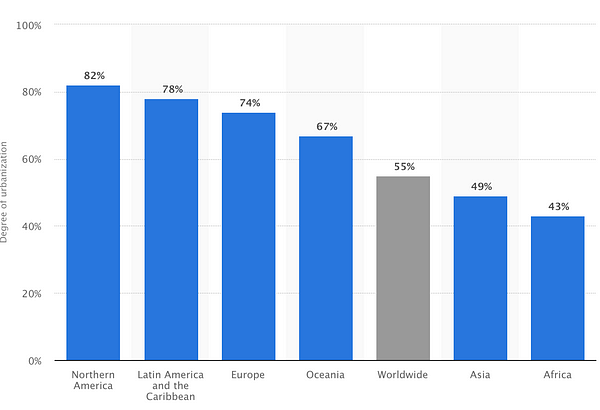
Degree of urbanization (percentage of urban
 population in total population) by continent in 2018 
Statista
As an example, the Appalachias of 1910 had close to 800,000 people employed in the coal industry, and that number is around 60,000 today. By comparison, New York City had under 5 million residents in 1910 vs 8.6 million today.
Global warming caused by humans since the beginning of the Industrial Revolution has a correlation with urbanization. Automation allowed and required the work force to leave rural areas and congregate in much more efficient cities which produced much more value. Urbanization is one of the factors which allowed more humans to survive and hence the population to grow. Cities were integral to the success of the Industrial Revolution, and without them humanity wouldn’t have changed the climate as much. But there are dozens of other factors, so it can’t be stated that cities are the cause of global warming, just a factor in the system which led to global warming.


Read the Medium story by Michael Blanchard - “Cities don’t cause global warming but must adapt to it.”

03 August, 2018

Losing Earth: The Decade We Almost Stopped Climate Change

The world has warmed more than one degree Celsius since the Industrial Revolution. The Paris climate agreement — the nonbinding, unenforceable and already unheeded treaty signed on Earth Day in 2016 — hoped to restrict warming to two degrees. The odds of succeeding, according to a recent study based on current emissions trends, are one in 20. If by some miracle we are able to limit warming to two degrees, we will only have to negotiate the extinction of the world’s tropical reefs, sea-level rise of several meters and the abandonment of the Persian Gulf. The climate scientist James Hansen has called two-degree warming “a prescription for long-term disaster.” Long-term disaster is now the best-case scenario. Three-degree warming is a prescription for short-term disaster: forests in the Arctic and the loss of most coastal cities. Robert Watson, a former director of the United Nations Intergovernmental Panel on Climate Change, has argued that three-degree warming is the realistic minimum. Four degrees: Europe in permanent drought; vast areas of China, India and Bangladesh claimed by desert; Polynesia swallowed by the sea; the Colorado River thinned to a trickle; the American Southwest largely uninhabitable. The prospect of a five-degree warming has prompted some of the world’s leading climate scientists to warn of the end of human civilization.
The front page of The New York Times on August 22, 1981
 - We knew then, we know now, but still we do nothing.
Is it a comfort or a curse, the knowledge that we could have avoided all this?
Because in the decade that ran from 1979 to 1989, we had an excellent opportunity to solve the climate crisis. The world’s major powers came within several signatures of endorsing a binding, global framework to reduce carbon emissions — far closer than we’ve come since. During those years, the conditions for success could not have been more favorable. The obstacles we blame for our current inaction had yet to emerge. Almost nothing stood in our way — nothing except ourselves.

Nearly everything we understand about global warming was understood in 1979. By that year, data collected since 1957 confirmed what had been known since before the turn of the 20th century: Human beings have altered Earth’s atmosphere through the indiscriminate burning of fossil fuels. The main scientific questions were settled beyond debate, and as the 1980s began, attention turned from diagnosis of the problem to refinement of the predicted consequences. Compared with string theory and genetic engineering, the “greenhouse effect” — a metaphor dating to the early 1900s — was ancient history, described in any Introduction to Biology textbook. Nor was the basic science especially complicated. It could be reduced to a simple axiom: The more carbon dioxide in the atmosphere, the warmer the planet. And every year, by burning coal, oil and gas, humankind belched increasingly obscene quantities of carbon dioxide into the atmosphere.


Read The New York Times Magazine story by Nathaniel Rich -  “Losing Earth: The Decade We Almost Stopped Climate Change.”

31 July, 2018

Oceans Expected To Become More Acidic Than They've Been In 14 Million Years.

Since we began burning fossil fuels and pumping carbon dioxide (CO2) into the atmosphere during the industrial revolution, the world's oceans have been acting like a massive sponge by absorbing up to half of this CO2. After taking up human-emitted CO2 for over 200 years, the oceans have become approximately 30% more acidic. And if current emissions rates persist, our oceans are on track to become more acidic than they have been in 14 million years.

The eastern shore of the Adriatic Sea in Split, Croatia.
The rising acidity of the oceans is especially threatening for sea life with structures made from calcium carbonate, such as shells. As ocean pH drops, carbonate becomes less readily available and causes these hard components to dissolve. Yet, it is in the fossilized calcium carbonate shells of tiny critters, called foraminifera, that Dr. Sindia Sosdian and colleagues were able to measure the acidity of prehistoric oceans.


Read the story by Priya Shukla from Forbes - “Oceans Expected To Become More Acidic Than They've Been In 14 Million Years.

21 January, 2018

Last year was one of Earth's hottest years on record and I can't believe I'm writing this story again

It's unanimous: 2017 was one of Earth's warmest years on record, continuing an impressive and quickening trend seen since the dawn of the industrial revolution. 
It's unanimous - 2017 was Earth's warmest year on record.
According to the National Oceanic and Atmospheric Administration, NASA, the UK Met Office, and other groups that monitor the planet's thermostat, 2017 was by far the warmest year to occur without an El NiƱo event, which can boost ocean and air temperatures and was partly responsible for propelling 2016 to the top spot on the list of warmest years. 

While each group differs slightly in their final numbers and rankings, the numbers they came up with differ mainly because of the way they calculate temperatures in data-poor regions, such as the rapidly warming Arctic.


29 September, 2016

The World Passes 400 PPM Threshold. Permanently

In the centuries to come, history books will likely look back on September 2016 as a major milestone for the world’s climate. At a time when atmospheric carbon dioxide is usually at its minimum, the monthly value failed to drop below 400 parts per million.

That all but ensures that 2016 will be the year that carbon dioxide officially passed the symbolic 400 ppm mark, never to return below it in our lifetimes, according to scientists.

Because carbon pollution has been increasing since the start of the Industrial Revolution and has shown no signs of abating, it was more a question of “when” rather than “if” we would cross this threshold. The inevitability doesn’t make it any less significant, though.

September is usually the month when carbon dioxide is at its lowest after a summer of plants growing and sucking it up in the northern hemisphere. As fall wears on, those plants lose their leaves, which in turn decompose, releasing the stored carbon dioxide back into the atmosphere. At Mauna Loa Observatory, the world’s marquee site for monitoring carbon dioxide, there are signs that the process has begun but levels have remained above 400 ppm.

Read Brian Khan’s story on Climate Central - “The World Passes 400 PPM Threshold. Permanently.”

08 June, 2016

Coal opened the window to the modern world

Love it or hate it, coal played a crucial role in launching us into the modern world by fuelling the Industrial Revolution. The byproducts of that role were, of course, the rise of greenhouse gases in our atmosphere and dangerous levels of air pollution in the big coal-fuelled cities.

But despite its insidious influence on the climate and our health, coal has a lesser-known positive side to its otherwise dark soul. It has provided us with some stunning fossils.

Geologists have known for centuries that coal is an accumulation of plant material that, once buried in the Earth’s sedimentary layers, gets compressed by gravity into a denser, compact form. Yet, in recent years, scientists have hotly debated the early phases of coal formation.

Read the piece by the Strategic Professor in Palaeontology from Flinders University, John Long on The Conversation -  Coal’s formation is a window on an ancient world.”

19 January, 2016

Oceans warming at quickening rate: new study


The world's oceans are
warming at a quickening rate.
The world’s oceans are warming at a quickening rate, with the past 20 years accounting for half of the increase in ocean heat content that has occurred since pre-industrial times, a new study has found.

US scientists discovered that much of the extra heat in the ocean is buried deep underwater, with 35% of the additional warmth found at depths below 700 meters. This means far more heat is present in the far reaches of the ocean than 20 years ago, when it contained just 20% of the extra heat produced from the release of greenhouse gases since the industrial revolution.