Showing posts with label Paris climate agreement. Show all posts

12 December, 2019

Australia’s use of accounting loophole to meet Paris deal found to have no legal basis

Australia’s plan to use an accounting loophole to meet its commitment under the Paris climate agreement has no legal basis and suggests it has reneged on a pledge to make deeper emissions cuts once a global deal was reached, a new report says.
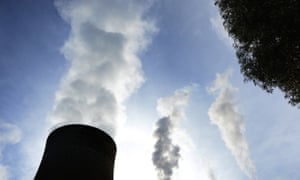
A coal-fired power station
Climate Analytics says there are no grounds for Australia
to claim credit towards its Paris emissions target for
having beaten targets under the Kyoto protocol.
An analysis by Climate Analytics, a Berlin-based science and policy institute, found there were no grounds for Australia to claim credit towards its Paris emissions target for having beaten targets under its predecessor, the Kyoto protocol.
It found the two agreements were separate treaties and should not be treated as a continuation of one agreement.

08 November, 2019

Trump Is Abandoning America’s Future by Quitting the Paris Climate Accord

President Trump made good on his promise this week to withdraw from the Paris Climate Agreement. This wasn’t a surprise. But it still baffles us. Try as we might, we cannot see how America’s interests are served by this decision.

Firefighters working to contain the
 Easy fire in Simi Valley on October 30.
Our climate emergency does not respect borders. California’s forest fires will not burn less fiercely, and rising sea levels will not spare Miami or Mar-a-Lago, just because Mr. Trump has chosen to opt out of a treaty of nearly 200 nations that represents our best and only chance of saving humanity from the catastrophic effects of rising temperatures.

Let us put it in language Mr. Trump might understand. If average global temperatures rise by the end of the century by another one degree Celsius, or 1.8 degrees Fahrenheit, there will be no winners on this planet. Only losers.


Read the story from The New York Times by Ban Ki-moon and Patrick Verkooijen - ”Trump Is Abandoning America’s Future by Quitting the Paris Climate Accord.”

15 September, 2019

5 Reasons Why the Paris Agreement is a Joke (and How We Can Fix It)

The Paris climate agreement is a joke. And I should know — I was there when it was drafted.

Celebrations in December 2015 after the signing of the Paris Agrreement.
Three and a half years ago, I was one of the hundreds of politicians and heads of industry who convened in Paris with a singular goal: Devise a plan to combat global warming and avoid a global environmental disaster.

We quickly realised that doing so would require an international public works project the scale of which the world has never seen. The political leaders deliberated for a month about to how to accomplish such a momentous feat, with myself and the other financial professionals in attendance offering guidance.

The group eventually settled on a wide-ranging pledge to reduce carbon emissions, invest in sustainable energy and minimise any further damage to the environment. The agreement was signed by 195 countries and was quickly celebrated as a historic achievement. The climate crisis has been averted, people thought at the time.

Nonsense.


Read the Medium story by Sasja Beslik - “5 Reasons Why the Paris Agreement is a Joke (and How We Can Fix It).”

27 August, 2019

5 Reasons Why the Paris Agreement is a Joke (and How We Can Fix It)

The Paris climate agreement is a joke. And I should know — I was there when it was drafted.

Image result for 5 Reasons Why the Paris Agreement is a Joke (and How We Can Fix It)
Paris celebrations!
Three and a half years ago, I was one of the hundreds of politicians and heads of industry who convened in Paris with a singular goal: Devise a plan to combat global warming and avoid a global environmental disaster.

We quickly realised that doing so would require an international public works project the scale of which the world has never seen. The political leaders deliberated for a month about to how to accomplish such a momentous feat, with myself and the other financial professionals in attendance offering guidance.

The group eventually settled on a wide-ranging pledge to reduce carbon emissions, invest in sustainable energy and minimise any further damage to the environment. The agreement was signed by 195 countries and was quickly celebrated as a historic achievement. The climate crisis has been averted, people thought at the time.


Read the Medium story by Sasja Beslik - “5 Reasons Why the Paris Agreement is a Joke (and How We Can Fix It).”

11 July, 2019

Banks Funneled $1.9 Trillion Into Fossil Fuels Since Paris Agreement

A new report published this week shows that 33 global banks provided $1.9 trillion to fossil fuel companies since the adoption of the Paris Climate Agreement at the end of 2015 and that the amount of fossil fuel financing has increased in each of the past two years.


The new report, Banking on Climate Change 2019, is the tenth annual fossil fuel report card and the first-ever analysis of funding from the world’s major private banks for the fossil fuel sector as a whole. The report was released Wednesday by Rainforest Action Network, BankTrack, Indigenous Environmental Network, Oil Change International, Sierra Club, and Honor the Earth, and endorsed by over 160 organizations around the world.

In addition to finding that 33 of the world’s top banks are supplied $1.9 trillion to fossil fuel companies since the adoption of the Paris Agreement, the report also found that of that $1.9 trillion, $600 billion went to 100 companies that are most aggressively expanding fossil fuels, highlighting business-as-usual practices that fly in the face of the latest scientific warnings from the Intergovernmental Panel on Climate Change (IPCC) which warned that “Limiting global warming to 1.5°C would require rapid, far-reaching and unprecedented changes in all aspects of society.”


Read the Clean Technica story by Joshua S. Hill - “Banks Funneled $1.9 Trillion Into Fossil Fuels Since Paris Agreement."

27 May, 2019

Unexpected surge in global methane levels

An unexpected surge in global atmospheric methane is threatening to erase the anticipated gains of the Paris Climate Agreement.  This past April NOAA posted preliminary data documenting an historic leap in the global level of atmospheric methane in 2018,[1] underscoring a recent wave of science and data reporting that previously stable global methane levels have unexpectedly surged in recent years.

The scientific community recently responded to the surge into two high profile publications by calling for a reduction in methane emissions from the natural gas system, framing it as the most practical response to the global increase.


Read the story from Climatenexus.org on Climate Code Red - “Unexpected surge in global methane levels.”

06 April, 2019

Reforestation is critical to meeting Paris climate change accord targets, researchers say

Climate change experts accept that reducing greenhouse gas emissions – even doing so substantially – won’t be sufficient for limiting atmospheric warming to the 2°C (3.6°F) goal of the Paris Climate Agreement. And with carbon capture technologies years away from maturity and widespread commercialization, one option is to take advantage of proven nature-based systems for sequestering carbon.
Reafforestation is critical.
That is the central message of a widely discussed recent article in the journal Science Advances. America’s trees, soil, and wetlands each year capture around 11 percent of the nation’s emissions, according to EPA. The study’s researchers calculate that they could be harnessed to sequester up to 21 percent of net annual emissions of the U.S.


Read the story from Yale Climate Connections by Sarah Wesseler - “Reforestation is critical to meeting Paris climate change accord targets, researchers say.”

08 March, 2019

Tony Abbott says no need to pull out of Paris climate agreement after all

Tony Abbott has changed his mind and now says Australia should stay in the Paris climate agreement.
 Tony Abbott has gone back on his opposition to the
Paris climate agreement, during a debate with his federal
 election opponent in the seat of Warringah, Zali Steggall. 
Abbott, who signed up to Paris when he was prime minister but then declared that Australia should pull out during the prime ministership of Malcolm Turnbull, confirmed he had changed his mind again during a debate on Friday morning with the independent challenger Zali Steggall and other federal election candidates in his seat of Warringah.

Asked by moderator David Speers if his change of heart was due to the ousting of Turnbull as prime minister, Abbott said it partly was.

“I certainly thought that the only way to break the emissions obsession was to pull out of Paris,” he said. “I think that the government has lost its emissions obsession now that Angus Taylor is the energy minister … Circumstances have changed. We have a new prime minister and a new energy minister.”

Read the story from The Guardian by Naaman Zhou - “Tony Abbott says no need to pull out of Paris climate agreement after all.”


(Tony Abbott would not be taking such a stance if he wasn’t feeling threatened by the arrival of Zali Steggall who has a clear policy on helping the residents of Warringah address and deal with climate change. Listen to Zali Steggall during an interview on Climate Conversations - Robert McLean)

16 January, 2019

Buildings produce 25% of Australia’s emissions. What will it take to make them ‘green’ – and who’ll pay?

In signing the Paris Climate Agreement, the Australian government committed to a global goal of zero net emissions by 2050. Australia’s promised reductions to 2030, on a per person and emissions intensity basis, exceed even the targets set by the United States, Japan, Canada, South Korea and the European Union.
Across our growing cities more and more
 buildings are going up, as are their emissions.
But are we on the right track to achieve our 2030 target of 26-28% below 2005 levels? With one of the highest population growth rates in the developed world, this represents at least a 50% reduction in emissions per person over the next dozen years.


17 October, 2018

PM admits Australia Paris target toothless, Coalition completely at sea on energy

Australian Prime Minister Scott Morrison has cleared the air on his party’s position on the Paris climate agreement: We won’t be pulling out of it. Why? There is no need, because it will have precisely zero impact on business-as-usual in Australia.


In an interview with Sydney radio shock-jock Alan Jones and former Abbott advisor Peta Credlin on Sky News on Tuesday, Morrison reiterated that his government would not spend any new money on the global climate compact, but ruled out “ripping up” Australia’s part of the deal.

Australia, as a signatory to the Paris Agreement on climate change, has committed to reduce its total emissions to 26-28 per cent below 2005 levels by 2030, and pitch for zero net emissions by 2050.

Read the story by Sophie Varrath from RenewEconomy - “PM admits Australia Paris target toothless, Coalition completely at sea on energy.”

10 October, 2018

New UN report outlines ‘urgent, transformational’ change needed to hold global warming to 1.5°C.

A landmark report from the Intergovernmental Panel on Climate Change, commissioned at the breakthrough 2015 summit that brokered the Paris climate agreement, outlines what’s at stake in the world’s bid to limit global temperature rise to 1.5℃.


The report, released today, sets out the key practical differences between the Paris agreement’s two contrasting goals: to limit the increase of human-induced global warming to well below 2℃, and to “pursue efforts” to limit warming to 1.5℃.


Read the report from The Conversation by Mark Howden and Rebecca Colvin - “New UN report outlines ‘urgent, transformational’ change needed to hold global warming to 1.5°C.”

08 October, 2018

Scott Morrison resists calls to withdraw from Paris climate agreement

Scott Morrison has resisted conservatives’ calls to withdraw Australia from the Paris climate agreement but ruled out providing more money to the global climate fund.
 Scott Morrison says there’s nothing to be gained
 from ripping up the Paris climate agreement.
The prime minister made the comments on 2GB Radio on Monday, before the release of a Intergovernmental Panel on Climate Change report, which is expected to call for a phaseout of coal power generation to help limit temperature rises to 1.5C.

Morrison repeated his claim that Australia would meet its Paris emissions reduction target “in a canter”, despite environment department figures showing emissions increased 1.3% in the year to March 2018, suggesting Australia is likely to miss the target.


Read the story by Paul Karp from The Guardian - “Scott Morrison resists calls to withdraw from Paris climate agreement.”

06 October, 2018

Climate change apathy, not denial, is the biggest threat to our planet

Three years after world leaders signed the Paris climate agreement, we’re about to better understand what that deal means for how we live our lives. On Monday, a major report from the UN’s climate science panel will set out what it will take to limit global warming to 1.5C, the key Paris target.
‘Cutting emissions will depend on people changing
how they live: flying less, for example.’ 
There are reasons to think the world is, finally, getting to grips with climate change. Carbon emissions are still rising but more slowly than before, and in many countries they’re falling. The UK has slashed its emissions to 19th-century levels, and we’re not alone – plenty of other countries, including the US, are making progress as well. Crucially, that’s happened without many people noticing, suggesting the world might be able to deal with the problem without having to persuade the public to change their polluting lifestyles.


Read the story by Leo Barasi from The Guardian - “Climate change apathy, not denial, is the biggest threat to our planet.”

07 September, 2018

Paris climate deal doesn't stop us building new coal plants, Canavan says

Australia does not need to quit the Paris climate agreement because our commitments are non-binding, and new coal plants can continue to be constructed, according to the resources minister, Matt Canavan.
 Resources minister Matt Canavan says Australia’s
commitment to the Paris climate deal is non-binding.
 
Canavan told Sydney broadcaster Alan Jones on Friday he had never been to Paris, and was “happy to leave the Champs-Élysées for others”, but people needed to be clear the treaty Tony Abbott committed Australia to in 2015 “doesn’t actually bind us to anything in particular”.

Abbott said in 2015, when he announced Australia would be signing up, that the government was making a “definite commitment” to a 26% reduction in emissions by 2030 and “with the circumstances that we think will apply ... we can go up to 28%”.

Read the story from The Guardian by Katharine Murphy -“Paris climate deal doesn't stop us building new coal plants, Canavan says.”


(The idea of resources minister, Matt Canavan, that Australia is not bound by the Paris climate agreement and so it can build new coal-powered energy plants its irresponsible, socially malignant and demonstrates little concern for the welfare of Australians and people of the world. Even if all the Paris promises made in December 2015 are fulfilled, the world is still heading for temperature increases of well over two degrees and maybe even three. Australians are, on a per capita basis, among the world’s largest, if not the largest emitters of carbon dioxide. Mr Caravan should be removed from his influential position just as quickly as we can - Robert McLean)

03 August, 2018

Losing Earth: The Decade We Almost Stopped Climate Change

The world has warmed more than one degree Celsius since the Industrial Revolution. The Paris climate agreement — the nonbinding, unenforceable and already unheeded treaty signed on Earth Day in 2016 — hoped to restrict warming to two degrees. The odds of succeeding, according to a recent study based on current emissions trends, are one in 20. If by some miracle we are able to limit warming to two degrees, we will only have to negotiate the extinction of the world’s tropical reefs, sea-level rise of several meters and the abandonment of the Persian Gulf. The climate scientist James Hansen has called two-degree warming “a prescription for long-term disaster.” Long-term disaster is now the best-case scenario. Three-degree warming is a prescription for short-term disaster: forests in the Arctic and the loss of most coastal cities. Robert Watson, a former director of the United Nations Intergovernmental Panel on Climate Change, has argued that three-degree warming is the realistic minimum. Four degrees: Europe in permanent drought; vast areas of China, India and Bangladesh claimed by desert; Polynesia swallowed by the sea; the Colorado River thinned to a trickle; the American Southwest largely uninhabitable. The prospect of a five-degree warming has prompted some of the world’s leading climate scientists to warn of the end of human civilization.
The front page of The New York Times on August 22, 1981
 - We knew then, we know now, but still we do nothing.
Is it a comfort or a curse, the knowledge that we could have avoided all this?
Because in the decade that ran from 1979 to 1989, we had an excellent opportunity to solve the climate crisis. The world’s major powers came within several signatures of endorsing a binding, global framework to reduce carbon emissions — far closer than we’ve come since. During those years, the conditions for success could not have been more favorable. The obstacles we blame for our current inaction had yet to emerge. Almost nothing stood in our way — nothing except ourselves.

Nearly everything we understand about global warming was understood in 1979. By that year, data collected since 1957 confirmed what had been known since before the turn of the 20th century: Human beings have altered Earth’s atmosphere through the indiscriminate burning of fossil fuels. The main scientific questions were settled beyond debate, and as the 1980s began, attention turned from diagnosis of the problem to refinement of the predicted consequences. Compared with string theory and genetic engineering, the “greenhouse effect” — a metaphor dating to the early 1900s — was ancient history, described in any Introduction to Biology textbook. Nor was the basic science especially complicated. It could be reduced to a simple axiom: The more carbon dioxide in the atmosphere, the warmer the planet. And every year, by burning coal, oil and gas, humankind belched increasingly obscene quantities of carbon dioxide into the atmosphere.

Read The New York Times Magazine story by Nathaniel Rich -  “Losing Earth: The Decade We Almost Stopped Climate Change.”

23 June, 2018

Burning Wood as Renewable Energy Threatens Europe’s Climate Goals

The European Union declared this week that it could make deeper greenhouse gas cuts than it has already pledged under the Paris climate agreement. But its scientific advisors are warning that the EU's new renewable energy policy fails to fully account for the climate impacts of burning wood for fuel.
A ranger explains to a group of landowners how maintaining
old-growth forest in the Dürrenstein Wilderness area
 helps Austria meet its climate targets by sequestering carbon. 
By counting forest biomass, such as wood pellets used in power plants, as carbon-neutral, the new rules could make it impossible for Europe to achieve its climate goals, the European Academy of Sciences Advisory Council (EASAC) wrote in a strongly worded statement. 

The council said the renewable energy policy's treatment of biomass is "simplistic and misleading" and could actually add to Europe's greenhouse gas emissions over the next 20 to 30 years.


Read the story by Bob Berwyn from Inside Climate News - “Burning Wood as Renewable Energy Threatens Europe’s Climate Goals.”

04 June, 2018

Building a post-carbon future: California tries to lead — will the world follow?

Last July, California Gov. Jerry Brown announced a “Climate Action Summit” meeting in San Francisco in September 2018, with the direct goal of supporting the Paris climate agreement recently abandoned by President Trump. “No nation or state is doing what they should be doing,” Brown said at the time. “You can’t do too much to sound the alarm because so far the response is not adequate to the challenge.”
California aims for a post-carbon future - will the world follow?
California’s own record  during Brown's tenure is muddled, as I’ve previously noted, but the state could start to change that, according to a new report called “The Sky’s Limit California,” from Oil Change International in collaboration with a broad coalition of environmental justice and consumer groups. California can do this by matching its existing policies to reduce fossil fuel consumption with new policies for “a managed decline of oil extraction” — an approach described in a recent paper as “cutting with both arms of the scissors” — and by providing for a "just transition" for workers and communities who would otherwise suffer, a major moral and political challenge that’s been neglected far too long. 


20 November, 2017

Australia’s reputation faces 'serious' risks if Adani loan goes ahead: Figueres.

Providing a $1 billion loan to underwrite Adani's proposed mega coal mine in Queensland would have "serious negative impacts" for Australia's international reputation and "unpick the progress" of the Paris climate agreement, according to Christiana Figueres, a former United Nations climate chief.
Christiana Figueres wearing Stop Adani ear rings,
 with Andrew Petersen, CEO of Sustainable Business Australia. 
Ms Figueres has written to the Turnbull government's Northern Australia Infrastructure Facility (NAIF), which is considering a concessional loan for a rail link from the mine to the coast.

The former executive secretary of the UN's Framework Convention on Climate Change
sought to highlight that under the NAIF's own enabling legislation, it "must not act in a way that is likely to cause damage to the Commonwealth government's reputation, or that of a relevant State or Territory”.

Ms Figueres warned the expected total lifetime carbon emissions from burning coal from the proposed Carmichael in the Galilee basin would be 4.64 billion tonnes of carbon-dioxide, according to details of the letter obtained by Fairfax Media.


Read Peter Hannam’s story in today’s Melbourne Age - “Australia’s reputation faces 'serious' risks if Adani loan goes ahead: Figueres."

01 November, 2017

World 'very likely' heading for three degrees of warming by 2100 — UN report

A UN Environment report says there's a "worrying" shortfall between the goals of the Paris Climate Agreement and the current pledges by global governments and industry to cut carbon pollution.
Fran Kelly.

The 2017 Emissions Gap Report is published ahead of the next round of UN climate talks starting next week in Bonn, Germany, and it finds that the world is currently on track for at least three degrees of warming.

That's double the most ambitious goal of the Paris Agreement, which is aiming for one and a half degrees by 2100.

The report also says no more new coal fired power stations should be built, and that existing coal fired plant should be phased out more rapidly — unless they're retrofitted with Carbon Capture and Storage technology.


Listen to the Radio National report by Fran Kelly - “World 'very likely' heading for three degrees of warming by 2100 — UN report.”

29 September, 2017

Graph of the day: Australia’s surging fossil fuel emissions

Australia can claim a new title: In the same way that the US and Syria are the only two countries to have either not signed or vowed to quit the Paris climate agreement, Australia can now lay claim with Turkey to be the only developed countries to break fossil fuel emissions records.

According to The Australia Institute’s newly released National Energy Emissions Audit, compiled by Dr Hugh Saddler, Australia’s annual emissions from energy use have increased to their highest ever level, higher than the previous peak seen eight years ago, in 2009.

“Australia’s failure to invest in efficient transport infrastructure, such as rail, has led to emissions from transport fuels continuing to grow, again, unlike the rest of the developed world,” Saddler says in the report.


Read the RenewEconomy story by Gile Parkinson - “Graph of the day: Australia’s surging fossil fuel emissions.”