Showing posts with label struggle. Show all posts

23 November, 2019

Malcolm Turnbull says Liberals' struggles with climate denial are hurting Australia

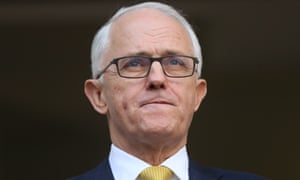
Former prime minister Malcolm Turnbull
Former prime minister Malcolm
Turnbull has slammed the Liberals’
 lack of climate policy.
Malcolm Turnbull says Australia will struggle to meet its Paris emissions target without rapid decarbonisation of the energy sector, and he says the Liberal party’s continuing failure to develop a coherent climate and energy policy is costing the country much-needed new investment in power generation.
In a wide-ranging interview with Guardian Australia’s politics live podcast ahead of the publication of his memoir next year, the former prime minister said the Liberal party had struggled with climate change denialism since 2007 because climate change had morphed into an issue of “identity” rather than fact.

Read the story from The Guardian by Katharine Murphy - “Malcolm Turnbull says Liberals' struggles with climate denial are hurting Australia.” 

02 April, 2019

'Climate of Change' on Four Corners

The struggle to reduce Australia's greenhouse gas emissions.

Climate change policy has been one of the most divisive issues in modern Australian political history. 


It has brought down governments and toppled political leaders.

At times the debate has become so polarised that the average Australian could be forgiven for tuning out.

With a Federal election looming, Four Corners brings the debate back to what is actually happening in the nation right now.

So much focus has been placed on energy policy, electricity prices and the role of coal, but this is only one part of the picture.

Four Corners walks you through key areas of everyday life and industrial production which fuel our carbon emissions - from the cars we drive, the animals we breed to gas we export.

The program investigates whether Australia is on track to deliver on the targets the nation has pledged to fulfil, and what effect the policies of successive governments have had on our emissions.


With activists on both sides of the debate pushing to make the Federal poll a climate election, this is a must watch Four Corners.

29 January, 2018

The revolution that will change how Australians live within 30 years

In 1988, if you wanted to speak to someone overseas, you would dial a number (literally – dial) on a phone attached to the wall and struggle to hear to a crackly voice on the other end – all while paying through the nose for the call.
Futurest Mark Pesce says homes will have energy and waste budgets in 20 to 30 years.
Fast forward 30 years, and you can now speak face to face with your loved ones through a smartphone from pretty much anywhere, and it won’t add a cent to your regular phone bill.

It begs the question – if technology has come so far since the 80s, where will it be in another 30 years, and more importantly, how will it change the way we live?


Read Jemima Clegg’s story in the Melbourne Age’s Domain - “In 1988, if you wanted to speak to someone overseas, you would dial a number (literally – dial) on a phone attached to the wall and struggle to hear to a crackly voice on the other end – all while paying through the nose for the call.

Fast forward 30 years, and you can now speak face to face with your loved ones through a smartphone from pretty much anywhere, and it won’t add a cent to your regular phone bill.

It begs the question – if technology has come so far since the 80s, where will it be in another 30 years, and more importantly, how will it change the way we live?

Read Jemima Clegg’s story in the Melbourne Age’s Domain - “The revolution that will change how Australians live within 30 years.”

28 January, 2018

Thousands hit by power cuts as Melbourne temperature soars

Thousands of Melburnians are without power and facing transport delays as the city's electricity grid and train services struggle to cope with the sweltering heat.

As of 3.30pm on Sunday 1167 homes were without power in south-east Melbourne alone, according to United Energy, with electricity in many areas not expected to be restored until Sunday evening.


Read the story from the Melbourne Age - “Thousands hit by power cuts as Melbourne temperature soars.”

05 January, 2018

How playing games on your phone or tablet could cut your power bill

Summer has arrived, and with it, soaring energy bills. Australian households are paying more for their power as generators struggle to meet consumer demand.

Money-saving screen time? 
We blast our air conditioners to stay cool, and put on that old fridge for the Christmas drinks, both of which are likely to blow out our electricity bill.

But while we wait for the situation to improve, there is something you can do to help save money in the meantime: play games.

There is growing evidence that “serious” mobile phone games (games designed for purposes other than entertainment) can help households become more energy-efficient.


15 May, 2017

Push to block Narrabri gas heading interstate

The backers of a proposed project to pipe gas from Narrabri, in north-west NSW, to Newcastle, are seeking government backing to force the gas from the project to be sold in NSW, rather than be transported across state borders for export abroad.
Construction of the Eastern Gas Pipeline between Nowra and Nerriga, NSW.
The push comes as the manufacturing sector is gripped by surging gas prices, which have forced a number of companies to look hard at closing operations, to avoid looming losses.Read Brian Robins’ story in today’s Melbourne Age - “Push to block Narrabri gas heading interstate.”

And while their is apparently a struggle to keep NSW gas in NSW, some argue that we should even by mining it in the first place.

The Wilderness Society is proud to stand with thousands of community members across NSW who are working to protect their land and water from Santos coal seam gas in North West NSW.

Santos’ plans to build gasfields across the Gunnedah Basin of North West NSW are being met with fierce community opposition. Their Narrabri Gas Project is Santos’ plan to drill 850 coal seam gas wells through the Pilliga forest, the largest inland forest left in Eastern Australia.

Santos’ risky quest for coal seam gas in the Pilliga so far has met disastrous results – with over 20 pollution scares, including groundwater contamination, waste spills, and continuing leaks from evaporation ponds.

Now the project has lost bipartisan political support with the State Opposition announcing policy specifically ruling out gasfield development in the Pilliga. The economic justification for the project, a gas supply shortage in NSW, has also been conclusively disproven.

Technical uncertainty at Narrabri remains high and reserves were recently written down by 32%. 
The project has already been delayed for years due to the geotechnical difficulties, environmental contamination and community protests.

The community will not rest until the Narrabri Gas Project is scrapped altogether.


In fact, local community members are celebrating the results of neighbour to neighbour coal seam gas surveys. The incredible results are in: 96% of people living across more than 3 million hectares of land in North West NSW want to be gasfield free!

22 February, 2015

Climate change brings inexplicable and confusing weather


Climate change brings with it weather conditions which to most people are inexplicable, confusing and so far beyond our experience that we struggle to make sense of them.

Climate change, or global warming, is about a base warming of the planet and that brings multiple disruptions to earth’s weather system and subsequently unsettles centuries of human experience about what is normal.

The benign weather system that has allowed humanity to tighten its grip on earth is vanishing and we are now seeing events that are beyond traditional experience to explain.

Mashable talks about these contradictory happenings in its story: “Despite frigid conditions in the East, U.S. seeing more record warmth this winter”.

It says: “The U.S. is experiencing one of the most unusual winters in years, with a pronounced and enduring bubble of warm, high pressure over the West, and blast after blast of frigid Arctic air and heavy snow in the eastern two-thirds of the country.”