Showing posts with label controversial. Show all posts

05 April, 2020

Activist defends failed constitutional challenge against Frydenberg

Michael Staindl has mixed feelings about his controversial and failed attempt to unseat Treasurer Josh Frydenberg from Parliament.
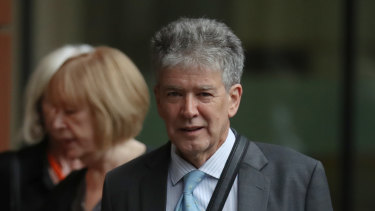
Michael Staindl leaves the Federal Court after the case was heard in February.
It's two weeks since his legal challenge to Frydenberg's eligibility on the basis of dual-citizenship was dismissed by the Federal Court. Staindl alleged Frydenberg had inherited Hungarian citizenship from his mother, Erica Strausz, a Hungarian-born Holocaust survivor, and as such should be disqualified from Parliament.
The full bench, sitting as the Court of Disputed Returns, was unanimous in dismissing the claim. Its judgment made pointed reference to the backdrop of “catastrophe, anti-Jewish violence and terror” which Strauz's family escaped and noted the “niceties of proof of the production or issue of documents ... can be put aside when one recognises the realities of 1949".
The judges went on to say there was "no evidence to support" the claim and ordered Staindl to pay Frydenberg's costs – likely to amount to hundreds of thousands of dollars. The Treasurer has refused to comment on the case even after it was resolved, but his supporters have been less restrained.
Read the story from The Age by Samantha Hutchinson - “Activist defends failed constitutional challenge against Frydenberg.”

20 February, 2020

The burn legacy: why the science on hazard reduction is contested

When it comes to reducing the extent of bushfires, scientists disagree on the best way to do it. Hazard-reduction burning (also known as “prescribed burning” or “controlled burning”) is controversial and, depending on the scientific paper, it’s shown to either be effective or not work at all.
Image result for The burn legacy: why the science on hazard reduction is contested
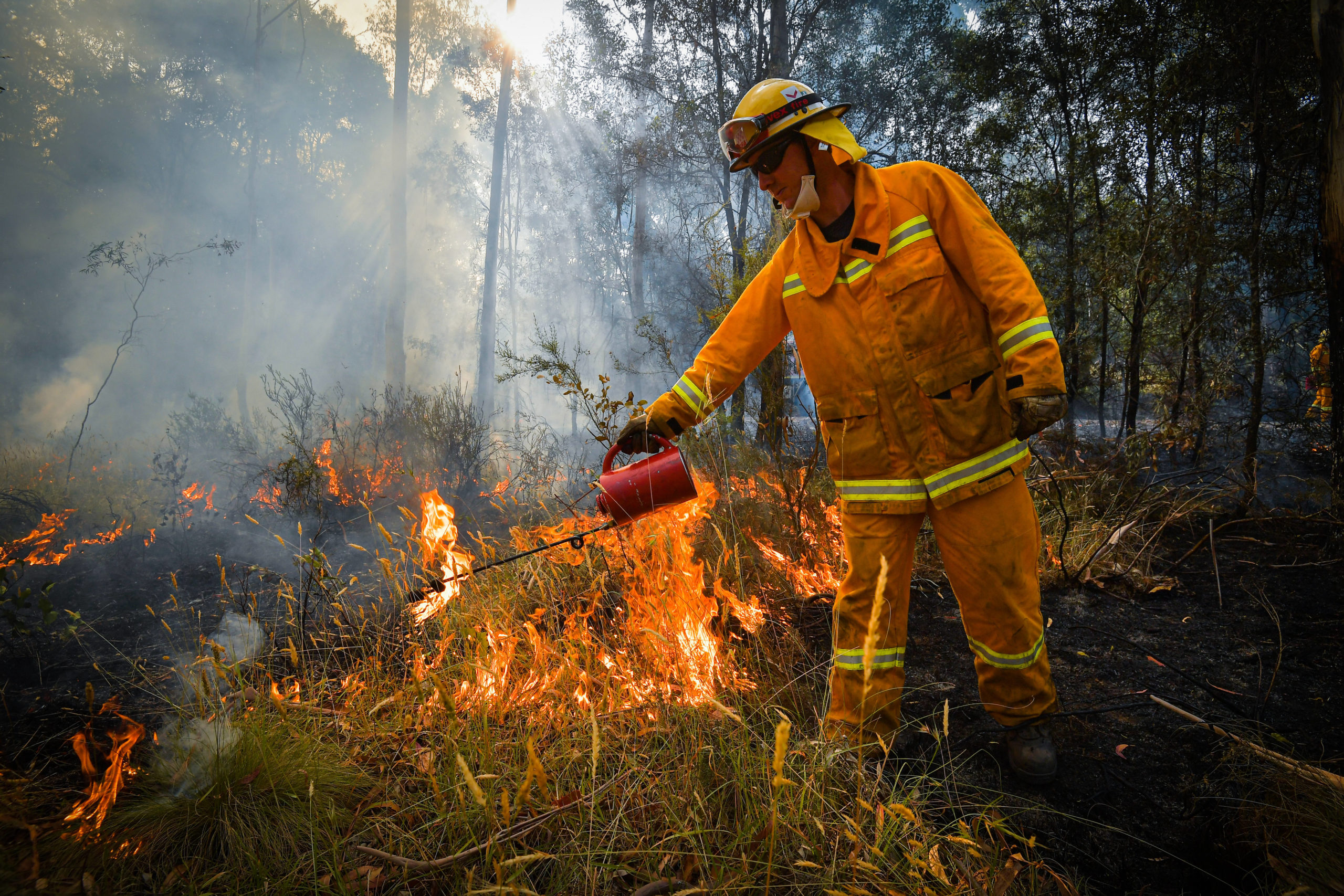
When conditions are safe, the CFA burns vegetation
 to remove fuel which in turn mitigates fire risk.
 
Hazard-reduction burning is the process of removing vegetation that would fuel a fire – the “hazard” – through burning, slashing or grazing. It’s one of the ways state governments try to prepare for looming bushfire seasons. 
The Climate Council published a fact sheet in January this year titled “Setting the record straight on hazard reduction”. It concluded that, while important, in future “no amount of hazard reduction will protect human lives, animals and properties from catastrophic fires”. 
But this is at odds with empirical studies in Victoria and Western Australia, which found otherwise, after taking a wider view on the issue. 

Read the story from The Conversation by Kevin Tolhurst - “The burn legacy: why the science on hazard reduction is contested.

09 April, 2018

Documents shed light on BP’s failures in the Great Australian Bight

BP’s plans to drill for oil in the Great Australian Bight were controversial from the outset. Even more so after the regulator twice rejected its environmental safety plan.
The coast of the Great Australian Bight. 
For the first time, Climate Home News can reveal why. Government documents have been released under freedom of information laws, nearly two years after they were requested. BP had tried to suppress the information.

A major oil spill in the sensitive seascape would pollute up to 750km of beaches and shoreline, according to BP’s own modelling, and the company thought drilling may disrupt migration of the endangered southern right whale.


Read the ClimateHome story by Karl Mathieson - “Documents shed light on BP’s failures in the Great Australian Bight.”

06 April, 2018

BP claims an oil spill off Australia's coast would be a 'welcome boost' to local economies

Coastal towns would benefit from an oil spill in the pristine Great Australian Bight because the clean up would boost their economies, energy giant BP has claimed as part of its controversial bid to drill in the sensitive marine zone.
Eyre Peninsula, South Australia. BP said local economies
would be boosted by clean up activities if its plan to drill
for oil caused a spill.
BP, which has since withdrawn the drilling plan, also told a federal government agency that a diesel spill would be considered “socially acceptable”.

BP made the statements in an environment plan submitted to the National Offshore Petroleum Safety and Environmental Management Authority in March 2016.

The company had been seeking to drill two wells off the South Australian coast, raising fears of an environmental disaster akin to BP's 2010 Deepwater Horizon oil spill in the Gulf of Mexico.


Read Nicole Hasham’s story from The Sydney Morning Herald - “BP claims an oil spill off Australia's coast would be a 'welcome boost' to local economies.”

(Only the brutal madness of a neo-liberal economist devoid of an sense of feeling for our environment could see the sense of such an argument - Robert McLean)

02 April, 2018

Speaker at OU takes aim at climate-change denial

An acclaimed and often controversial critic of climate-change denial spoke at Ohio University last Wednesday about the issue “in the age of Trump.”

Professor Michael Mann. 
Dr. Michael Mann, a distinguished professor of atmospheric science at Penn State University, delivered his speech at OU’s Templeton-Blackburn Alumni Memorial Auditorium. The whole title: “A Return to the Madhouse: Climate Change Denial in the Age of Trump.”

Mann co-authored the Intergovernmental Panel Climate Change report that earned the Nobel Peace Price in 2007. He’s often a target of groups and politicians who argue that even if climate change is happening, there’s insufficient evidence to conclude that humans are causing it.

During his talk Wednesday, Mann explained that global temperatures have been steadily rising, hitting new maximums in 2014, 2015, and 2016. “Oceans have been warmer than they’ve ever been,” said Mann. This causes water to evaporate over the ocean’s surface, creating a layer of warm air that energizes hurricanes and makes them bigger and faster, he said.


Read The Athens News story by Becca King - “Speaker at OU takes aim at climate-change denial.”

17 December, 2017

Controversial Abbott-era climate fund will survive climate review: Josh Frydenberg

A controversial Abbott-era fund that uses public money to pay companies to reduce their pollution will survive the federal government's review of Australia's climate policies.
Environment and Energy Minister, Josh Frydenberg.

In an interview with Fairfax Media, Environment and Energy Minister Josh Frydenberg also expressed confidence that future generations would avoid disastrous predicted impacts of climate change, saying technology would drive the transition to decarbonised economies and "get us where we need to be". 


Read Nicole Hasham’s story in today’s Melbourne Age - “Controversial Abbott-era climate fund will survive climate review: Josh Frydenberg.”

16 December, 2017

Taking the 'EasyMile' electric, driverless bus

Anything new, or different, is frequently (always) controversial.

The EasyMile electric, driverless bus at Mooloolaba.
And the Easymile’s EZ10 driverless shuttle fits that criteria perfectly.

The driverless electric vehicle, that can carry up to 12 people, was demonstrated in Mooloolaba over three days giving locals a ride up and down The Esplanade and experience being in a vehicle not only without a driver, but even without a steering wheel.

Australians are known as early adopters of new technology and so the arrival of something new in terms of personal transport created considerable interest.

The reaction, however, was mixed from those loud in the praise for this revolutionary bus to those equally noisy in their criticism of what they saw as just another slow moving obstruction on our roadways.

People accustomed to zooming about Mooloolaba at 60km/h, and sometimes faster, saw the demonstration bus, that travelled at less than 10km/h, as dreadfully slow and of no obvious benefit to the movement of people.

Sadly, those who doubted the fundamental idea of electric driverless vehicles viewed this revolution in people movement through the dated prism of the fossil-fuel powered traditional car and had no appreciation of the reduction in carbon dioxide emissions and the fact that the bus is just the first step, and a small one at that,  in a significant change to people movement.

Privately owned traditional vehicles kill thousands of people every year and leave many with health issues that leave society with huge medical costs, and depend entirely on an energy-rich publicly funded infrastructure - it illustrates conclusively the idea of privatising profits at public expense.
The driverless bus, at least the model demonstrated, is just the first step in disrupting that strategy.

The EasyMile electric, driverless bus is equipped with
wheelchair access facilities, but sadly the ramp had
been damaged in transit and so wasn't working at
Mooloolaba.
Those critical of the demonstration bus must remember that the early internal combustion engined cars need to be proceeded by a fellow waving a red flag warning others that this newfangled “thing” was following.

The driverless bus, that is neither coming nor going, is air-conditioned, is quiet and wheelchair ready, although as it had been damaged in transit, the electric ramp on the Mooloolaba bus was not working.

The company behind the bus, EasyMile, sees the bus ideal for use at train stations, airports, city centres, theme parks and cultural sites, industrial sites, retirement villages and educational campuses.

In the case of Mooloolaba, EasyMile had previously plotted the short course used over the three days, but along with that is uses lasers, odometry, GPS technology and so is able to avoid obstacles and brake if necessary.


EasyMile is headquartered in France and was set up in 2014.  

22 November, 2017

China will finance Adani mine, insiders say, but it will cost Australian jobs

The Adani Group is close to securing finance for its controversial coal mine and railway project in outback Queensland, with an announcement expected in coming weeks that Chinese state-owned enterprises, banks, and export credit agencies are backing the venture.
China's money could mean Adani no longer
needs a loan from the Australian Government.
Australian taxpayers may be let off the hook under the deal, which could mean Adani no longer requires an Australian Government-subsidised loan of up to $1 billion for the railway it needs to transport the coal to port.

But China's money will come at the cost of local jobs.

Chinese enterprises and export credit agencies invariably require that materials for key infrastructure are sourced from China, effectively shifting work out of Australia and undermining Adani's claims its project will create many thousands of additional jobs for Queensland.


Read the story by Stephen Long on ABC News - “China will finance Adani mine, insiders say, but it will cost Australian jobs.”

18 September, 2017

Enough tiptoeing around. Let’s make this clear: coal kills people

Coal kills people. This isn’t even slightly scientifically controversial.

‘How can journalists and editors report on the politics
of coal on one page and bushfires around Sydney in
September on another without making the connection?’
From the mines to the trains to the climate disruption; from black lung to asthma, heat stress to hunger, fires to floods: coal is killing people in Australia and around the world right now.

Yet we are once again having what passes for political debate about extending the life of coal-fired power stations and, extraordinarily, building new ones. The conversation is completely disconnected from the fact that two-thirds of Bangladesh was reported to be underwater, record-breaking hurricanes were battering the US, and wildfires were roaring in both the northern and southern hemispheres at the same time.

Read Tom Hollo’s comment in The Guardian - “Enough tiptoeing around. Let’s make this clear: coal kills people.”

12 August, 2017

The Problem With Climate Doomsday Reporting, And How To Move Beyond It

It’s not often that an article about climate change becomes one of the most hotly debated issues on the internet — especially in the midst of a controversial G20 summit.


But that exact thing happened following the publication of a lengthy essay in New York Magazine titled “The Uninhabitable Earth: Famine, Economic Collapse, a Sun that Cooks Us: What Climate Change Could Wreak — Sooner Than You Think.”

In the course of 7,200 words, author David Wallace-Wells chronicled the possible impacts of catastrophic climate change if current emissions trends are maintained, including, but certainly not limited to: mass permafrost melt and methane leaks, mass extinctions, fatal heat waves, drought and food insecurity, diseases and viruses, “rolling death smog,” global conflict and war, economic collapse and ocean acidification.

Slate political writer Jamelle Bouie described the essay on Twitter as “something that will haunt your nightmares.”
It’s a fair assessment. Reading it feels like a series of punches in the gut, triggering emotions like despair, hopelessness and resignation.

But here’s the thing: many climate psychologists and communicators consider those feelings to be the very opposite of what will compel people to action.


Read the Desmog Blog story by James Wilt - “The Problem With Climate Doomsday Reporting, And How To Move Beyond It.”

24 May, 2017

Labor senator breaks ranks and says Adani coalmine would be a 'huge mistake’

The federal Labor senator Lisa Singh has said the Adani coalmine would be “a huge mistake for this country” in a departure from the official Labor position. The opposition maintains the controversial project can proceed on its merits, but without any government support.
 Labor senator Lisa Singh (centre) with Tasmanian
independent senator Jacqui Lambie. Singh has said
 the proposed Carmichael coalmine has no merit.
Singh, a left-leaning Tasmanian senator, told Guardian Australia on Tuesday the coal project had absolutely no merit.

“If we are going to be serious about climate change, we should not be starting any new coalmines in this country,” she said. “I understand the need for jobs in the regions, but those jobs need to be long-term sustainable jobs.


Read Katherine Murphy’s story on The Guardian - “Labor senator breaks ranks and says Adani coalmine would be a 'huge mistake’.”

11 February, 2016

'Sounds more like religion than science' - CSIRO boss

Dr Larry Marshall - 'sounds more
 like religion than science.'
The CSIRO's chief has told the ABC the backlash from his decision to restructure the organisation has made him feel like an "early climate scientist in the '70s fighting against the oil lobby" and that there is so much emotion in the debate it almost "sounds more like religion than science".

Dr Larry Marshall said he would not be backing down on his controversial shake-up of the organisation's climate divisions, telling the ABC he was yet to be persuaded.


(Larry Marshall appears to making and “either, or” call for Australia’s preeminent science body in relation to its approach to climate change. However, the dilemma is so complex, so consuming and so inconsiderate of what we would like to do and spend our money on, that we cannot afford to the choosey about what it is we do. He has argued that the institution needed to get “measurement and modelling” and use its resource to better understand what Australia and world needed to do in terms of adaptation.
Constrained by an ideologically limited budget, Dr Marshall has made a call, but I suggest the wrong one for without the measurement and modelling, our scientists, and others, do not what they are adapting to or how far it is they need to reach.
Both the fundamentals of climate science need to be attended to as do the broader sweep of behaviour and how we must act responsibly in our attempts to adapt to different circumstances that will evolve as climate change unfolds.
The suggestion by Dr Marshall that the climate conversation is so emotional that it sounds more like religion than science is somewhat ironic as any challenge to the market-driven economy (the prime cause of climate change) will bring an emotive, religious-like response from most anyone, including certainly our PM and probably Dr Marshall himself -
Robert McLean).