Showing posts with label ecosystem. Show all posts

28 January, 2020

Australia’s Devastating Wildfires Were Not Inevitable

Blue Mountains, Australia—“There is no one in this current federal government that has any semblance of a sense of crisis,” Mark Greenhill tells me as we sit in his mayoral office in Katoomba, a small town some 100 kilometers west of Sydney. It is December 19. For over a month, three massive bushfires have plagued this small mountain community, a UNESCO World Heritage site, ravaging its ecosystem and laying waste to residents’ homes. I could smell the smoke in Sydney that morning; the haze descended on the city at least a dozen times in the past month, casting a sepia-toned pall and tripping office fire alarms. But it was nothing compared with Katoomba, where my eyes began to burn the moment I stepped off the train.
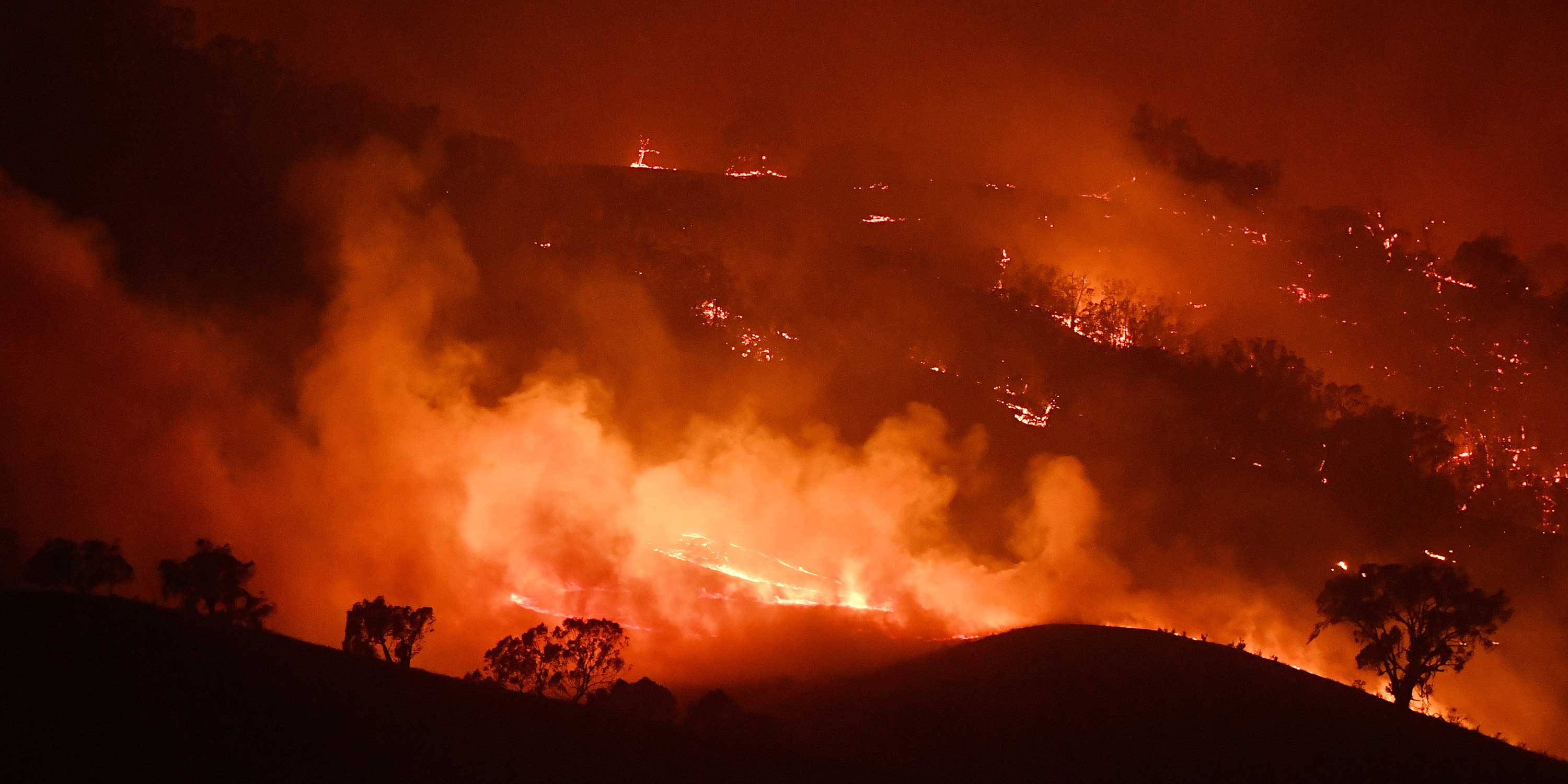
The country was once actually poised to lead on climate politics, and now, it burns.

As Greenhill speaks, his eyes dart to the window behind me. “Oh, fuck,” he says. I turn to look. A thick gray plume is billowing up from the trees just north of us. He jumps up and rushes to the window. “That is a cloud of fire,” he says. “That’s climate change right there.” A moment passes as the two of us stand in silence. “So, so,” he continues, picking up his train of thought, “there’s no sense of that national crisis. And that’s what we’re missing.” He points back to the fire cloud—“I’m just going to find out what that is”—and begins texting furiously. 
The technical term for what we saw that day is “pyrocumulonimbus,” or “pyroCb” for short. PyroCbs are weather events generated by wildfires. They can produce dry lightning storms, high winds, even full-blown tornadoes. (An aerial photo of the Hiroshima bombing, long thought to capture the distinctive nuclear mushroom cloud, was only recently reidentified as an image of the pyroCb from the ensuing firestorm that swept through the city.) In recent weeks, “pyroCb” has become a household term in Australia—a literal manifestation of the fires but also a symbol, nudging us to see what is happening to the country in the terms of armed conflict. As the fires tear through town after town with ruthless efficiency, pyroCbs lend them the look of an airborne attack: climate blitzkrieg. When Prime Minister Scott Morrison called in the navy to evacuate thousands of people stranded on beaches and mobilized the Australian Defence Force to help fight the fires, the symbolism became reality. Australia went to war with itself.

Read the story from The Nation by Daniel Judt - “Australia’s Devastating Wildfires Were Not Inevitable.”

30 July, 2018

The Salt Marshes Can’t Save Us Now

The essential barriers between land and sea are starting to drown. Salt marshes coastal grasslands that are regularly inundated by seawater during high tide are crucial elements of our ecosystem. They provide a habitat for 75 percent of fish species that are commercially harvested. And because they’re great at absorbing water, they protect coastal communities from flooding. But thanks to the human desire to build homes and cities along coastlines and the fact that sea-level rise is accelerating, coastal salt marshes are under threat.
The world's salt marshes, home to millions of birds,
are, because of sea level rise, beginning to "drown".
Anne Giblin is the interim director of the Ecosystems Center at the Marine Biological Laboratory at Woods Hole, Massachusetts. She’s the principal investigator of research at Plum Island, a salt marsh in northern Massachusetts, where she studies nitrogen cycles in the marsh and how the rising sea level affects the overall chemical health of these coastal ecosystems. Though salt marshes aren’t found everywhere mangroves, which are water-dwelling trees, perform similar functions in the tropics they are a necessary ecosystem in middle and high latitudes around the world.


Read the story by Erin Biba from Medium - “The Salt Marshes Can’t Save Us Now.”

20 September, 2017

Negative emissions: potentials and challenges”

- Robert McLean
“Academic”, “inadequate” and “familiarity” were the thoughts that came to mind listening yesterday to a public lecture about “Negative emissions: potentials and challenges”.


The former was to be expected as the lecture at the University of Melbourne’s Climate and Energy College; the second, “inadequate” was a personal issue as I am insufficiently skilled or knowledgeable to grasp the complexity or implications of what was being said; and “familiarity” was sensed as the lecture was populated by about 40 people with some knowledge of the topic. 

That said, it was an excellent session and the organisers (the Melbourne Sustainable Society Institute) and speakers deserve applause.

 The trio of speakers addressed land-based negative emissions technologies: 

Ecosystem restoration: looking at the social, environmental and climate benefits of forest restoration; 

Bioenergy with Carbon Capture and Storage (BECCS) investigating the sustainability of different BECCS options; and,

Soil carbon as mitigation: also addressing the difficulties in achieving net negative greenhouse balances with soil carbon accumulation and the impacts of climate change on carbon stocks.

Pro. Richard Eckard.
A preamble to the lecture said: “Most proposals to limit global temperature rises to well below 2°C rely on ‘negative emissions’ – the removal of carbon from the atmosphere. Scenario analyses suggest that negative emissions technologies (NETs) are necessary to limit dangerous warming”.

Chairing the events was a professor and director of the Primary Industries Climate Challenges Centre, a joint research initiative between the University of Melbourne and Agriculture Victoria,  Professor Richard Eckard.

And the speakers were:

Kate Dooley.
Nasim Pour.
Kate Dooley is currently undertaking a PhD at the University of Melbourne, researching the environmental integrity of terrestrial carbon accounting, and the equity implications of land-based climate mitigation, including the use of 'negative emissions'. Previously Kate has worked in Europe and Africa on forest governance reforms and illegal logging, and has followed negotiations on forests in the UN climate talks since 2009;


Rachelle Meyer.
Nasim Pour who is completing her PhD at the University of Melbourne. Her research investigates the sustainability of bioenergy with carbon capture and storage (BECCS) as a carbon removal technology. In her research, Nasim applies environmental and techno-economic analyses to assess the feasibility and sustainability of different BECCS options.  Her project focuses on potentials and challenges for using organic wastes as resource for BECCS; and,


Rachelle Meyer's research interests include adaptation and mitigation in the land sector. For her recently submitted PhD thesis, she used a whole-farm system modelling approach to quantify the agro-ecosystem benefits and mitigation implications of soil carbon in grazing systems of western Victoria. This included calculating net greenhouse gas balances and investigating the impact of climate change on the potential of soil carbon as a mitigation option.

20 June, 2016

Chris Hedges sees veganism as a move toward countering climate change


By Chris Hedges

My attitude toward becoming a vegan was similar to Augustine’s attitude toward becoming celibate—“God grant me abstinence, but not yet.” But with animal agriculture as the leading cause of species extinction, water pollution, ocean dead zones and habitat destruction(2), and with the death spiral of the ecosystem ever more pronounced, becoming vegan is the most important and direct change we can immediately make to save the planet and its species. It is one that my wife—who was the engine behind our family’s shift—and I have made.

Animal agriculture is responsible for more greenhouse gas emissions than all worldwide transportation combined—cars, trucks, trains, ships and planes.(3) Livestock and their waste and flatulence account for at least 32,000 million tons of carbon dioxide (CO2) per year, or 51 percent of all worldwide greenhouse gas emissions.(4) Livestock causes 65 percent of all emissions of nitrous oxide, a greenhouse gas 296 times more destructive than carbon dioxide.(5) Crops grown for livestock feed consume 56 percent of the water used in the United States.(6) Eighty percent of the world’s soy crop is fed to animals, and most of this soy is grown on cleared lands that were once rain forests. All this is taking place as an estimated 6 million children across the planet die each year from starvation and as hunger and malnutrition affect an additional 1 billion people.(7) In the United States 70 percent of the grain we grow goes to feed livestock raised for consumption.(8)

31 August, 2015

Dakota Johnson eco-film is a 'game changer'


A

 new film starring Dakota Johnson tackles the subject of climate change, but don’t expect images of factories guzzling pollutants into the air or statistics on how much greenhouse gases are impacting the ecosystem.

There is no special effects-laden disaster scene to show what will happen if climate change is not dealt with either.

 Instead, ‘Chloe & Theo’ is a heartfelt fable of a passionate man with an important message to deliver to the world: The power to change the planet is within ourselves.

Read the Care2 story and watch the trailer - “Why Dakota Johnson’s New Eco-Film Is a Game Changer”.