Showing posts with label lobbyists. Show all posts

25 November, 2019

We push fossil fuels with the zeal of a drug lord – we do not care about the misery we are creating

The Coalition is too closely linked to the fossil fuel industry to be able to contemplate a future without coal, oil or gas. As climate change-induced crises continue through Australia, they must distance themselves from the industry associations and their lobbyists, and face up to a future which is different from the past, one that can be both exciting and beneficial to all Australians.
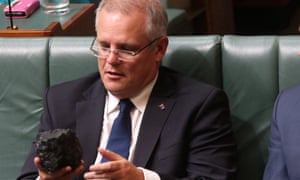
Then treasurer Scott Morrison with a lump of coal during question time in the house of representatives in parliament house, Canberra, 9 February 2017
‘The problem, as we are now seeing, is that
 the industry associations are also heavily
invested in our political processes,
to the detriment of us all.’
While unprecedented bushfires burn across the country – first in New South Wales and Queensland, then in Western Australia and now in South Australia and Victoria – it is worth pausing for a moment on the word “unprecedented” to let it sink in. Unprecedented does not mean unexpected. At BP, over 20 years ago, we acknowledged climate change and what it would bring and that we needed to reduce emissions. Our acknowledgment brought cries of foul from industry associations and many peer companies.

23 September, 2018

Energy policy captive to lobbyists and 'mad ideologues', Tim Flannery says

Five years since the Abbott government scrapped the Climate Commission, the environmentalist Tim Flannery says our energy policy remains hostage to lobbyists, political self-interest and “mad ideologues”.
‘We’re being held hostage at a federal level,’
Tim Flannery told Guardian Australia.
But the organisation Flannery helped start from the ashes of Abbott’s climate bonfire, the Climate Council, says that attitudes have shifted substantially since 2013 – at least those outside federal parliament.

“We’re being held hostage at a federal level,” Flannery told Guardian Australia.

“It has been a disgrace. Our failures are the failures of a small group of politicians who are supposed to be acting in the national interest. Instead, they’re using energy policy as a cudgel, they’re listening to paid lobbyists and doing their bidding.”


Read the story from The Guardian by Ben Smee - “Energy policy captive to lobbyists and 'mad ideologues', Tim Flannery says.”

14 October, 2017

'Labouratory' by George Monbiot

We are still living in the long 20th Century. We are stuck with its redundant technologies: the internal combustion engine; thermal power plants; factory farms. We are stuck with its redundant politics: unfair electoral systems; their capture by funders and lobbyists; the failure to temper representation with real participation.

George Monbiot - we're still living in the 20th Century.
And we are stuck with its redundant economics: neoliberalism, and the Keynesianism still proposed by its opponents. While the latter system worked very well for 30 years or more, it is hard to see how it can take us through this century, not least because the growth it seeks to sustain smacks headlong into the environmental crisis.

Sustained economic growth on a planet that is not growing means crashing through environmental limits: this is what we are witnessing, worldwide, today. A recent paper in Nature puts our current chances of keeping global heating to less than 1.5°C of at just 1%, and less than 2° at only 5%. Why? Because while the carbon intensity of economic activity is expected to decline by 1.9% a year, global per capita GDP is expected to grow by 1.8%. Almost all investment in renewables and efficiency is cancelled out. GDP, the index that was supposed to measure our prosperity, instead measures our progress towards ruin.


Read the piece by Guardian columnist George Monbiot - “Labouratory.”

05 December, 2015

Richard Denniss laments our preference for banks over the climate


Richard Denniss - "If only the climate
was as important as banks".
Want your country to enter the European Union? Want better access to Indian agricultural markets? Want some extra aid funding? Perhaps a seat on the UN Security Council? Which would you like? How can I help you? Step right in. Welcome to the biggest foreign policy swap meet since Copenhagen in 2009.

The Paris climate talks are not just about climate change. Paris isn't full of scientists, engineers or even economists. Its full of trade negotiators and lobbyists, most of whom know little about, and care even less about, what burning fossil fuels is doing to the atmosphere.

Anyone who has ever solved a problem or chaired a meeting knows that it doesn't take 40,000 negotiators and "observers" to break an impasse or solve a problem. Indeed, a cynic might argue that the creation of a process that requires so many participants was designed to ensure that the market for coal and oil continues to grow each year.

In 1992, world leaders first agreed that burning fossil fuels caused climate change, that we needed to burn less fossil fuels, and that rich countries should act first. Fossil fuel consumption and production have risen steadily since.

Read by the comment piece by The Australia Institute chief economist, Richard Denniss in the Canberra Times - “If only the climate was as important as big banks.”

18 May, 2015

Governance critical to climate change response


G

overnance at every level is critical to Australia’s response to climate change.

John Menadue - he's concerned
about lobbyists.
That governance, however, is being corrupted by the lobbyists, secret and otherwise, who have infiltrated the highest levels of our democracy, and rarely with intentions to boost the efforts of those advocating action to avoid climate change.

Former Secretary to the Department of the Prime Minister and Cabinet, John Menadue, has written in today’s Melbourne Age about the corruption of democracy in Australia by paid lobbyists.

His story - “How the rise of the lobbyist is corrupting Australia's democracy” – illustrates how lobbyists stand between climate advocates and a meaningful conversation with federal politicians.