Showing posts with label Black Saturday. Show all posts

13 September, 2019

‘It’s going to be a bad year': Victoria's bushfire threat looms large

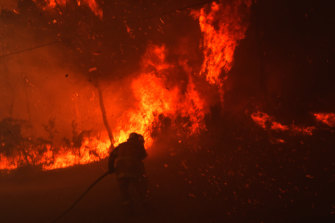
Parts of Victoria face their worst bushfire threat since Black Saturday left 173 people dead a decade ago, with years of low rainfall turning swaths of the state into a tinderbox.

“All indications are it’s going to be a bad year," says Dr Thornton.
Australia's year of record-breaking heat has set the scene for a monster fire season, experts warn, with forecasters tipping a hot, dry summer.

“This is potentially one of the worst droughts we have seen,” says Dr Richard Thornton, chief executive of the Bushfire and Natural Hazards Research Centre.

“It means that coming into the start of the fire season, the vegetation is already very dry – probably the driest we have seen since the federation drought, if not longer.”


Read the story from The Age by Liam Mannix - “‘It’s going to be a bad year': Victoria's bushfire threat looms large.”

27 July, 2018

It’s a savage summer in the Northern Hemisphere – and climate change is slashing the odds of more heatwaves

In Australia, we know about sweltering summer heat. We all remember the images of burned koala paws, collapsing tennis players and, far more seriously, the tragic events of Black Saturday.
Firefighters and volunteers battle a blaze
near Loutraki in southern Greece.
Aussies may scoff at Britain’s idea of a heatwave, but this time it’s the real deal and it’s no laughing matter.

Extreme heat has hit locations throughout the Northern Hemisphere, in places as far apart as Montreal, Glasgow, Tokyo and Lapland. In the past few weeks heat records have tumbled in a wide range of places, most notably:


02 December, 2017

El Niño and La Niña – por que no los dos?! (Actually, that would be very bad)

It would be pretty remarkable if you weren’t somehow affected by the Queensland floods in 2011, the Great Ocean Road Christmas bushfires in 2015, or even the heatwaves leading up to Black Saturday in 2009 that killed 173 people in Victoria.
When floods occur, is it always La Nina to blame?
Nope. The tricky part is that no two El Niño or
La Niña events are exactly the same.
But have you ever taken a step back to think about what’s really going on with the weather in times like this? We don’t have bushfires and floods all the time, so something was obviously happening to cause such a drastic change in weather.

You’d be correct in saying that something more was at play here. In fact, it’s called ENSO – the El Niño- Southern Oscillation – the changing surface ocean temperature patterns in the Pacific Ocean. When the central and eastern equatorial Pacific is warmer than normal, it is called El Niño, “the little boy” in Spanish; conversely, when it is cooler than normal, it is called La Niña, or “the little girl.”

These two children are responsible for changes in our weather patterns every two to seven years. They make tweaks in the Pacific Ocean temperatures, wind and clouds that have enormous effects on the rest of us.


12 February, 2017

Unprecedented fire danger for NSW as heatwaves continue across south-east

Swimmers escape the heat at the Nepean
River Reserve in Sydney. Meteorologists
are predicting what could be the hottest
three-day spell ever for the city.
Firefighters are warning Sunday will present an unprecedented fire danger for New South Wales, as the prolonged heatwave creates conditions worse than Black Saturday.

The heatwave across south-east Australia continued to break records on Saturday. Parts of Western Sydney reached 47C on Saturday afternoon, including Penrith, which experienced its hottest day on record.

The outback town of White Cliffs, in NSW’s north-west, broke the record for the hottest minimum overnight temperature. Residents endured a stifling night with a low of only 34.2 degrees.


Read Christopher Knaus’s story in The Guardian - "Unprecedented fire danger for NSW as heatwaves continue across south-east.”

08 September, 2016

Soon it will be 'Black Saturday' every two or three years

Bushfires will soon be bigger, more
severe and more intense.
Most people can clearly remember the 2009 Victorian bushfire known as “Black Saturday”.

Soon, however, it will not be a matter of remembering the fires rather it will be the reality of actually dealing with them.

The Climate Institute believes that with the current progress of climate change, Victoria could, on average, have a ‘Black Saturday’ level event every two or three years.

Australia’s 50,000 to 60,000 annual bushfires are likely to increase in size, severity and intensity as climate change continues to worsen.

Promoting another Climate Conversations forum: “Can we prevent bushfires? Issues and challenges”, the Melbourne Sustainable Society Institute  (MSSI) and the Australian-German Climate and Energy College say that as with many of our climate change responses, the response to bushfire is still operating in the old world paradigm.

A trio of speakers will speak about preventing bushfires and the issues challenges with that at the University of Melbourne’s School of Design on Tuesday, September 27, at 12.30pm.

The speakers will be:

Associate Professor Janet Stanley - A Principal Research Fellow in Urban Social Resilience at MSSI, a consultant in Sustainable Policy, and Director of the National Centre for Research in Bushfire and Arson.

Her work involves strategic responses to social, environmental and economic challenges in the context of social equality and climate change with particular interests in policy, bushfire, social inclusion and transport.

Associate Professor Alan March – the Director of Bachelor of Environments and Bachelor of Design, School of Design.

Alan’s publications and research include an examination of the practical governance mechanisms of planning and urban design, and the ways that planning systems can successfully manage change and transition as circumstances change, especially in relation to emergencies and establishing resilience.

Dr Paul Read - is shortly to take up a position with MSSI to undertake research on bushfire.

Dr Read is also a senior lecturer in Psychology, teaching Post-Graduate Diploma, Masters, and honours students at Monash Faculty of Medicine, and a Director of the National Centre for Research in Bushfire and Arson.

He undertakes research on the interface between social, economic and environmental sustainability and climate change, as well as the prevention of bushfire arson.

The seminar is free, but those intending to attend should RSVP to Claire Denby at MSSI

16 March, 2016

Australia's wild weather and three oceans

Australia is a land of extremes, and famously of “droughts and flooding rains”. That’s been truer than ever in the 21st century; since 1999 the country has see-sawed from drought to deluge with surprising speed.

There was the millennium drought, which lasted more than a decade and culminated in disasters such as Victoria’s Black Saturday bushfires in 2009. Then, in 2011, Cyclone Yasi struck Queensland and a large swathe of Australia exploded under a green carpet of grasses, shrubs and trees.

Filming of the movie Mad Max: Fury Road was moved from outback Australia to Namibia after the big wet of 2010-11, because Australia’s luxurious growth of wildflowers and metre-high grasses didn’t quite match the post-apocalyptic landscape the movie’s producers had in mind. In Alice Springs, the Henley-on-Todd Regatta was almost cancelled in 2011 because there was water in the normally dry river.

Read the piece on The Conversation by research fellow in environmental sciences at the University of Technology, Sydney, James Cleverly, and Derek Eamus from the same institution - “Droughts and flooding rains: it takes three oceans to explain Australia’s wild 21st-century weather.”

23 January, 2014

Understandable evidence of global warming is indisputable


The heat of summer-
there's more to come.
Evidence people can understand illustrating difficulties associated with rising global temperatures is indisputable.

A story in today’s Melbourne Age headed: “Deaths spark call to review state’s heatwave plan” tell us about the rash of deaths in Victoria during last week’s oppressive heat.

“Hundreds of Victorians died last week during the heatwave and there are fears the death toll could match or exceed the lives lost during the 2009 heatwave the occurred a week before the Black Saturday fires,” it was reported.

The concern for many is that the real height of summer has not yet arrived and further heatwaves are in the offering and the last week’s experiences will be repeated.


29 August, 2013

The realities of climate change appear beyond comprehension


The intellectual dynamic that prevailed in
Victoria's Black Saturday bushfires
prevails as the world's coast cities
face certain flooding.
Climate change is going to impact on humanity in ways that seem almost beyond comprehension.

The impacts are so extreme that they are outside the contemporary frame of reference for most leaving them seemingly unable to even grasp that the certain unfolding difficulties are warning us of could possibly be real.

There is another complication, for psychologically we all seem to naturally disallow ourselves from considering anything that doesn’t fall within our purview of what is rewarding and satisfying.

Beyond the fact that we may see a unique bonding among people as they work together to confront the evolving challenges of our damaged climate, there is distressingly little good news to report.

The broad optimism presently pervading the world is about the profit and growth of business as usual and the pessimism, and sadness, associated with the collapse of that paradigm seems necessary before we can switch to being optimistic about an entirely new way of life.

The death of anything demands a period of mourning before we can see a new dawning.

Considering that, it was unsettling to read in the Huffington Post that “14 U.S. Cities That Could disappear Over The Next Century,Thanks to Global Warming” and nothing truly effective is being done.

Looking back to Victoria’s Black Saturday bushfires we see an example of a similar problem – many people could see the smoke, but seemed convinced such a disaster could never befall them; the people in those American cities can “see the smoke”, but seem intellectually unable to process the information.

Considering our knowledge and the realities of science, nothing we could do in the short term will save those cities.

However, nothing seems to be done in preparing the cities and those who live there for what is going to be a momentous change to their lives.

The intellectual and emotional state the doomed many in Victoria’s Black Saturday bushfires is going to play our again for the world’s coastal cities, only on a massively destructive scale, as our seas continue to rise as a result of climate change.


23 May, 2013

Talking about "Slap Tomorrow 'Beneath the Wisteria'


Final details of the June 6 public forum, “Slap Tomorrow – A Wake-Up Call” will be discussed by those who gather Beneath the Wisteria in Shepparton tomorrow.

Beneath the Wisteria convenor, Mr Robert McLean, who is also involved with Slap Tomorrow organizing committee, will outline the June 6 forum and talk about the broad community involvement it has generated.

Attempts had been made to have the Member for Murray, Shaman Stone, attend and talk about the Coalition’s Direct Action program, but Ms Stone argued it would be unwise to discuss that until the latest version of the policy had been released.

Those who gather Beneath the Wisteria to consider the public and individual response to climate change are concerned about community health and so how people at the extremes of age cope with increased temperatures.

More than 170 people died in the 2009 Black Saturday bushfires and although that fact is well documented, what is not widely known, or discussed, is that more than 300 perished because of the extreme heat in the week leading up to the fires.

Public health and climate change will be discussed and the group will talk about how that can be explored and better understood.

Beneath the Wisteria  start at 11:30am, is free, open to the public and, reflecting its name, held Beneath the Wisteria at the northern end of the Maude St Mall. Some public seating is available, but those attending are advised to bring a folding chair.

09 January, 2012

Steve's reflections on climate change


Stephen Rogers was among the eight who joined that first “chat” Beneath the Wisteria.
Below are some of his reflections on climate change:
When I think about the reach of Climate Change I realise that it affects and has implications for all aspects of human existence.  The very idea of Climate Change seems to be embedded in our humanity.  Big claims I know so let me expand on this.
The Personal:

It is trite to state that the climate has always changed.  Individual humans experience a change of climate every time they move from one geographical location to another.  I grew up in Nelson in New Zealand.  The climate there maritime and is very benign being due to it being protected from the worst of New Zealand’s weather by mountains to the west, south and east.  I enjoyed warm sunny days with few weather extremes.  I moved to Wellington at 18 and experience some of the windiest weather of any major city in the world.  The climate was cooler, more windswept and wetter than Nelson.  After a year I found myself in Shepparton in the Goulburn Valley region of Australia.  Here was a huge change of climate to hot and dry with flies and spiders to match.  Over some 40 years off and on in Shepparton I have learned to live with some of the extremes but find 35+ degree days very taxing without air-conditioning.

My Fear:

Having experienced a number of radical changes of climate by moving my location, I have come to fear the prospect that Nelson will become like Shepparton and Shepparton something akin to the fires of hell.  In 2009 when we experienced a series of 40+ days culminating in the Black Saturday fires I began to realise the implications of the prospect of that sort of event happening more frequently in future.  It is generally accepted that human induced warming of around 0.8 degrees has so far occurred.  If, as I believe they are, the 13 year rain deficit from 1996 to 2009 and the heat wave of January/February 2009 are the  predicted consequences of such an apparently small change in average temperature, then I fear the consequence of the already in train 2 degree rise will be a catastrophe for humans.  The question uppermost in my mind is “How will humans respond?”  As I have written this piece I have


One Emotional Response Discussed:

Mike Hulme in his book “Why we Disagree About Climate Change” identifies four common emotional responses to Climate Change being:

REMEMBERING EDEN:  The belief that there once was a Golden Age in which humans lived a paradise like existence with no problems such as disease, over population, discord or war.  As our thinking matures we come to understand that this is a human yearning that probably has never been an actuality of human existence.  Why would it be, when existence for all living organisms is randomly peaceful and violent by turns.  I have recently come to question my understanding of this but will let it stand for the time being.  See my later discussion of “The Continuum Concept”.

ARMAGEDDON:  The biblically expressed deep seated fear in humans that all will come crashing down in a great catastrophe any moment now.  Once again mature thinking leads us to notice that notwithstanding all of the dire warnings from history, humans have prospered on the earth for quite a long time, in the human time frame.  Yes things look like getting worse for a very long time but it is likely that at least some humans will continue to exist when the climate again stabilises sometime in the next 1,000 odd years.  See also my later discussion of “The Continuum Concept”.

BABEL being the belief in humans that we can do the same job as nature. That we can manipulate our environment to our ends ahead of its natural tendencies.  In the past this lead hunter gatherers to create civil society (Cities) leading seemingly inevitably to over population, over exploitation of resources and the invention of a whole world of things that promise comfort and ease but deliver pollution and unquenchable desire for more.  It is this thinking that leads to proposals to put sulphur into the atmosphere in order to achieve the sort of temporary cooling produced by huge volcanic dust clouds and proposals to put some sort of light filter between here and the sun.

JUBILEE being the example provided by the Jewish concept of forgiveness and renewal every 50 years (Jubilee).  This is the hope that in seeing and experiencing the consequences of civilisation carried to its final extreme, we may find a way to change our nature and live sustainably on the earth.

I recommend that those interested in the debate over Climate Change read Mike’s book and visit these two related web sites http://mikehulme.org/ and http://www.tyndall.ac.uk/


Another Response:

After 35 odd years, I am reading again “The Continuum Concept”, by Jean Liedloff.  It contrasts the way that children are raised in so called “civilised” cultures with the child rearing practices of indigenous cultures in remote South American jungles.  The continuum refers to the way that human children are born expecting, based on the whole of human history,  to be gently introduced to life outside the womb in the arms of a loving mother figure.  The young of all living creatures are born into an expectation of being raised according to the history of their species.  The coming of civilisation seems to have broken the continuum for humans and I can see it is possible that unsustainable living is an inevitable consequence of this.  Civilised humans seem separated from and fearful of nature and yearning for something that seems to be missing.  Thus perhaps the REMEMBERING EDEN emotional response to Climate Change is a reflection of our not having been born into the continuum we expected and ARMAGEDDON describes the fear of catastrophe experienced at birth when the expected continuum is not there.


Perhaps we wasteful, all consuming, moderns can find in those few remaining sustainable human cultures some acceptable examples and lessons for a way to live in the future.  Clearly there is no way back to nature for us.  However, many of us want to change the way we act in order to address the known dangers of Climate Change.  I for one propose to keep thinking along these lines and read as much as I can on the topic.  Whenever I think about the wisdom of the indigenous cultures around the world, I deeply regret and am dismayed by the vigour with which “civilised” humans dismiss, belittle, attack and seek to wipe out indigenous humans wherever they encounter them.  It tells me that there is clearly a fundamental divide between being civilised and living sustainably.  I think a lot about this sort of stuff.  I have not yet found a way to act on the thinking and so my partner and I do the best we can and try to cut down our carbon emissions by cutting power consumption at home, generating some of our own power and growing our own vegies.